Zip ties history starts with a patent problem rather than a product launch: the tie was invented twice, by two different people, for two different jobs, and the industry spent years sorting out which claim came first. What survived is the part that matters to anyone specifying one today, which is that the ratchet-and-pawl geometry at the centre of the modern tie has not changed since the 1950s, while the material, the moulding and the size range have changed completely. This tag gathers the two guides that follow that story from the original patent to the disposable tie in a contractor's pouch.
What the guides here answer
Who invented zip ties follows the people and the patents, including the disputed claim and why two names appear against the same invention. When were zip ties invented puts the dates in order: the earliest patent, the years the product was confined to aviation and aerospace wiring, and the point at which it became a commodity sold by the thousand rather than a specialist part.
Why the tie waited decades to become disposable
For most of its early life the tie was a premium fastening for aircraft and defence wiring, where the cost of a single part was irrelevant next to the cost of a failure. That market paid for the mould tooling, and the same tooling is what eventually made the tie cheap: once a family of sizes could be shot in one cycle from a single tool, the unit price fell far enough for the tie to move into vans, garages and eventually domestic drawers. The history is therefore a history of manufacturing economics rather than of design, because the design was settled early.
What changed after the patent expired
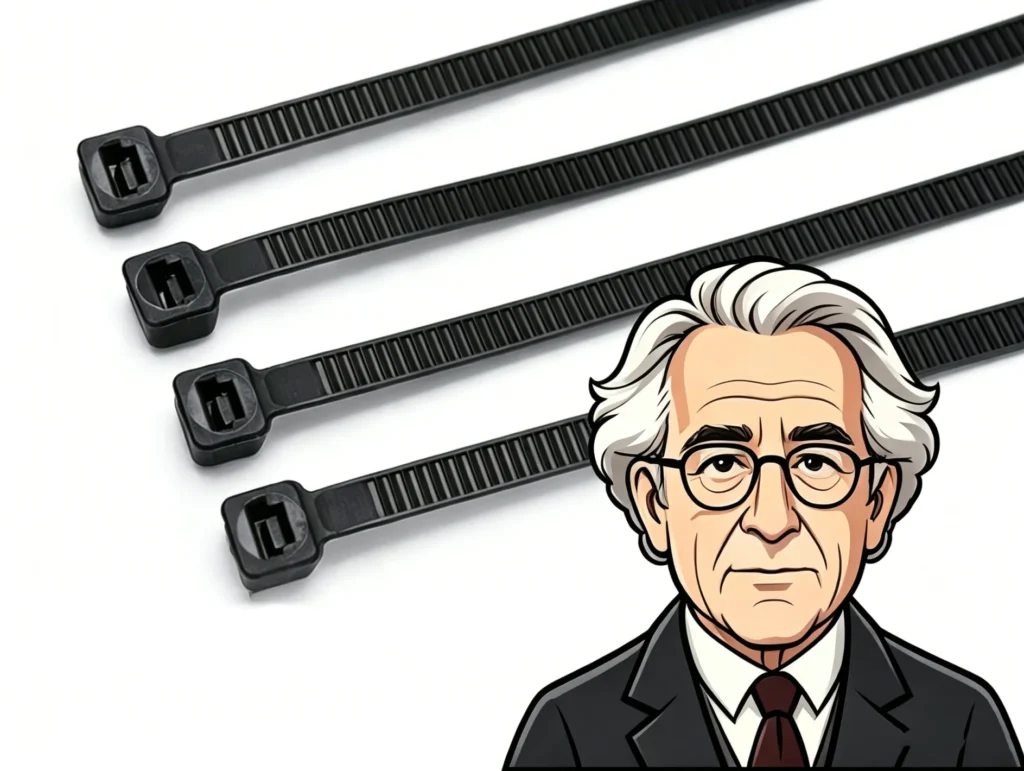
Once the original protection lapsed, the tie became a commodity with regional standards rather than a single product. Nylon 6/6 replaced earlier materials, widths were standardised into the 2.5, 3.6, 4.8, 7.6 and 9 mm families that are still the trade norm, and variants appeared: the releasable head, the marker flag, the stainless steel strap, and the UV-stabilised black tie that made outdoor use possible.
Specification reference
The current generation of the same product, with its width and length families and tensile ratings, is listed on the standard cable ties product page.
When was the cable tie invented?
The first patents date from the late 1950s, in the United States, and the product was commercialised for aviation and electrical wiring before it reached general trade.
Who invented the zip tie?
Two inventors are usually credited, working independently on the same one-piece ratchet idea, which is why the historical record has competing claims. The guide linked above sets out both.
Were zip ties always plastic?
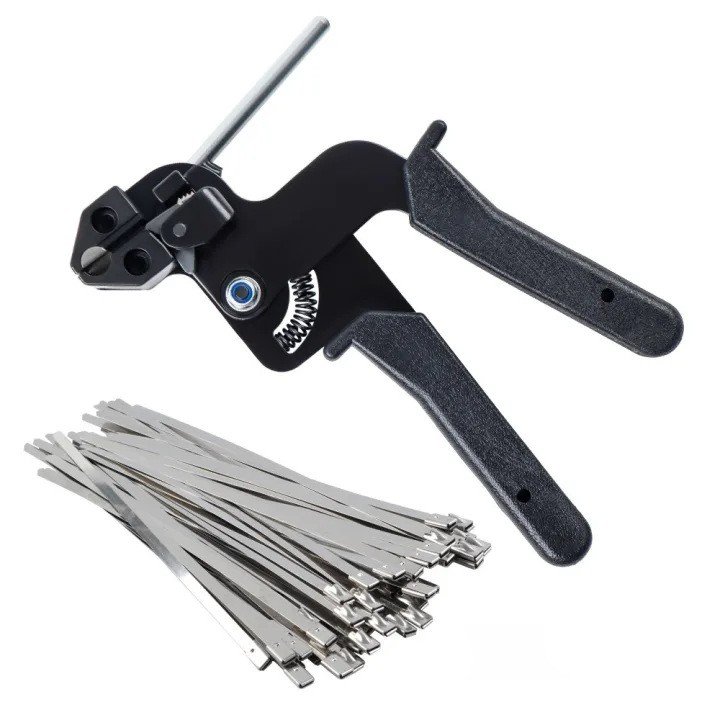
No. Early ties were also produced in metal for high-temperature wiring, and stainless steel ties remain a separate product family today rather than a historical footnote.


 EN
 AR
 ES
 PT
 FR
 RU
 DE
 KO
 JA
 IT
 NL
 TR