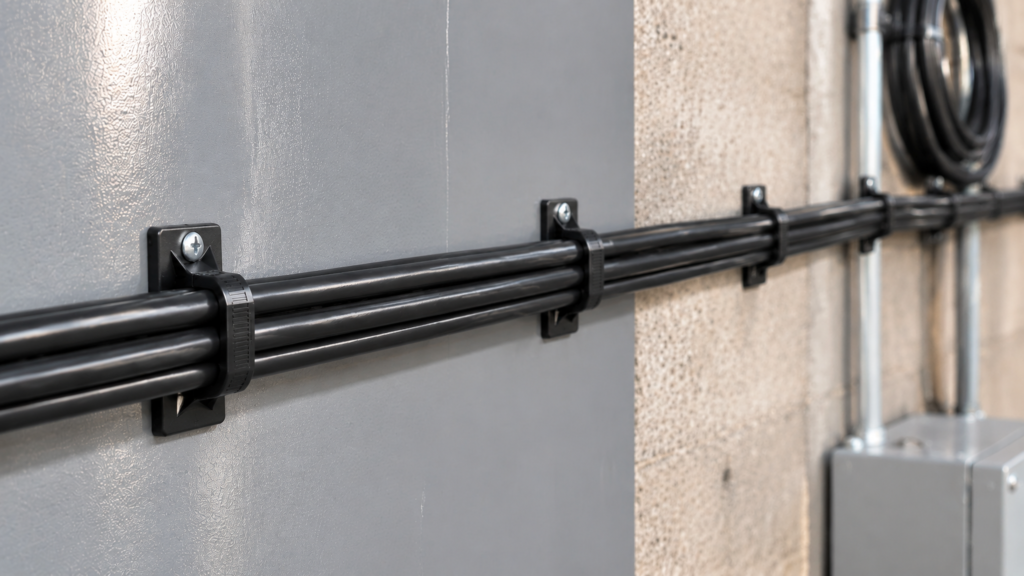
Cable tie mounts are the interface between a tie and a surface: the tie threads through a slot in the mount, and the mount is what is actually fixed to the wall, panel or ceiling. They exist because most surfaces will not take a clip and many will not take a screw either, and because a tie on its own has nothing to pull against. This tag holds the site's guide to adhesive and screw-fixed mounts, plus the category that lists the range.
What the guide here answers
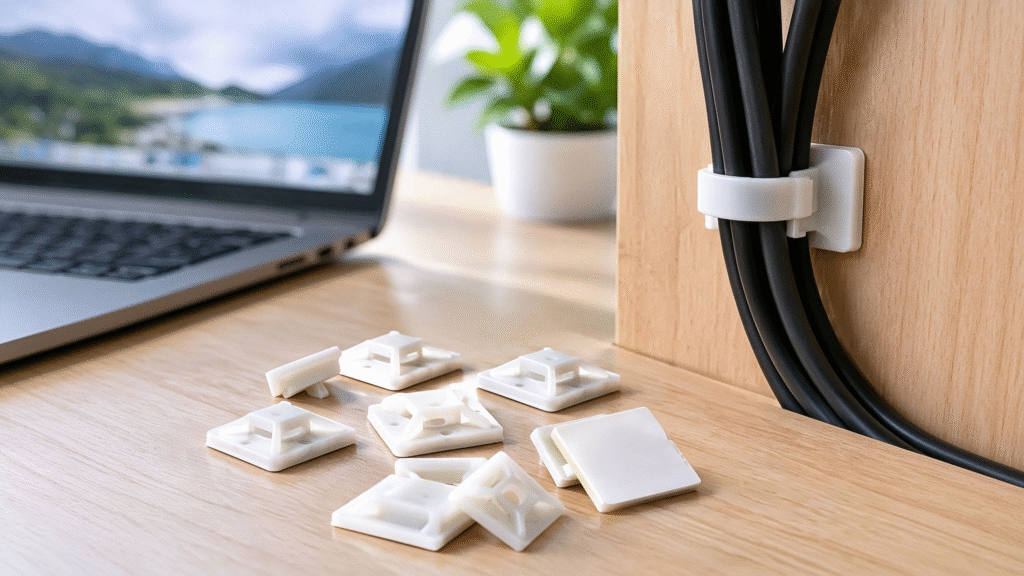
What are adhesive zip tie mounts: a complete guide covers the self-adhesive type end to end: surface preparation, the curing time before load is applied, the difference between an acrylic and a rubber-based adhesive, and the temperatures at which each stops holding. It is the article to read before deciding that adhesive has failed, because most adhesive failures are preparation failures.
Adhesive or screw-fixed
An adhesive mount needs a clean, flat, non-porous surface and time: the bond builds over hours and reaches full strength later than most installers allow. On painted plasterboard, dusty concrete, or any surface above the adhesive's working temperature, it will creep under load and eventually let go. A screw-fixed mount trades installation time for certainty and is the correct choice where the bundle is heavy, where the surface is rough or damp, or where the route will be pulled on. Saddle mounts sit in the same family and cradle the cable instead of holding it on a pad.
Match the slot to the tie
The slot width in the mount has to take the strap width of the tie, and the mount's footprint has to be large enough for the load the tie will carry. A narrow mount used with a wide strap will not seat the tie flat, and a small mount under a heavy bundle peels at one corner first, which is the failure that takes the whole run down. Mount spacing matters as much as mount size: a bundle supported every 300 mm behaves very differently from the same bundle supported every metre.
Specification reference
Length, width, hole diameter and slot width for each mount size are listed in the tie mounts and cable clamps category.
Why do adhesive cable tie mounts fall off?
Almost always because of the surface or the wait. Dust, grease, moisture and paint that is still curing all prevent the bond, and a load applied within the first hours pulls the adhesive before it has developed strength.
How much weight will an adhesive mount hold?
Less than the datasheet figure in most real installations, because that figure assumes a clean, flat, room-temperature surface and a static load. Derate for heat, roughness and any dynamic pull on the bundle.
Do I need a mount if I can just tie around a pipe?
If there is something to tie around, no. Mounts are for surfaces where the tie has nothing to grip: panels, walls, ceilings and enclosures.

 EN
 AR
 ES
 PT
 FR
 RU
 DE
 KO
 JA
 IT
 NL
 TR