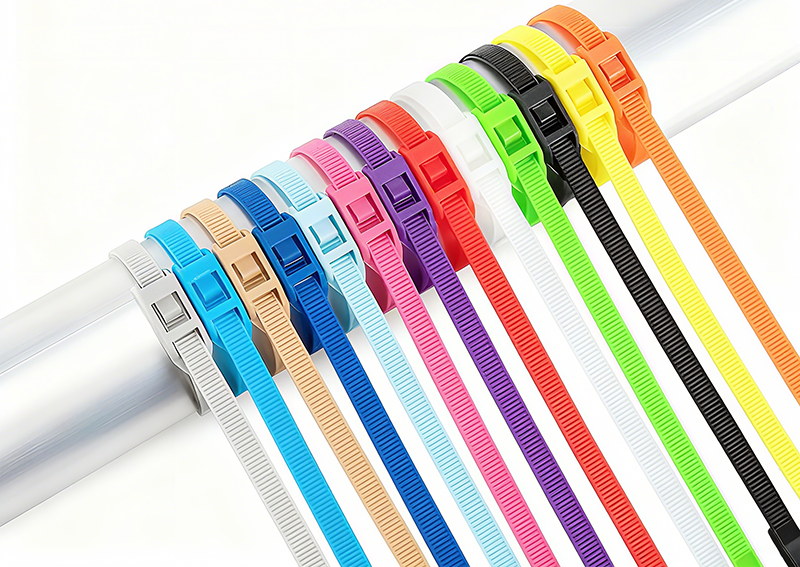
Low profile cable ties keep the locking head close to the strap instead of standing proud of it, so a finished bundle stays flat and can be pulled through a gap, laid under a panel or slid along a surface without the head catching. The difference from a standard tie is one dimension, and that dimension is the reason to buy them. This tag holds the site's guide to choosing between the low profile range and a standard tie.
What the guide here answers
How to choose the right low profile zip ties works through the decision in the order it is actually made: head height first, then strap width, then length against the bundle, and finally the tensile figure that the application needs rather than the highest one on the list. It also covers where a low profile head is the wrong choice, which is usually a bundle that needs to be cut and re-made often.
Head height is the deciding number
The head of a low profile tie sits noticeably lower than a standard head of the same width, and that is what buys clearance: under a floor panel, inside a trunking lid, behind a drawer, or anywhere a bundle has to pass through a gap sized for the cable rather than for the tie. Length and tensile figures do not tell you whether the tie will fit the space; head height does, and it is the figure to check first when the clearance is tight.
Where a standard tie is still better
A low profile head carries less material around the pawl, so the same strap width gives a lower tensile figure than the standard equivalent. On a heavy static bundle, or where the tie is being used as a structural fixing rather than a bundler, the standard head is the stronger part. Low profile also makes the tail harder to grip when the tie has to be pulled very tight by hand, which matters on production lines where the tie is tensioned without a tool.
Specification reference
Head height, strap width, length, bundle diameter and tensile rating for each size are on the low profile cable ties product page.
What is the difference between low profile and standard cable ties?
The head. A low profile tie has a flatter head that sits closer to the bundle, while the strap, pawl and method of use are the same. The low head is chosen for clearance, not for strength.
Are low profile ties weaker?
For the same strap width they usually carry a lower tensile rating, because there is less material around the locking head. Choose by the load the application actually applies, then check whether the low profile part still covers it.
Can low profile ties be used under a floor panel?
Yes, and that is a typical use, provided the head height plus the cable diameter fits the void. Measure the gap first, then check the head height of the tie against it.

 EN
 AR
 ES
 PT
 FR
 RU
 DE
 KO
 JA
 IT
 NL
 TR