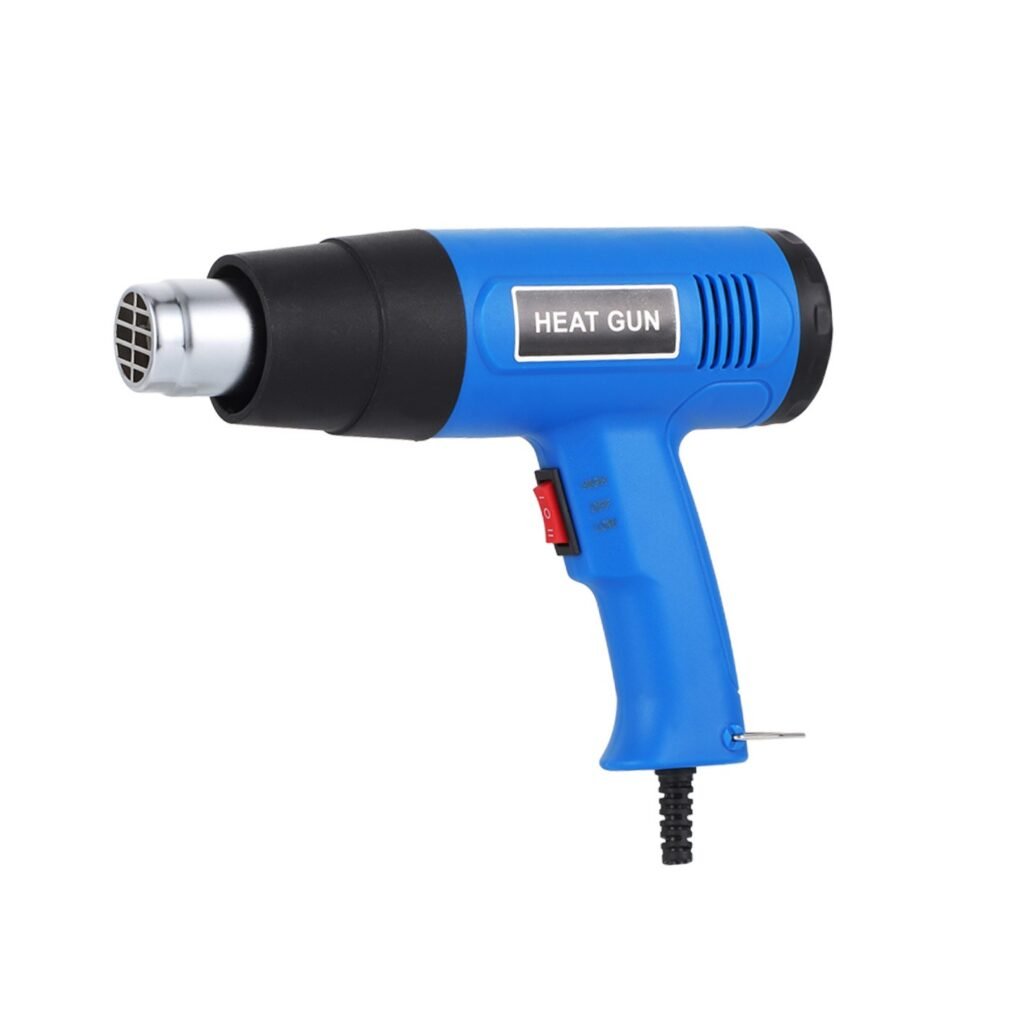
Heat gun uses in cable work come down to one job done properly: shrinking tubing evenly, without the scorched patch that a lighter or a match leaves and without heating the conductor so hard that the insulation behind it softens. The gun is also used to soften adhesive-lined tubing, to warm PVC so it conforms, and to free seized parts, and each of those has a temperature at which it goes right and a higher one at which it goes wrong. This tag holds the site's guide to using a heat gun safely.
What the guide here answers
How to use a heat gun safely: tips, settings and uses covers the settings and the technique: which temperature range suits which material, how far the nozzle is held from the work, why the gun is kept moving, and how to shrink from the middle of a length outwards so trapped air escapes at the ends instead of forming a bubble. It also covers the safety points that actually cause accidents, which are the nozzle left resting on a surface and the hot air redirected onto a cable behind the work.
Temperature and material
The setting has to suit the material being heated, not the task being attempted. Heat-shrink tubing recovers within its own rated band and will split or char above it; PVC softens and deforms at a temperature well below where it burns, so a gun that is right for one material is too hot for the other. The practical approach is to start below the figure you expect to need and raise it, watching the surface rather than the dial, because airflow and nozzle distance change the temperature the work actually sees.
Where a heat gun is the wrong tool
In a confined space with no airflow, in an area with dust or solvent vapour, and anywhere the air will carry heat onto something unseen behind the work. It is also the wrong tool where the joint needs a defined, repeatable temperature: production shrinking belongs in an oven or a purpose-made shrink station, because a hand-held gun gives a different result on every pass. For a single joint in the field, the gun is the right answer; for a batch, it is a source of variation.
Specification reference
Power, temperature range, airflow and nozzle options are listed on the heat gun product page.
What temperature should a heat gun be for heat shrink tubing?
Within the tubing's own rated shrink range, which is stated by the tube maker rather than by the gun. Start low and raise it while watching the tube recover, because nozzle distance and airflow change the temperature at the work.
Can a hair dryer shrink heat shrink tubing?
Rarely. Most tubing needs more heat than a hair dryer delivers, and the result is a partly recovered tube that does not seal. The exception is thin, low-temperature tubing used on delicate work.
Why did my heat shrink go shiny and hard?
It was overheated. A tube taken past its recovery range loses its flexibility and can crack later, which is why the gun is kept moving and why the work is watched rather than the dial.


 EN
 AR
 ES
 PT
 FR
 RU
 DE
 KO
 JA
 IT
 NL
 TR