Metal detectable cable ties are nylon ties compounded with a metal-detectable additive so that a broken fragment is caught by inline metal detectors and X-ray inspection. They are specified in food processing, pharmaceutical and packaging plants, where a fragment of plastic in the product is a recall event rather than a maintenance note.
The problem they solve
A standard nylon tie that snaps during cleaning or maintenance leaves a piece of blue or black plastic somewhere in the line. Plastic is invisible to metal detectors and to most inline inspection equipment, so the fragment travels with the product. Adding a metallic pigment to the polymer makes the same fragment detectable by the equipment the plant already runs, which turns an invisible contamination risk into a rejected batch.
Sizes and loads
Item
Length
Width
Max. bundle dia.
Min. tensile
WD-3x100MD
100 mm / 4"
2.5 mm
22 mm
18 lbs
WD-4x150MD
150 mm / 6"
3.6 mm
35 mm
40 lbs
WD-4x200MD
200 mm / 8"
3.6 mm
50 mm
40 lbs
WD-5x200MD
200 mm / 8"
4.8 mm
50 mm
50 lbs
WD-5x300MD
300 mm / 12"
4.8 mm
82 mm
50 lbs
Colour is part of the specification
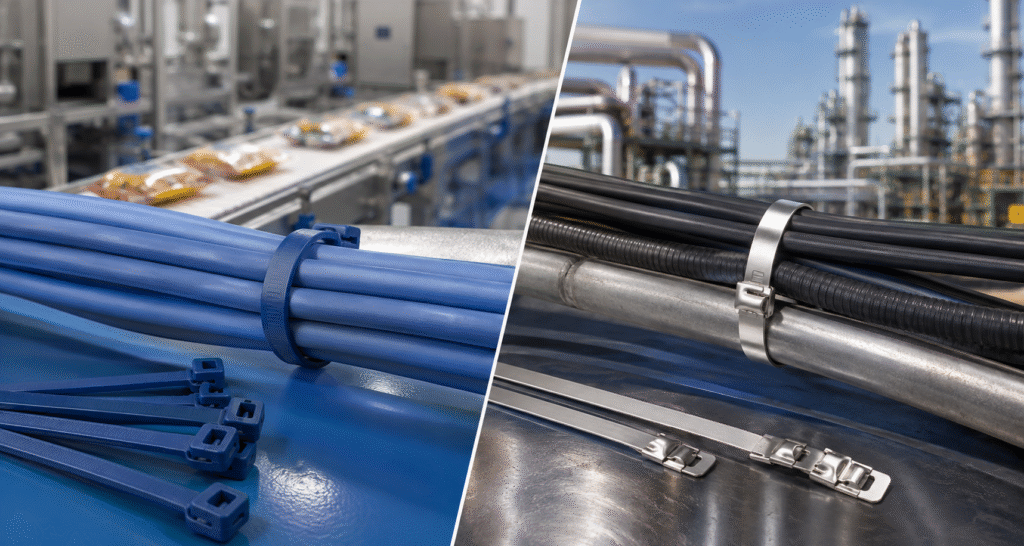
Detectable ties are normally moulded in blue, because blue has almost no natural occurrence in food and is therefore easy to see on a visual inspection as well as being caught by detection equipment. Black and white detectable ties exist, but blue is the colour most plants write into their foreign-body control procedure, and it should be matched to whatever colour the site has standardised on.
What detection does not cover
Detectability reduces the consequence of a break, it does not prevent one. The tie is still PA66 and still has the same temperature ceiling of 85 °C and the same UV behaviour as any nylon tie. In a wash-down area the working life is set by chemical and thermal cycling, not by the additive. Sites that treat detectable ties as unbreakable usually discover otherwise at the worst moment.
Are metal detectable cable ties food safe?
They are made from PA66 with a metal-detectable additive and are intended for indirect contact applications such as cable and pipe routing in production areas. They are not a food-contact material in their own right, and the grade should be confirmed against the site's own compliance requirements.
Can metal detectors find a broken detectable tie?
That is the purpose of the additive. Whether a specific fragment is caught depends on fragment size, detector aperture and sensitivity settings, which is why plants validate detectable consumables against their own equipment rather than relying on a supplier statement.
What is the difference between metal detectable and metal cable ties?
Two different products. A metal detectable tie is plastic with a metallic additive, used for contamination control. A metal cable tie is a stainless steel strap, used for heat, corrosion and load. One is about detection, the other about strength.
Understanding Metal Cable Ties vs Metal Detectable Cable Ties Industrial cable management demands specific solutions tailored to environmental threats and safety standards. At WANDU, we engineer specialized fastening hardware to help facility operators maintain strict compliance, operational safety, and wiring integrity across global markets. What Are Metal Cable Ties? Metal cable ties are heavy-duty fasteners […]
Metal detectable zip ties are specially engineered nylon cable ties embedded with metal particles, making them easily detectable by metal detectors or X-ray inspection systems. Even tiny fragments can be identified, preventing foreign object contamination (FOC) in critical industries like food processing, pharmaceuticals, aviation, and laboratory environments. Metal detectable cable ties help ensure product integrity […]
We use cookies to enhance your browsing experience, serve personalised ads or content, and analyse our traffic. By clicking "Accept All", you consent to our use of cookies.
Looking For High Quality Nylon Cable Ties At A Great Price?
Order now to experience cost-effective cable tie products that provide convenience and protection for your work and life.