Industry Applications
How to Remove Cable Clips Without Damaging Walls
How to Remove Cable Clips Without Damaging Walls
Read More
Round cable clips fix a single round cable to timber, brick or concrete with a nail driven through the clip body, gripping the sheath around its full circumference. The circular throat is the whole point of the design: it holds the cable on every side, so the clip resists sideways pull as well as weight. This tag currently holds one guide, on removing clips without damaging the surface underneath.
How to remove cable clips without damaging walls is written around the moment a clip has to come off: which tool goes under the clip body rather than the cable, how to free a nail that has rusted into masonry, and how to avoid the crescent of missing paint that follows a screwdriver used as a lever. The same method applies to round and flat clips, because the fixing is the same nail through the same body.
A round clip is chosen by the outside diameter of the cable, measured over the sheath. Take the clip whose throat matches that diameter; a clip one size up lets the cable rotate and slide, and a clip one size down will not close over the sheath at all. On twin-and-earth or any flat cable the round throat touches only the two edges, crushes them, and leaves the flat faces unsupported.
The two are not interchangeable and the choice is decided by the cable, not by the wall. Flat and twin-and-earth cable takes a flat clip with a rectangular throat. Single round cable, flex and coaxial take a round clip. Running a round cable through a flat clip is the more common error, because the clip appears to close over the cable while the cable is actually loose inside the throat.
Throat diameter, clip height and nail size for each size are listed on the round cable clips product page.
Measure the cable across its sheath with a rule or caliper, then choose the clip whose throat equals that figure. Do not measure the conductor or the core, and do not add a margin for insulation: the throat is already sized for the finished cable.
Only if both cables together fit the throat as a bundle, and even then the grip is uneven because the clip is shaped for one circular section. Two separate cables are better run through a saddle or a tie mount than forced into one round clip.
A correctly sized clip grips without crushing. If the sheath deforms when the nail is driven, the clip is a size too small or the nail is being over-driven into a soft substrate.
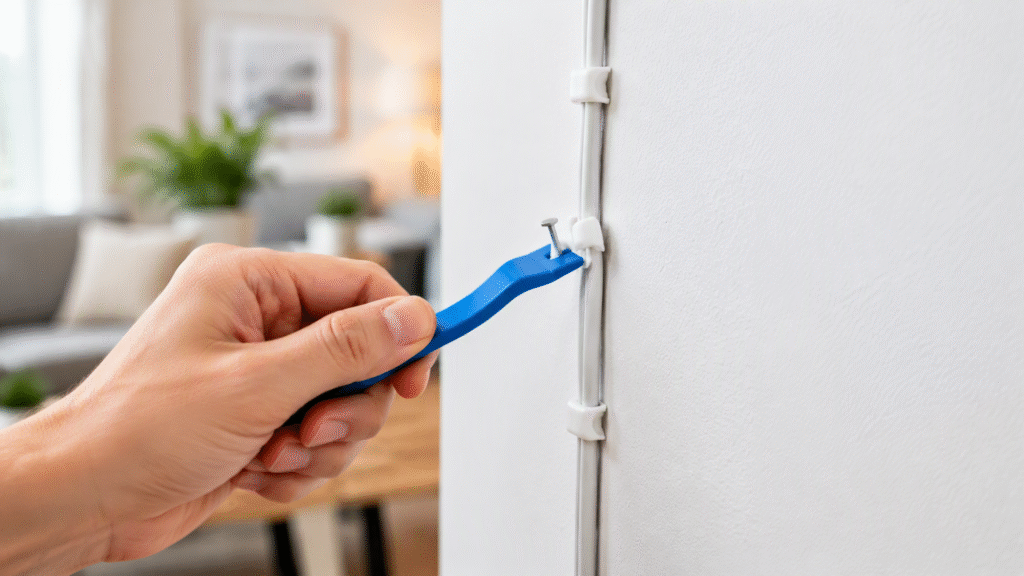
How to Remove Cable Clips Without Damaging Walls
Read More
 EN
 AR
 ES
 PT
 FR
 RU
 DE
 KO
 JA
 IT
 NL
 TR