Industry Applications
How to Remove Cable Clips Without Damaging Walls
How to Remove Cable Clips Without Damaging Walls
Read More
Flat cable clips are the square-throat clips that pin flat and twin-and-earth cable against a wall, so the cable runs flat to the surface instead of standing off on a saddle. The throat is rectangular and sized on the width of the cable's flat face, which is why a clip chosen by cable length never fits. This tag collects the two guides on the site that deal with them: one on fitting, one on taking them off again without pulling the plaster away.
How to use cable clips with nails covers the fixing side: how the nail is driven, what happens when the clip is a size too small, and why the arch has to sit square to the cable before the nail seats. How to remove cable clips without damaging walls covers the other direction, which is where most of the damage happens: levering a clip off a painted wall takes the paint with it, and driving the nail back out through a brittle clip usually cracks the throat.
The number stamped on a flat clip is the width of the throat, so it has to match the flat face of the cable, not its overall diameter and not its length. Measure that face with a rule and take the clip that equals it or the next size up. The height of the clip rises with the width, because a wider throat needs a taller arch to keep the same grip, and the nail grows with the clip as well: the small sizes take a 1.7 × 15 mm nail, while the 14 mm size takes a 2.0 × 18 mm nail to hold the same load.
A flat clip will not hold a single round cable: the round sheath touches the throat at two points and sits loose in between, so the cable slides under any pull. Round cable needs a round clip sized on diameter. Flat clips also stop at plasterboard, where the nail has nothing behind the board to expand into and the clip pulls out once the cable is loaded; hollow partitions need an adhesive clip or a screw-fixed mount instead.
Full height, width and nail dimensions across the range sit on the flat cable clips product page, which is the page to quote from when a size has to be confirmed against a drawing.
Measure the width of the flat face of the cable and choose the clip whose throat equals or slightly exceeds it. The height of the clip tells you how far it will stand off the wall, which matters under skirting and behind trunking lids.
Yes, with hardened masonry nails. Ordinary steel nails bend at the point where they meet the brick and will not seat the clip, however hard they are hit.
No. There is nothing behind the board for the nail to expand into, so the clip pulls out as soon as the cable is loaded. Use an adhesive clip or a screw-fixed cable tie mount on hollow partitions. Round cable clips fix a single round cable to timber, brick or concrete with a nail driven through the clip body, gripping the sheath around its full circumference. The circular throat is the whole point of the design: it holds the cable on every side, so the clip resists sideways pull as well as weight. This tag currently holds one guide, on removing clips without damaging the surface underneath. What the guide here answers How to remove cable clips without damaging walls is written around the moment a clip has to come off: which tool goes under the clip body rather than the cable, how to free a nail that has rusted into masonry, and how to avoid the crescent of missing paint that follows a screwdriver used as a lever. The same method applies to round and flat clips, because the fixing is the same nail through the same body.
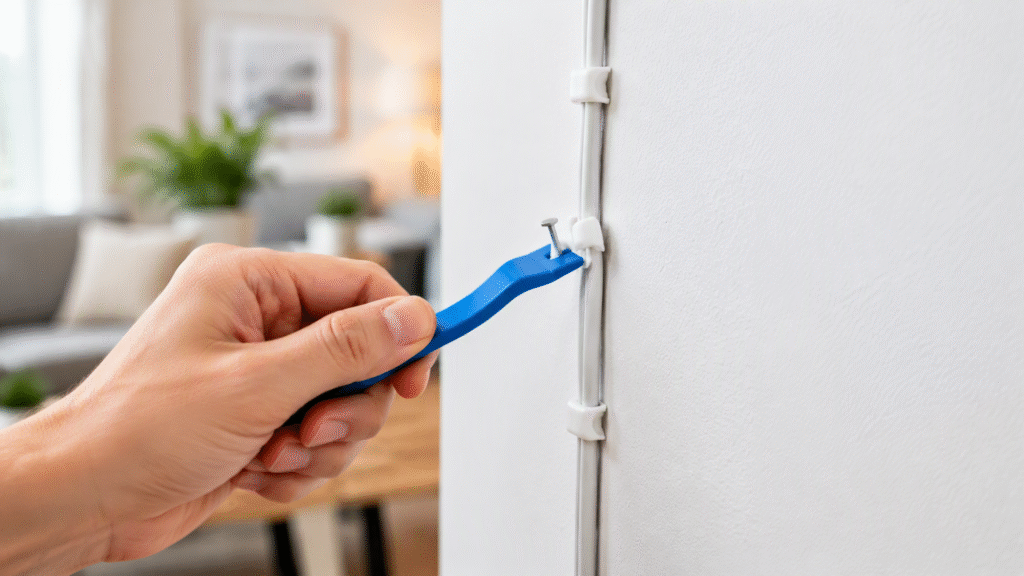
How to Remove Cable Clips Without Damaging Walls
Read More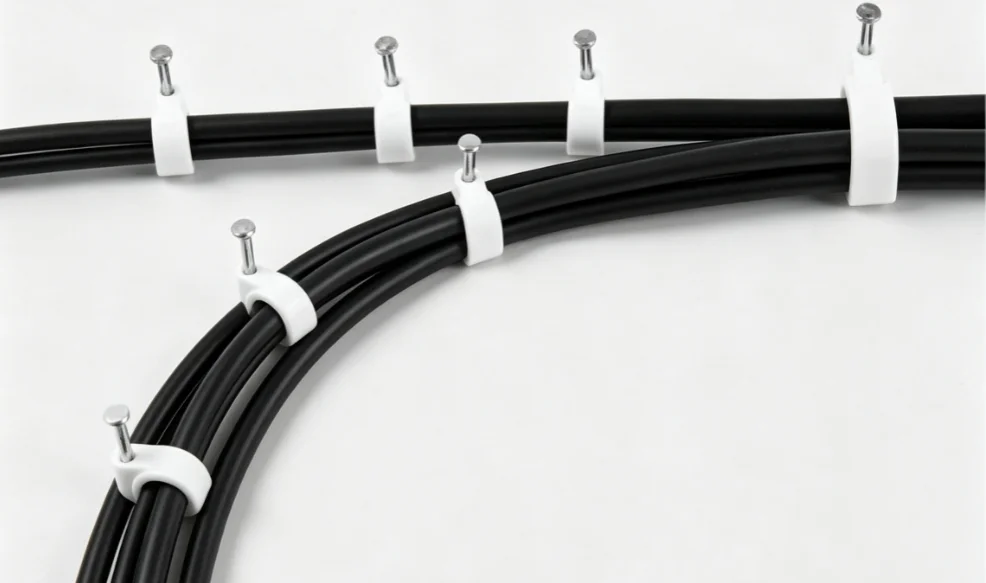
What Are Cable Clips with Nails? Definition and Main Function Cable clips with nails are simple, highly effective fasteners used to anchor electrical, data, or entertainment cables to walls, baseboards, and framing. Featuring a molded hook or collar integrated with a heavy-duty steel pin, these nail in cable clips allow for clean wire routing. Their […]
Read More

 EN
 AR
 ES
 PT
 FR
 RU
 DE
 KO
 JA
 IT
 NL
 TR