Releasable cable ties carry a release lever in the head: pressing it lifts the pawl out of the strap so the tie can be opened and closed again instead of being cut. That single mechanism moves the tie into a different category of purchase, because the cost is no longer the tie but the number of times it will be used. This tag collects the two guides on the site that deal with opening, releasing and reusing ties.
What the guides here answer
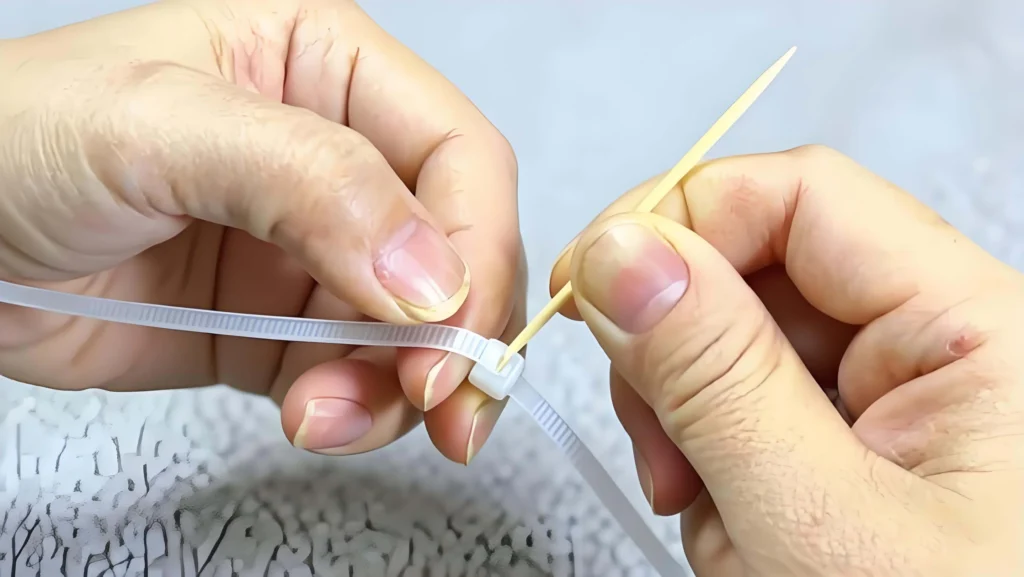
How to reuse zip ties: undo, release and reuse safely covers the mechanism and the limits: which ties can be released without damage, how the lever is pressed, and what a tie loses each time it is opened. Nylon releasable zip ties guide sets out the range, the materials and the applications where a releasable tie replaces a single-use one.
Releasing is not the same as reusing
Every release bends the pawl teeth and the strap serrations that they engage. A releasable tie is designed for it, so it survives many cycles; an ordinary tie forced open with a pin survives one or two at best before the pawl no longer holds the load it was rated for. That is the line between the two products, and it is why a releasable tie is worth its higher unit cost anywhere a bundle is opened on a schedule: patch panels, test rigs, temporary routing, and any installation that is still being commissioned.
Where the extra cost pays back
The comparison is not price per tie but price per closure. A single-use tie that is cut and replaced every time a cable is added costs the tie plus the labour of re-routing the bundle; a releasable tie costs more once and is opened in seconds. The break-even sits at a handful of reopenings, which is why releasable ties are standard in racks, labs and anywhere a harness is still changing. On a permanent outdoor run that will never be touched, a standard tie remains the cheaper and stronger part.
Specification reference
Lengths, widths, bundle diameters and tensile ratings for the releasable range are on the releasable cable ties product page.
Can ordinary cable ties be reused?
Usually not safely. A single-use tie can sometimes be released with a pin, but the pawl is damaged in the process and the tie will not hold its rated load afterwards. A releasable tie has a lever designed for the purpose.
How many times can a releasable tie be reopened?
Many times, provided it is opened with the lever rather than by force and is not left under load while being released. The strap and pawl wear gradually, so a tie that no longer clicks positively should be replaced.
Are releasable ties as strong as standard ties?
For the same width they are generally rated lower, because the head contains a lever and a movable pawl. Check the tensile figure against the application rather than assuming equivalence.


 EN
 AR
 ES
 PT
 FR
 RU
 DE
 KO
 JA
 IT
 NL
 TR