Industry Applications
How to Shrink Heat Shrink Sleeves
Heat Shrink Tubing Application Scenarios
Read More
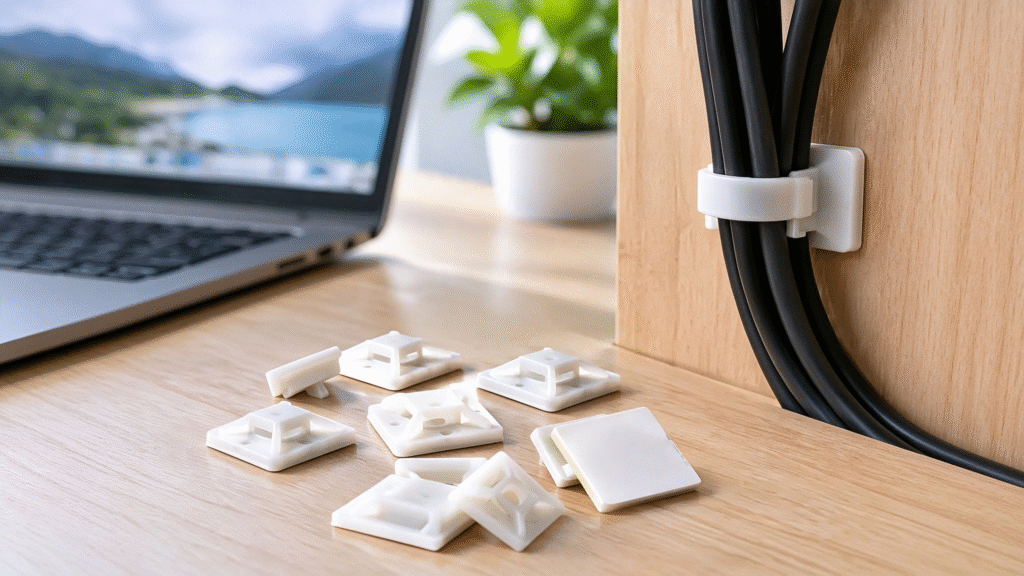
Struggling with messy cords but don’t want to drill holes into your walls, desks, or equipment?
You’re not alone.
If you’re wondering what are adhesive zip tie mounts and whether they can truly handle heavy wire bundles, you’re in the right place. These peel-and-stick anchors are the ultimate drill-free solution for clean, long-lasting cable management—whether you’re routing wires in a home office, a data center, or an industrial setup.
In this guide, you’ll learn exactly how adhesive zip tie mounts work, the critical differences between rubber and acrylic backings, and the proper installation steps to ensure they never peel off.
Let’s dive right in!
Adhesive zip tie mounts—also known as self-adhesive cable tie mounts or nylon cable tie bases—are precision-molded mounting anchors engineered to secure, guide, and bundle cables across flat surfaces. Molded from high-grade Polyamide 6.6 (Nylon 66), these mounts feature an integrated, high-tack adhesive backing that eliminates the need for panel drilling, sheet-metal punching, or specialized welding.
Their primary function is to establish a fixed anchoring point on control panels, machinery enclosures, electronic chassis, and interior structural surfaces, keeping wiring harnesses organized, tension-free, and compliant with industrial routing standards.
Adhesive zip tie mounts combine a mechanical retention head with a pressure-sensitive adhesive (PSA) base to deliver rapid and reliable wire management:
Managing cables in tight electrical enclosures, machinery, and workstations requires mounting hardware that is fast to deploy and dependable over time. Self adhesive cable tie mounts eliminate the hassle of traditional mounting methods while keeping cable runs neatly secured.
The primary advantage of adhesive backed zip tie mounts is the ability to mount wire runs without drilling holes or modifying mounting surfaces.
Industrial-grade self adhesive tie wrap mounts are engineered to withstand rigorous operating conditions without losing their grip.
| Feature | Performance Advantage |
|---|---|
| 4-Way Tie Entry | Allows multi-directional routing without repositioning the mount |
| High-Grade Nylon 66 | Resists aging, heat, and common industrial chemicals |
| PE Foam Adhesive | Delivers strong initial tack and shear resistance on smooth surfaces |
| Center Screw Mounting Hole | Provides secondary mechanical support for heavy-duty wire bundles |
Using adhesive cable tie mounts streamlines both initial harness installation and downstream maintenance.
The holding strength and longevity of adhesive zip tie mounts depend largely on the adhesive tape formulation used on the base. We manufacture and supply self adhesive cable tie mounts backed with industrial-grade closed-cell PE foam tapes designed to match specific operating conditions and surface textures.
Rubber-based adhesive backed cable tie mounts are engineered for immediate bonding and high initial tack. They provide a quick, dependable anchor point without requiring extended waiting periods.
For demanding environments involving heat, UV exposure, or moisture, acrylic tape backing offers unmatched long-term durability. Our industrial adhesive cable tie mounts utilize high-performance acrylic foam tape to ensure cables remain secured over extended service lifecycles.
Standard flat nylon cable tie bases work best on planar substrates, but irregular, textured, or curved surfaces require specialized backing properties:
We design our self-adhesive cable tie mounts to solve routing challenges across a wide range of settings. Because they eliminate the need for drilling, welding, or specialized fasteners, these mounts serve as an essential cable management tool in commercial, industrial, and everyday environments.
Messy cables create clutter and safety hazards around workstations. Adhesive backed zip tie mounts provide a clean, damage-free way to route cords along furniture surfaces. Under-Desk Cable Routing: Anchor power cords, monitor cables, and docking station wires neatly along the underside of wood, metal, or laminate desks. Entertainment Systems: Route audio, video, and gaming console wiring behind TV stands and media units without visible damage. Appliance Wiring: Keep kitchen and utility appliance cords flush against cabinets and backsplashes.
High-density wiring environments require precise layouts to maintain airflow, system performance, and quick maintenance access. Server Racks and Network Cabinets: 4-way entry nylon cable tie bases allow technicians to run patch cords horizontally and vertically along rack frames. Control Panels and Enclosures: Secure delicate wiring harnesses inside electrical cabinets and switchboards without compromising the structural enclosure. Telecommunications Distribution: Organize bundled fiber-optic lines and Ethernet cables securely along painted metallic raceways.
Industrial machinery and vehicles generate constant vibration, requiring rugged, dual-securing cable management. Industrial Machinery: Fix hydraulic lines, sensor wires, and pneumatic tubing securely against smooth metal panels and structural frames. Automotive Harness Routing: When you need to optimize automotive wiring harness and component fixation, our UV-resistant black PA66 mounts resist high operating temperatures, fuel exposure, and road vibrations. Heavy-Duty Anchor Points: For high-load cable runs in engine compartments or manufacturing equipment, technicians utilize the integrated center screw hole alongside the high-tack foam adhesive for permanent mechanical anchoring.
To get the highest holding power and longest service life from our self adhesive cable tie mounts, following a standardized installation process is essential. While the peel-and-stick design provides fast assembly, proper surface contact ensures the pressure-sensitive adhesive reaches its maximum load capacity.
Adhesives require direct contact with the substrate to create a strong mechanical bond. Dust, grease, moisture, and mold-release agents drastically reduce holding strength.
Once the surface is prepped, position the base carefully to utilize its multi-directional routing slots.
Avoid applying tension or loading wire bundles immediately after placement. The adhesive layer needs time to flow into the microscopic ridges of the surface.
Selecting the right adhesive zip tie mounts keeps your wiring secure and prevents premature bond failure. At WANDU, we manufacture our self adhesive cable tie mounts using industrial-grade PA66 nylon and high-tack backing tapes to suit different operational environments. Consider these key parameters before making your selection.
The substrate surface directly impacts how well the pressure-sensitive foam tape adheres:
Matching the footprint of your adhesive backed cable tie mounts to the bundle load prevents peeling. Larger bases distribute tensile load across a broader surface area and accommodate wider zip ties.
| Mount Size (mm) | Compatible Tie Width | Recommended Load Capacity | Ideal Application |
|---|---|---|---|
| 19 × 19 mm | Up to 3.6 mm | Light-duty wire routing | Small electronic enclosures & sensors |
| 20 × 20 mm | Up to 4.8 mm | Standard wire bundles | Control cabinets & automotive dashboards |
| 28 × 28 mm | Up to 5.2 mm | Medium-duty wire harnesses | Telecom racks & power distribution panels |
| 30 × 30 mm | Up to 6.0 mm | Heavy-duty commercial wiring | Industrial machinery & automation tracks |
| 40 × 40 mm | Up to 9.0 mm | Heavy industrial runs | Thick cable looms (Screw reinforcement recommended) |
Operating conditions determine the longevity of both the nylon base and the adhesive backing:
While pressure-sensitive double-sided foam tape provides immediate initial tack upon contact, it requires time to form a permanent bond.
For heavy wire bundles, we advise waiting the full 24-hour curing window before bundling and checking rated zip tie strength and load capacity to avoid unnecessary stress on the adhesive layer.
The molded nylon base itself is built to last, but the adhesive backing is designed for single-use installation:
Standard self-adhesive zip tie mounts bond best to clean, non-porous, and flat surfaces such as bare metal, smooth plastics, and glass.
Textured panels, heavy grain surfaces, and low-surface-energy powder coatings reduce the surface contact area of the foam tape. For these installations, we recommend: Surface Cleaning: Thoroughly degrease the area with an isopropyl alcohol wipe before placement. Mechanical Reinforcement: Use the central screw hole to mechanically fasten the mount into the enclosure wall for permanent, high-vibration stability.
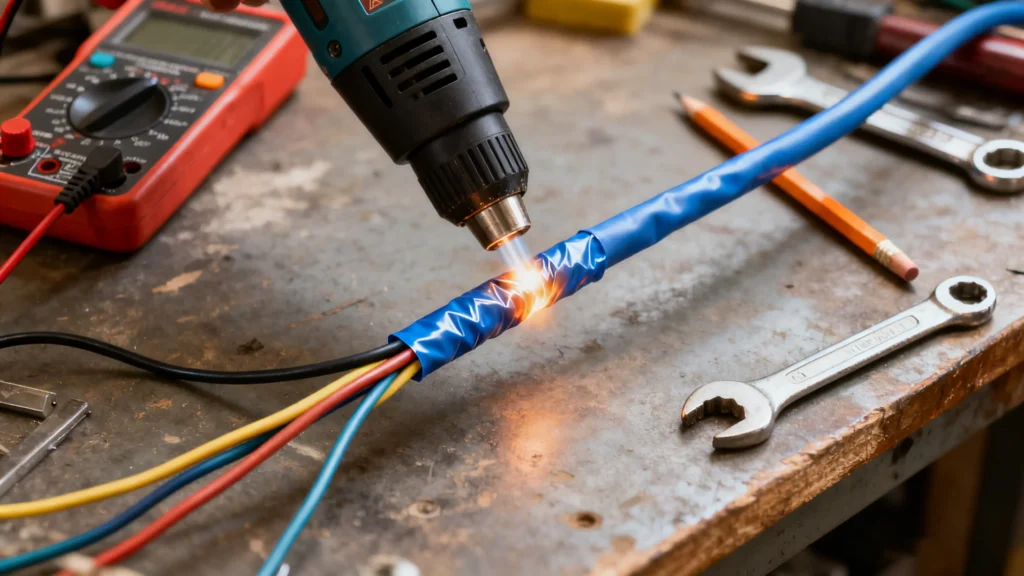
Heat Shrink Tubing Application Scenarios
Read More
What Is Heat Shrinking Tubes and How Does It Work? A heat shrinking tube (also known as a polymer sleeve) is an expandable plastic tube engineered to insulate, protect, and bundle wires, cables, and electrical components. When exposed to a heat source, the tubing shrinks radially to fit tightly around underlying components, creating a protective […]
Read More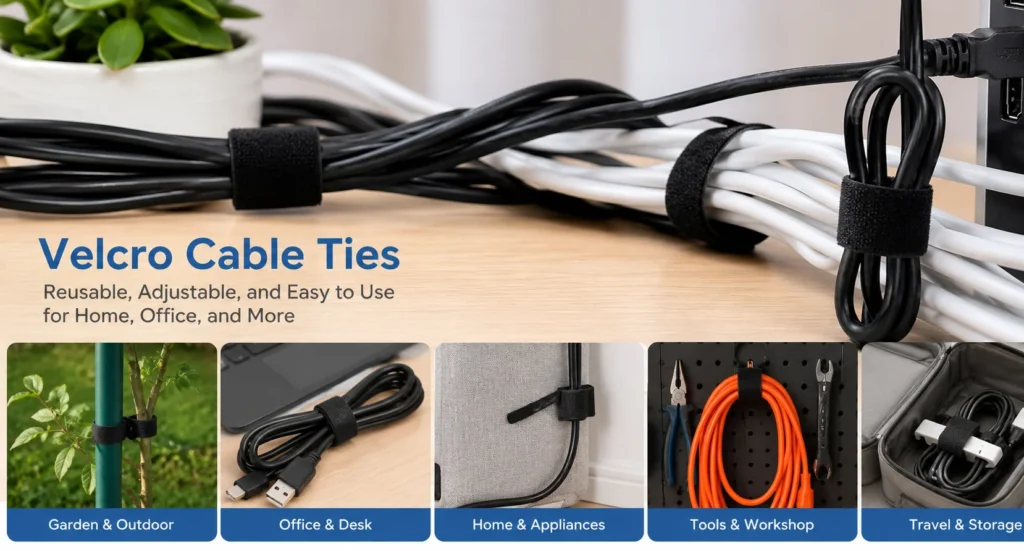
Understanding Velcro Cable Ties and Hook-and-Loop Fasteners What Are Velcro Cable Ties? Velcro cable ties are reusable fastening solutions designed to bundle, organize, and secure wires and cables. Made from durable nylon or polyester fabric, these ties feature a two-sided mechanism that grips itself without the need for adhesive. They are widely used across global […]
Read More
 EN
EN  AR
AR  ES
ES  PT
PT  FR
FR  RU
RU  DE
DE  KO
KO  JA
JA  IT
IT  NL
NL