This article thoroughly explains “zip ties strength: how much weight can they hold”—covering rated tensile strength, key influencing factors, material and size selection. It also provides selection guidelines and practical considerations, including comparison tables and FAQs, to help you quickly choose the right cable tie and ensure safe use.
Definition and Data of Loop Tensile Strength
• The industry’s commonly used term “load bearing” is equivalent to “minimum loop tensile strength,” which refers to the maximum force a cable tie can withstand when bent into a loop (like a noose) and subjected to radial tension until it breaks. A typical zip ties strength tester can display this value.
• Zip ties strength grades are 8 kgs, 18 kgs, 22 kgs, 55 kgs, 80 kgs, and 114 kgs; stainless steel cable ties typically range from 200–485 lb (varies by specification/brand).
Common Specifications and Typical Tensile Strength Comparison Table (Industry Reference)
A1: Unlike the other models, the UV resistant cable tie is made of nylon 66UV, which is weather resistant and UV resistant.
Q2: Why are metal cable ties stronger?
A2: Compared to nylon, stainless steel has a higher yield strength and stiffness, resulting in higher tensile strength.
Q3: Is connecting multiple nylon cable ties in parallel safer?
A3: While it can improve redundancy to a certain extent, it can also create a risk of breakage due to uneven force distribution. High strength cable ties or stainless steel cable ties are preferred.
To successfully remove cable ties in various situations, understanding both their design and removal options is essential. Cable ties, with their simple yet effective locking mechanism, provide robust fastening, but this same feature can make them challenging to release or reuse. Whether your goal is to cut them free, unlock them for reuse, or simply break them […]
1. Introduction Wire ties plastic (also called cable ties or zip ties)are indispensable, practical tools in daily life and are also widely used across industrial scenarios. From home gardening and car repair to electrical wiring and solar installations, you’ll see them almost everywhere. When used outdoors, however, service life is not fixed; it’s jointly determined […]
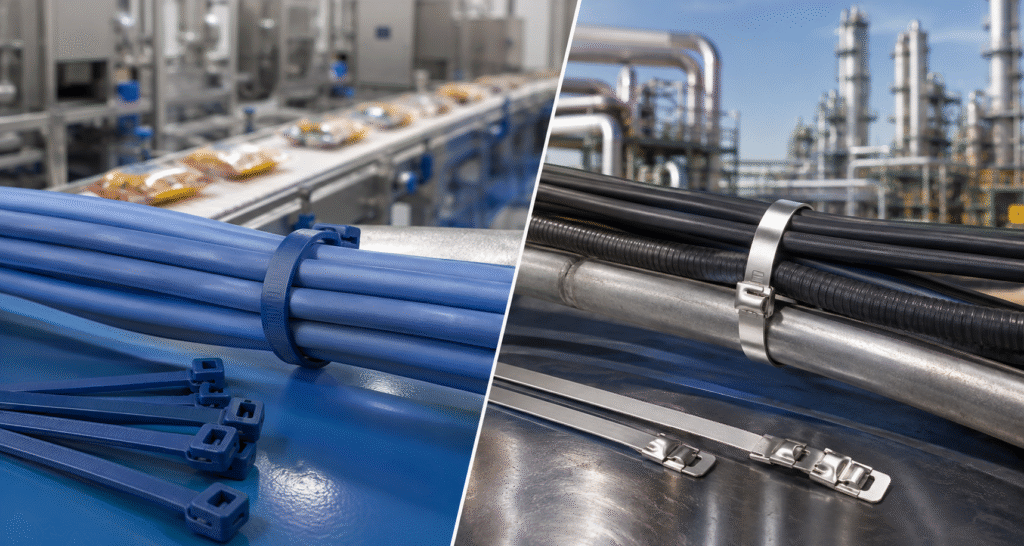
Understanding Metal Cable Ties vs Metal Detectable Cable Ties Industrial cable management demands specific solutions tailored to environmental threats and safety standards. At WANDU, we engineer specialized fastening hardware to help facility operators maintain strict compliance, operational safety, and wiring integrity across global markets. What Are Metal Cable Ties? Metal cable ties are heavy-duty fasteners […]
We use cookies to enhance your browsing experience, serve personalised ads or content, and analyse our traffic. By clicking "Accept All", you consent to our use of cookies.
Looking For High Quality Nylon Cable Ties At A Great Price?
Order now to experience cost-effective cable tie products that provide convenience and protection for your work and life.


 EN
EN  AR
AR  ES
ES  PT
PT  FR
FR  RU
RU  DE
DE  KO
KO  JA
JA  IT
IT  NL
NL