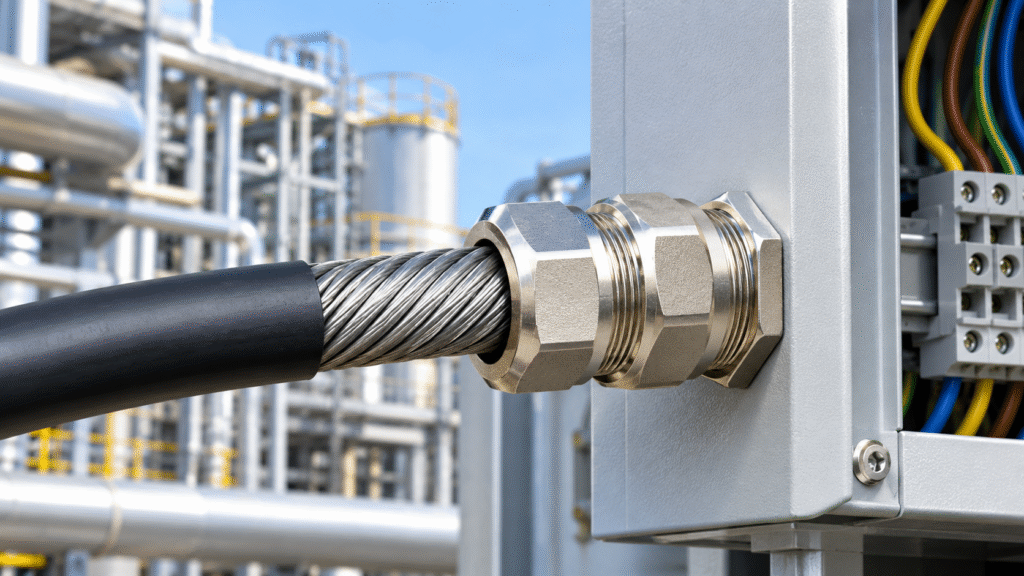
Standard cable glands only seal against the outer jacket of a non-armoured cable. An SWA cable gland serves a dual engineering purpose: it secures the heavy physical steel wire armour (SWA) and provides a continuous earth path, all while maintaining ingress protection at the enclosure entry.
Armour Clamping: The Function a Standard Gland Cannot Perform
A standard non-armoured gland relies solely on an elastomeric rubber seal compressed against the outer jacket. When subjected to axial pull, vibration, or thermal expansion, standard seals can slip, exposing the internal conductors to strain.
A dedicated gland for swa cable integrates an internal two-part mechanical grip—typically a cone and an armour clamping ring. When tightened, this mechanism locks the steel wires permanently in place.
Axial Retention: Holds the cable securely to resist high pull-out forces.
Strain Relief: Transfers external mechanical stress away from internal terminations and the soft bedding layer directly onto the equipment chassis.
Vibration Resistance: Prevents wire loosening in harsh industrial operating environments.
Feature
Standard Unarmoured Gland
SWA Armoured Cable Gland
Primary Retention
Rubber compression seal
Two-part metal armour clamping ring & cone
Load Bearing Target
Outer PVC / LSZH sheath
High-tensile steel wire armour (SWA)
Earth Path Capability
None
Full metal-to-metal earth continuity
Mechanical Pull-out Force
Low to moderate
High mechanical load resistance
The Armour as an Earth Path
In steel wire armoured cable systems, the steel wires do not just shield against physical impact; they also function as a protective circuit conductor (CPC). If an insulation fault occurs, high fault current travels along the armour wires back to the source to trip upstream protective devices.
A quality brass armoured cable gland ensures uninterrupted earth continuity across this connection:
Metal-to-Metal Contact: The internal clamping cone bites firmly into clean, stripped steel wires, establishing a low-resistance electrical interface.
Fault Current Dissipation: Fault energy passes safely from the armour wires, through the conductive gland body, through the earth tag or enclosure wall, and straight to earth.
Elimination of Arc Risks: Preventing loose wire contact avoids localized high-resistance hotspots and electrical arcing during system faults.
BW, CW and E1W: The Three Body Types for Armoured Cable
Selecting the right armoured cable gland comes down to where your cable terminates and the environmental pressures it faces. Standard cables rely on outer friction, but steel wire armour requires positive mechanical clamping and dedicated ingress sealing. Three body configurations dominate installations of this kind: BW, CW, and E1W. Our own armoured range, the BDM-VII series, is built to both patterns — the standard body is single-compression, and the D variant adds a second compression stage on the inner bedding. It runs from M16 to M130, with NPT 3/8 to 4 and G 3/8 to 4 threads available on the same body sizes. If you need a refresher on general terminology, review our guide to cable gland types, uses, and thread sizes.
BW: Indoor and Dry Enclosures
A BW gland is a two-part fitting engineered strictly for dry, indoor commercial and light-industrial environments. It features an internal cone and armour clamping ring designed to lock down the steel wire armour firmly, providing the mechanical pull-out resistance and earth continuity required by electrical codes.
Sealing: No internal or external elastomeric seals.
Ingress Protection: None of its own. The BW body carries no elastomeric seal, so protection comes from the enclosure and a supplemental PVC shroud rather than from the gland.
Best Applications: Main switchgear rooms, indoor distribution boards, and dry control panels.
CW: Weatherproof Outdoor Entry
The CW gland is the go-to standard for general outdoor work. It keeps the mechanical armour clamping mechanism of the BW series but introduces an elastomeric seal that compresses directly against the cable outer jacket when you tighten the outer body nut.
The outer seal is what turns a CW fitting into an IP66 gland, preventing water ingress, dust penetration, and environmental degradation from reaching the internal electrical connections. It handles extreme weather, driving rain, and routine washdowns on factory floors without issue.
E1W: Double Compression for Wet, Corrosive and High-Vibration Sites
An E1W gland represents heavy-duty double-compression engineering. While single-compression fittings seal only the outer jacket, the E1W seals both the inner bedding layer and the outer protective sheath, with the armour locked between them.
Bedding Seal: An elastomeric inner ring compresses directly onto the inner cable bedding, preventing moisture or explosive gases from tracking down the cable core.
Outer Seal: An external seal grips the outer jacket to isolate the armour wires from corrosive atmospheric agents.
Performance: Specified as an IP68 gland, the E1W absorbs severe vibration, protects against mechanical shock, and withstands sustained submersion or aggressive chemical exposure.
Matching Body Type to Site Conditions
Specifying the wrong gland style risks moisture ingress, compromised earthing, and equipment corrosion. We evaluate the core functional differences using this operational baseline:
Gland Type
Sealing Mechanism
Protection Level
Recommended Deployment
BW
Armour clamp only; zero elastomeric seals
IP20 (Dry indoor)
Internal switchboards, dry enclosures, and indoor risers.
CW
Outer sheath compression + armour clamp
IP66 Weatherproof
Outdoor plant equipment, junction boxes, and standard industrial feeds.
E1W
Inner bedding seal + outer sheath seal + armour clamp
IP66 / IP68 Submersible
Direct burial, wet cable pits, marine docks, and high-vibration plants.
For outdoor or challenging settings, pairing a brass armoured cable gland with a complete gland kit—including the matching locknut, earth tag, and protective shroud—ensures the assembly maintains structural rigidity and mechanical earth protection for the life of the installation. Our brass and nickel-plated armoured glands ship as complete kits with locknut, earth tag and shroud matched to the body size.
Measuring an Armoured Cable for Gland Sizing
Sizing an armoured cable gland solely by conductor cross-section (such as 4-core 16 mm²) leads to improper fits on site. Different cable manufacturers use varying insulation thicknesses and filler compounds, meaning the physical dimensions of SWA cables differ even within the same conductor rating. To guarantee secure mechanical retention, earth continuity, and environmental ingress protection, we always size glands against exact physical cable measurements using a calibrated vernier caliper.
The Three Dimensions You Must Measure
To select the right gland for SWA cable, you must record three critical dimensions:
Bedding Diameter (Inner Sheath): The diameter directly over the cable’s inner bedding layer, beneath the armour wires. This dimension determines whether the inner seal (in double-compression glands like E1W) will seat correctly and whether the cone will slip cleanly under the wires.
Armour Wire Diameter: The thickness of an individual wire strand within the steel wire armour. Clamping rings and cones are engineered for specific wire gauge ranges; mismatched rings can crush the wire or fail to grip it securely under tension.
Overall Diameter (Outer Sheath): The maximum external diameter across the outer jacket. This measurement dictates the gland body size and the compression range of the outer sealing ring in CW gland and E1W configurations.
Reading an SWA Gland Sizing Table
A standard gland size chart matches your measured dimensions against the mechanical tolerances of the gland body and clamping components.
Entry Thread
Product Number
Incoming Range (mm)
Max Outlet (mm)
Thread Length (mm)
Spanner Size (mm)
M16 × 1.5
QG-BDM-VIIM16
5 – 16
12
15
24
M20 × 1.5
QG-BDM-VIIM20
5 – 16
12
15
24
M25 × 1.5
QG-BDM-VIIM25
9 – 20
16
15
30
M32 × 1.5
QG-BDM-VIIM32
14 – 26
20
17
38
M40 × 1.5
QG-BDM-VIIM40-33
18 – 33
28
17
45
M50 × 1.5
QG-BDM-VIIM50
20 – 40
35
20
55
M63 × 1.5
QG-BDM-VIIM63
26 – 50
45
20
68
M75 × 2
QG-BDM-VIIM75
30 – 64
55
22
82
The same range is available with NPT threads from 3/8 to 4 inch and G threads from 3/8 to 4 inch; larger metric sizes run to M130. Sizing method and body structure are identical across all three thread forms.
When reading a chart, make sure your cable’s outer diameter sits comfortably inside the minimum and maximum range rather than at the absolute limit. Incoming Range is the outer sheath diameter the body will accept. Max Outlet is the largest bedding diameter that passes through the inner seal — if your bedding measurement exceeds it, move to the D variant of the same thread rather than stepping up a thread size, because the body grows while the entry stays the same. Thread length and spanner size then follow from the body you have chosen. Thread sizing must also match the enclosure knockout; our guide on the difference between plastic PG and metric cable glands provides deeper detail on entry thread specifications.
Where Sizing Fails: Sheath Thickness and Bedding Compound
Field installation failures frequently occur when cable variance pushes dimensions outside standard design limits:
Extruded vs. Taped Bedding: Compacted, extruded bedding provides a uniform cylinder, while taped bedding can deform under pressure, causing the inner seal or cone to lose tension over time.
Outer Sheath Tolerances: Low Smoke Zero Halogen (LSOH) and heavy-duty flame-retardant jackets tend to run thicker and stiffer than standard PVC, shifting the cable toward the upper limit of the swa cable gland outer seal.
Armour Clamping Ring Misalignment: If the wire diameter falls between standard sizes, the armour clamping ring cannot achieve proper metal-to-metal bite, degrading both the pull-out resistance and the electrical return path.
Material and Finish Selection
Selecting the right metal for an armoured cable gland ensures mechanical integrity and stops galvanic corrosion before it compromises an electrical installation. Four materials cover almost every specification, and the choice follows the environment rather than the price.
Brass, Nickel-Plated Brass and Stainless Steel
Standard Brass: The industry baseline for a brass armoured cable gland. It delivers exceptional mechanical strength and earth fault conductivity for standard indoor switchgear and dry commercial distribution boards.
Nickel-Plated Brass: Features an electroplated barrier over the brass body. This finish resists atmospheric moisture, prevents tarnishing, and withstands salt-laden coastal air and industrial washdown environments without degrading.
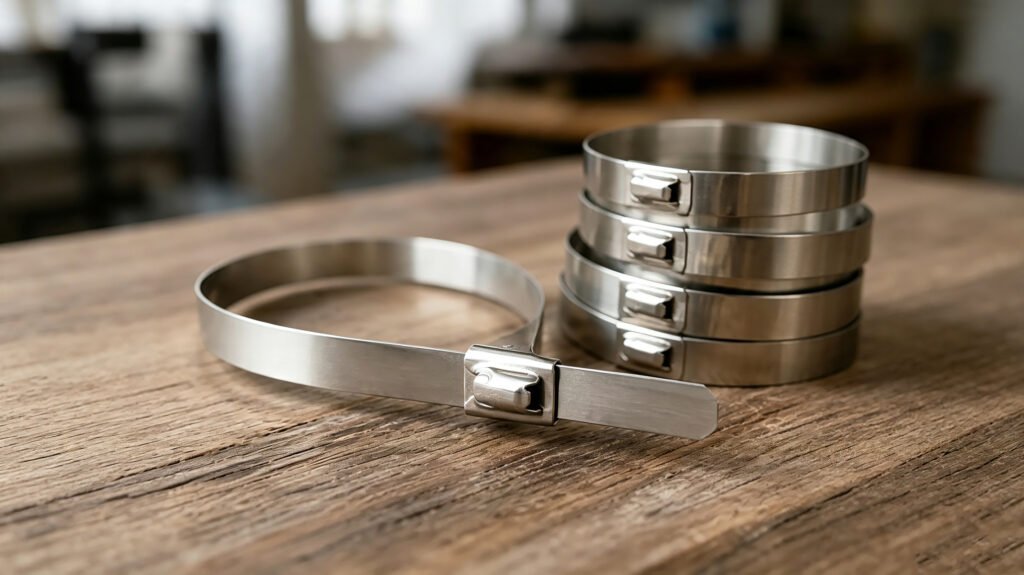
Grade 316 Stainless Steel: The necessary choice for chemical processing facilities, marine vessels, and offshore oil platforms. It provides unmatched resistance to chloride pitting, acidic atmospheres, and severe mechanical impacts. When routing heavy cable runs to stainless enclosures in corrosive environments, securing the lines with resilient stainless steel cable ties ensures the supporting hardware matches the service life of the gland.
When Aluminium Is the Wrong Choice
Aluminium is unsuitable for standard SWA cable. Placing aluminium directly against steel wire armour in the presence of ambient moisture creates a strong galvanic cell. The aluminium acts as the sacrificial anode, rapidly corroding away at the contact interface.
This electrolytic reaction destroys the threads, loosens the clamping cone, and breaks earth fault continuity. Aluminium glands must be reserved exclusively for single-core cables armoured with aluminium wire armour (AWA). For all standard steel wire runs, stick strictly to brass, nickel-plated brass, or stainless steel swa gland assemblies.
Earth Tags, Shrouds and Locknuts
A complete armoured cable gland installation relies on the accessories that secure, earth, and protect the entry point. The locknut anchors the gland body to the enclosure wall, the earth tag provides a direct fault current path, and the shroud shields the mechanical assembly from moisture and environmental contaminants. Omitting any of these components undermines the safety and durability of the installation.
Earth Tag Orientation and Continuity Testing
When installing an SWA gland, the earth tag must sit flush against the enclosure wall or gland plate, secured firmly by the locknut on the inside or sandwiched on the entry side depending on the enclosure design:
Placement: Position the tag directly between the gland body and the enclosure surface to guarantee metal-to-metal contact. Ensure the mating surface is free of paint, powder coating, or non-conductive finishes that could insulate the connection.
Orientation: Orient the tag’s connection lug to minimize strain on the earth lead. Avoid bending the tag sharply, as micro-fractures in the brass or copper reduce current-carrying capacity during fault conditions.
Fastening: Terminate a dedicated bonding conductor to the earth tag lug using an appropriately sized bolt, washer, and locking nut.
Continuity Testing: After torquing the gland and locknut, verify the circuit using a calibrated low-resistance ohmmeter. Measure from the SWA clamping ring back to the main earth terminal (MET). The resistance reading must comply with local wiring standards to ensure immediate circuit breaker or protective device operation during a line-to-earth fault.
Shroud Selection for Outdoor and Buried Runs
Protective shrouds act as the primary barrier against the elements, preventing moisture ingress around the gland threads and armour clamping components.
Material Compatibility: Use high-grade PVC, neoprene, or low-smoke zero-halogen (LSOH) shrouds depending on site exposure. Outdoor runs require UV-stabilized materials to prevent cracking and hardening under persistent sunlight.
Sizing and Fit: Select a shroud matched to the specific gland size and cable outer diameter. A loose fit allows water pooling around the gland entry, while an excessively tight fit risks tearing during installation over the cable outer sheath.
Direct-Buried Applications: For underground installations, choose thick-wall protective boots resistant to ground chemicals, moisture saturation, and soil pressure.
Installation Technique: Slide the shroud onto the cable before gland assembly. Once the gland is tightened and tested, pull the shroud completely over the gland body, sealing the transition between the enclosure entry and the cable jacket. Where high moisture is present, seal the shroud ends with compatible non-hardening sealant to block capillary water draw.
Standards to Check Before You Order
Procuring an armoured cable gland requires verifying specific engineering standards rather than just relying on generic catalog numbers. Meeting recognized testing benchmarks ensures your termination maintains structural integrity, prevents mechanical pull-out, and preserves electrical safety during a fault.
What BS 6121 and EN 62444 Actually Cover
When sourcing an SWA cable gland, two primary standards govern performance and dimensions:
BS 6121: This British standard defines the classic mechanical gland types, including BW, CW, and E1W body designs. It sets specific criteria for the armour clamping ring, clamping cone angles, and mechanical retention to ensure the gland grips the steel wire armour without crushing the underlying bedding layer.
EN 62444 (IEC 62444): This international standard covers cable glands for electrical installations, principally the unarmoured types. It focuses on functional testing:
Cable retention: Testing pull-out force resistance based on cable diameter.
Impact resistance: Ensuring the brass armoured cable gland body withstands physical blows at low and high temperatures.
Earth continuity: Verifying a low-resistance path between the gland body and the enclosure it is mounted on. Continuity through the armour wires themselves is addressed under BS 6121.
Clamping mechanics for SWA cables (BW/CW/E1W types)
EN 62444
Performance & Testing
Mechanical pull-out, impact ratings, and earth continuity
Why an IP Number Alone Does Not Prove a Gland Is Weatherproof
Specifying an IP66 gland or IP68 gland rating does not automatically make your installation weatherproof in real-world environments. Ingress protection tests are short-term static laboratory tests conducted with uniform, round mandrels or fresh test cables under stable temperatures.
Field conditions present challenges that standard IP tests do not account for:
Thermal Cycling: Daily temperature swings cause the cable jacket and metal components to expand and contract at different rates. Low-grade elastomeric seals can lose elasticity over time, resulting in gaps that allow moisture ingress.
Capillary Action in Armour Wires: If moisture enters the armour layer behind the gland, water travels along the steel wire armour directly toward the bedding. A simple outer seal cannot stop moisture that has already penetrated upstream.
UV and Chemical Exposure: Sunlight degrades standard neoprene or rubber seals. Without adding a protective shroud over a CW or E1W gland kit, the outer sealing ring hardens and cracks long before the metal body shows wear.
Cable Non-Circularity: Armoured cables are rarely perfectly circular. A nominal IP68 rating fails if the gland’s displacement seal cannot accommodate variations in outer sheath thickness and ovality.
What to Send in an RFQ for SWA Glands
When sourcing an armoured cable gland, vague requests lead to mismatched parts, wrong thread pitches, and unnecessary quote delays. As a manufacturer, we need exact cable parameters and site conditions upfront. Providing complete engineering details in your initial Request for Quotation (RFQ) ensures you receive an accurate price, correct gland sizing, and the exact sealing performance required for the job.
Six Fields a Supplier Needs to Quote Accurately
To get an accurate quote for an SWA gland package without back-and-forth emails, include these six critical details in your inquiry:
1. Cable Dimensions (Bedding, Armour, and Outer Sheath): Provide the exact inner bedding diameter, SWA gauge, and overall outer cable diameter. An armoured cable gland relies on precise clamping dimensions to secure the wire armour and compress the seals properly.
2. Gland Body Type: Specify the entry design based on the installation environment:
CW: Outdoor weatherproof entry with an outer seal (IP66).
E1W: Heavy industrial or wet environments requiring double compression on both the inner bedding layer and outer jacket.
3. Entry Thread Type and Size: State the required thread standard (such as Metric M20 to M75, NPT, or PG) and whether standard thread length or extended threads are required for thick enclosure walls.
4. Material and Surface Treatment: Identify the base metal. Standard brass armoured cable gland models handle typical industrial setups, while nickel-plated brass or stainless steel (316) is needed for marine, chemical, or washdown zones.
5. Complete Gland Kit Requirements: Specify if you need bare glands or a full gland kit containing matching accessories:
Earth tag for earth continuity
Matching metallic locknut
Sealing washer (nylon or fibre for entry threads)
Protective PVC or LSF shroud
6. Compliance and Ingress Protection: State required certifications, such as BS 6121 or EN 62444 standards, along with target ingress protection ratings like IP66 or IP68.
Send the six fields above and we will come back with a sized gland, the matching kit, and the thread form your enclosure needs — view the BDM-VII armoured range or send the specifications directly.
Frequently Asked Questions
Can a CW gland be used indoors?
Yes, you can use a CW gland indoors without issue. While standard BW glands handle dry indoor spaces, a CW gland includes an outer elastomeric seal that locks out dust and water ingress. If your indoor run sits in a damp basement, a washdown area, or an unconditioned plant room, stepping up to a CW gland adds essential ingress protection while maintaining solid mechanical retention on the steel wire armour.
How many armour wires should the gland clamp?
The gland must clamp 100% of the steel wire armour strands. When seating the cable onto the cone, spread every single wire evenly across the tapered shoulder before securing the armour clamping ring. Trimming back wires or leaving gaps causes two major failure points: it weakens mechanical pull-out resistance and compromises the low-resistance earth continuity path required for fault current clearance.
Does armoured cable always need an earth tag?
An earth tag is necessary on almost every standard installation unless you are threading directly into a substantial, unpainted metallic enclosure verified for earth fault currents. On painted enclosures, non-metallic enclosures, or clearance hole entries, an earth tag clamped tightly under the locknut guarantees a continuous, dedicated bond from the steel wire armour directly to the protective earth bar.
About Wandu — Zhejiang Wandu Plastic Co., Ltd. has produced nylon cable ties in Yueqing, Zhejiang, China since 2011. Our ISO 9001 certified factory runs 10 high-speed injection moulding machines and 8 professional cable tie test benches, covering nylon cable ties, stainless steel cable ties, cable clips, cable glands and spiral wrap. Products are CE and RoHS compliant and ship to buyers in 50+ countries. Every technical question below is answered by our own engineering team.
What Are Stainless Steel Zip Ties? Overview and Primary Functions Stainless steel zip ties—also known as metal cable ties—are high-strength, heavy-duty fasteners engineered to secure cables, wires, pipes, and hoses in severe operational environments. When standard plastic ties melt, crack, or degrade, these industrial-grade metal fasteners maintain structural integrity and steady tension. At WANDU, we […]
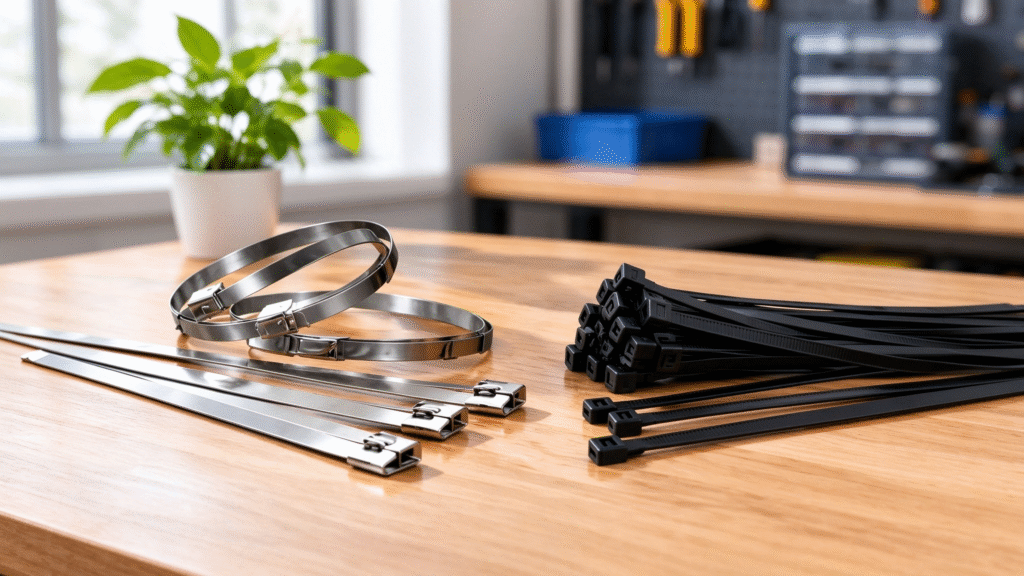
Understanding Metal vs. Plastic Zip Ties Not all zip ties are created equal. Fasteners vary extensively in chemical composition, locking design, structural width, and mechanical load limits. Selecting between polymer and metallic fasteners depends entirely on environmental exposure, mechanical stress, and application demands. What Are Plastic Zip Ties? Plastic cable ties, commonly known as nylon […]
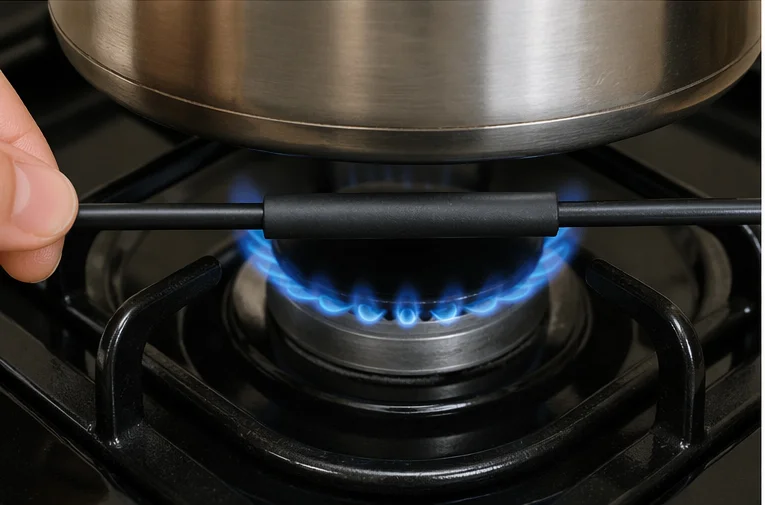
Why You Might Need an Alternative to a Heat Gun While an electric heat gun is the industry standard for activating heat shrink tubing, it is not always the most practical or accessible tool for every scenario. Resourcefulness is key in electrical maintenance, and understanding how to achieve a professional-grade seal with alternative heat sources […]
We use cookies to enhance your browsing experience, serve personalised ads or content, and analyse our traffic. By clicking "Accept All", you consent to our use of cookies.
Looking For High Quality Nylon Cable Ties At A Great Price?
Order now to experience cost-effective cable tie products that provide convenience and protection for your work and life.

 EN
 AR
 ES
 PT
 FR
 RU
 DE
 KO
 JA
 IT
 NL
 TR