Are you dealing with brittle, snapped straps or callbacks from crushed line set insulation?
Choosing the right HVAC zip ties isn’t just about keeping wires tidy—it’s about protecting your entire system against blistering heat, constant vibration, and severe UV breakdown. Standard fasteners simply won’t cut it in harsh mechanical environments.
In this guide, you’ll learn exactly how to select the best HVAC-grade cable ties for any job, meet strict building codes, and secure your line sets without damaging the vapor barrier.
Let’s dive right in.
What Are HVAC Zip Ties?
HVAC zip ties are heavy-duty, engineered mechanical fasteners specifically designed to withstand the harsh physical and environmental demands of heating, ventilation, air conditioning, and refrigeration systems. Unlike light-duty consumer ties, these industrial-grade fasteners secure flexible ductwork, anchor insulated refrigerant line sets, and route high-voltage and control wiring across residential, commercial, and industrial HVAC installations.
Role of Zip Ties in HVAC Units and Refrigerant Line Bundling
In HVAC/R installations, cable ties serve critical load-bearing and protective functions:
Flexible Duct Strapping: Extra-long, high-tensile ties clamp flexible duct inner cores and outer vapor barriers onto sheet metal collars, preserving airtight seals against positive air pressure.
Line Set Bundling: Straps secure paired suction lines, liquid lines, and condensate drain tubing together, eliminating line sag across long vertical drops and horizontal runs.
Insulation Protection: Wide-strap ties compress closed-cell pipe insulation evenly without pinching or tearing the thermal barrier.
Cabinet Harness Routing: Ties organize high-voltage motor leads, capacitors, and low-voltage control boards inside air handlers and condenser compartments to prevent contact with sharp sheet metal edges.
Standard Zip Ties vs. HVAC-Grade Fasteners
Standard general-purpose nylon ties rapidly fail when exposed to the thermal shifts and mechanical tensions common to air-handling equipment. HVAC-grade ties are manufactured from specialized resins and structural geometries engineered for continuous mechanical performance.
Performance Parameter
Standard Zip Ties
HVAC-Grade Fasteners
Base Material
Standard Polyamide 66 (PA66)
UV-Stabilized PA66, Heat-Stabilized PA66, or Coated Stainless Steel
Loop Tensile Strength
18 lbs – 50 lbs (Miniature to Standard)
120 lbs – 175+ lbs (Heavy Duty to Extra Heavy Duty)
Operating Temperature
-20°C to +85°C
-20°C to +105°C (Specialized grades to +150°C)
Flammability Rating
Non-rated or standard commercial
UL 94V-2 / UL 94V-0 self-extinguishing ratings
Weather & UV Resistance
Low; rapid outdoor embrittlement
High; carbon-black additives for long-term outdoor exposure
Locking Mechanism
Thin single-tooth pawl
Reinforced 4-tooth pawl or stainless steel roller-ball lock
What Makes HVAC Different: Heat, UV, Vibration, and Condensation
HVAC equipment operates under a combination of mechanical and atmospheric stress factors rarely found in standard electrical installations:
Extreme Heat Cycling: Attic duct runs and rooftop units (RTUs) experience sustained temperatures exceeding 60°C, combined with seasonal thermal expansion and contraction. Standard plastics soften, stretch, and lose retention torque under these conditions.
Solar UV Degradation: Line sets routed along exterior walls and condenser cages face constant ultraviolet radiation. Unstabilized ties undergo photo-oxidation, leading to surface micro-cracking and sudden snap failures within months.
Compressor Vibration: Constant mechanical resonance generated by compressors, blower wheels, and draft inducer motors causes standard cable tie pawls to loosen or abrade against copper piping.
Condensation & Moisture: Cold refrigerant suction lines create continuous condensation sweating. Fasteners must resist water absorption, mold, and galvanic corrosion when placed in direct contact with copper, aluminum, and galvanized steel surfaces.
Key Applications of Zip Ties in HVAC Systems
In HVAC and refrigeration installations, fastener failure can lead to thermal loss, crushed line sets, and premature equipment shutdowns. We manufacture specialized hvac zip ties built specifically to handle the deadweight, thermal cycling, and constant vibration typical of mechanical systems.
Securing Refrigerant and Condensate Lines
Bundling suction lines, liquid lines, and condensate drain tubing requires fasteners that hold firm without choking line insulation. Crushing closed-cell foam compromises the thermal barrier, causing pipe sweating, water damage, and efficiency loss.
Line set straps: We supply wide strap cable ties that distribute clamping force evenly over elastomeric insulation jackets.
Flexible ductwork connections require heavy-duty mechanical locking to prevent air leaks and static pressure drops at the collar joint. Standard light-duty ties snap under duct expansion pressure, making high-strength fasteners non-negotiable.
High tensile ratings: Our 120-lb to 175-lb extra-heavy-duty nylon duct strap ties ensure an airtight seal over inner duct cores.
Long-reach dimensions: Straps up to 48 inches accommodate large-diameter supply and return ducts in commercial runs.
Insulation securing: These ties clamp external fiberglass blankets and vapor barriers securely around sheet metal fittings to prevent condensation.
Wire and Harness Organization in HVAC Units
Air handlers, heat pumps, and furnaces house dense wiring networks that must stay isolated from high-heat heat exchangers and dynamic blower assemblies.
Chassis routing: A cable tie with mounting hole anchors control boards, relays, and power feeds directly to the unit cabinet sheet metal.
Flame safety: Formulated from UL 94V-2 rated Polyamide 66, our ties extinguish quickly in electrical fault conditions.
Selection versatility: Sourcing from our multipurpose nylon cable ties ensures your field teams have the right lengths and tensile profiles on hand for high-density control panels.
Outdoor Condenser Units and Line Set Routing
Exterior line sets run across roofs, along masonry walls, and directly into outdoor condenser disconnects where direct sun and seasonal weather ruin standard hardware.
UV degradation defense: Our black uv cable ties incorporate carbon black additives that prevent embrittlement, micro-cracking, and snapped heads under persistent sunlight.
Wide thermal range: Rated for operating windows of -20°C to +85°C (with heat-stabilized options reaching up to 105°C), our ties maintain their retention strength through freezing winters and scorching rooftop summer peaks.
Extreme duty: For heavy industrial refrigeration racks or marine coastal zones, our coated stainless steel cable ties provide complete resistance to salt spray and chemical corrosion.
Types of Zip Ties for HVAC and Line Set Bundling
Choosing the correct HVAC zip ties is critical to keeping ductwork secure, passing inspection, and preventing premature failure in demanding environments. We manufacture specialized strapping solutions engineered to withstand mechanical load, thermal movement, and environmental degradation across residential and commercial HVAC/R installations.
Plenum-Rated Air Handling Zip Ties
Air-handling spaces and drop ceilings impose stricter fire requirements than open ceilings, because everything installed there sits in the return air stream. A tie that burns readily or smokes heavily in a plenum redistributes combustion products through the occupied space rather than confining them.
What the rating actually means: Plenum suitability is evaluated on heat release and visible smoke density under UL 2043, the test for discrete products installed in air-handling spaces. That is a different test from UL 94, which only measures whether a plastic specimen self-extinguishes in a vertical burn.
Why UL 94 V-0 is not enough: A V-0 rating confirms the polymer stops burning once the flame source is removed. It says nothing about smoke density or heat release rate, so V-0 alone does not establish that a tie may be installed in a return-air plenum.
Primary use: Bundling control wiring, pneumatic tubing, and lightweight flexible ducting inside enclosed ceiling voids and mechanical rooms where the local code requires plenum-rated components.
What to specify: Confirm which listing your authority having jurisdiction accepts, and ask for the test report rather than a marketing claim. Where the space is not a return-air plenum, a UL 94 V-0 or V-2 nylon tie is normally sufficient.
UV-Resistant and High-Temperature Zip Ties
Outdoor line sets and condenser hookups are exposed to intense sunlight, ambient ozone, and extreme weather swings. Standard natural nylon degrades and snaps quickly under direct sunlight.
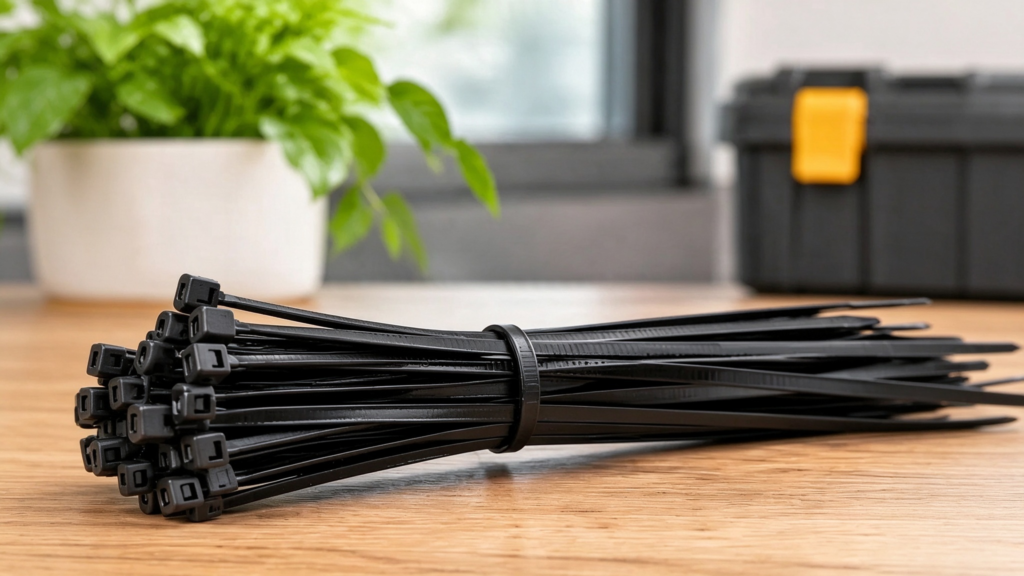
Carbon Black Stabilization: Our black outdoor cable ties incorporate high-grade carbon black additives that absorb damaging UV radiation, preventing surface micro-cracking and brittleness.
Thermal Endurance: Formulated to maintain locking integrity across standard operating ranges of -20°C to +85°C, with specialized heat-stabilized compounds rated up to 105°C and 150°C for high-heat refrigeration discharge lines.
Application Focus: Securing exterior line set insulation, mini-split run strapping, and outdoor condenser wiring runs. Explore our full range of nylon cable ties built for demanding industrial and outdoor environments.
Stainless Steel Zip Ties
For high-corrosion, marine-grade, or extreme-temperature setups, metal fasteners provide permanent mechanical security where polymers reach their operating limits.
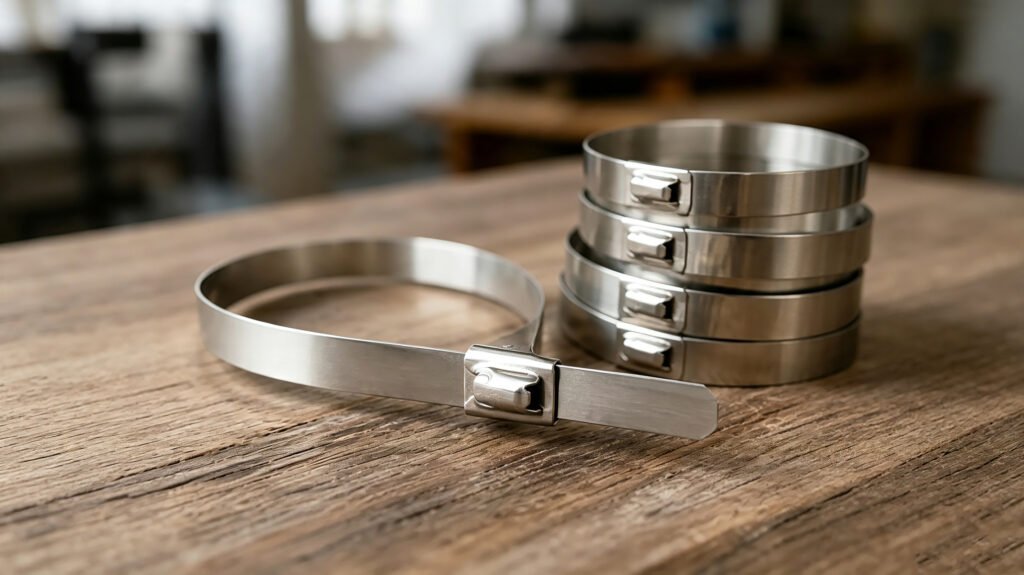
Material Grades: Built from marine-grade 304 and 316 stainless steel to eliminate rust and corrosion.
Protective Coatings: Available with epoxy or PVC coatings to create a smooth protective barrier. This prevents direct metal-on-metal abrasion, galvanic corrosion, and pinch cuts into soft copper refrigerant lines.
Locking Mechanism: Features a self-locking roller-ball mechanism that locks tight under high tension without slipping. Learn more about proper tensioning techniques with our guide on stainless steel cable ties.
Heavy-Duty Nylon Zip Ties
Duct hanging and line set bundling demand high tensile capacity to prevent sagging under airflow pressure and line weight.
High Tensile Strength: Available in Heavy Duty (120 lbs) and Extra Heavy Duty (175+ lbs) loop ratings to eliminate strap snapping.
Wide Strap Profiles: Extended strap widths distribute mechanical pressure over a larger surface area, preventing the strap from slicing through exterior duct jackets, vapor barriers, and elastomeric foam insulation.
Extended Lengths: Ranging from 24 inches to 48 inches to strap large-diameter flexible ductwork and commercial trunks in a single cinch.
Material Grades: Nylon 66, PA46, and PPA
The base polymer dictates how your fasteners perform over decades of HVAC service cycles:
Polyamide 66 (PA66): The primary standard for professional HVAC zip ties. Offers exceptional mechanical toughness, high rigidity, and excellent wear resistance. Meets UL 94V-2 and UL 94V-0 flammability ratings.
Polyamide 46 (PA46): A high-performance engineering thermoplastic designed for high-heat environments. It maintains dimensional stability and stiffness at sustained temperatures up to 130°C–150°C, making it suitable for immediate proximity to industrial compressor heads and exhaust zones.
Polyphthalamide (PPA): Engineered for severe-duty applications requiring near-zero moisture absorption and superior chemical resistance against aggressive refrigerants, oils, and industrial cleansers.
How to Choose the Right Cable Ties for HVAC Applications
Selecting the right hvac zip ties is essential for long-term system reliability. Using standard consumer ties on commercial mechanical systems leads to premature failure, sagging ductwork, and damaged line set insulation. When evaluating fasteners for mechanical systems, we focus on four critical engineering factors: material formulation, load ratings, building code compliance, and strap dimensions.
Material and Environmental Resistance
HVAC environments present extreme conditions, ranging from freezing rooftop condenser lines to sweltering attic spaces. Standard nylon breaks down quickly under continuous thermal stress and ultraviolet exposure.
Indoor Applications: Standard Polyamide 66 (PA66) provides balanced mechanical strength in conditioned spaces with an operating range of -20°C to +85°C.
Outdoor Installations: Condenser lines and rooftop duct runs require black UV cable ties formulated with carbon black additives. These prevent polymer degradation and embrittlement caused by solar radiation.
High-Heat Zones: Furnace plenums and unventilated attics demand heat-stabilized materials. Reviewing our technical guide on understanding heat resistance and material properties helps determine exact thermal thresholds for demanding installations.
Extreme Environments: For corrosive industrial exhaust runs or extreme chemical exposure, coated stainless steel cable ties provide permanent security.
Tensile Strength and Bundle Diameter
Mechanical ductwork and insulated copper line sets carry significant physical weight, especially when condensation forms or duct air pressure shifts. Choosing the correct loop tensile strength prevents strap snapping and line drops.
Tie Grade
Loop Tensile Strength
Typical Length Range
Recommended HVAC Application
Standard
50 lbs (22 kg)
8″ – 14″
Thermostat control wiring, light condensate drain tubing
Heavy-Duty
120 lbs (54 kg)
12″ – 24″
Paired refrigerant copper lines, mini-split line set bundles
Extra Heavy-Duty
175+ lbs (79+ kg)
24″ – 48″
Flexible air duct strapping, heavy insulated trunk lines
Always size the tie length so that at least two to three inches of tail remain after reaching the final bundle diameter. This ensures positive pawl engagement inside the locking head.
Building Codes and Safety Standards Compliance
Mechanical inspections require certified materials that meet stringent safety standards. When working with inspectors and project engineers, compliance documentation is non-negotiable. Knowing how to choose the right nylon cable tie manufacturer ensures your fasteners carry authentic certifications.
Flammability Ratings: All interior nylon ties should carry a UL 94V-2 or UL 94V-0 self-extinguishing rating to stop flame spread along wire and line runs.
Air-Handling Spaces: Fasteners placed inside drop ceilings or return-air plenums must be evaluated to UL 2043 for heat release and smoke density, not merely to UL 94.
Quality Approvals: Verify manufacturing compliance under ISO9001, UL, CE, and RoHS standards to guarantee uniform tensile performance across every production batch.
Width, Length, and Strap Profile for Insulated Lines
The physical shape of the strap directly affects the thermal efficiency of refrigerant and air delivery systems:
Preventing Insulation Compression: Narrow ties concentrate clamping force over a thin line, cutting into rubber foam insulation or crushing flexible duct liner. Crushed insulation creates thermal bridges, resulting in exterior condensation, dripping, and energy loss.
Wide Strap Advantage: Utilize wide strap cable ties (typically 0.30 inches / 7.6 mm or wider) for line sets and flex ducts. The wider surface distributes tension evenly, holding the vapor barrier securely without pinching the core insulation.
Smooth Edge Design: Look for fasteners engineered with rounded, chamfered edges to eliminate snagging or slicing into exterior foil vapor jackets during tensioning.
Best Practices for Refrigerant Line Bundling and Installation
Proper installation of refrigerant line sets requires strapping techniques that protect thermal performance, preserve line integrity, and prevent long-term system failure. Using the correct hvac zip ties and adhering to mechanical standards ensures clean routing and dependable support across residential and commercial HVAC jobs.
Securing Lines Without Damaging Pipe Insulation
Over-tightening strapping over elastomeric foam insulation crushes the closed-cell structure, destroying its R-value and leading to localized condensation.
Opt for wide strap cable ties: Use broader profiles (7.6 mm to 12.7 mm / 0.30 in to 0.50 in wide) to distribute clamping force over a wider surface area.
Prevent thermal bridging: Crushed insulation allows heat transfer, triggering sweating and water damage along indoor runs.
Avoid cutting the vapor barrier: Sharp tie edges slice through exterior insulation jackets. Select ties with smooth, rounded edges to keep the protective outer barrier intact.
Proper Spacing and Tension Control
Uneven strapping causes line sag, vibration transfer, and mechanical stress at flared or brazed copper joints.
Support intervals: Install line set straps every 1.2 to 1.8 meters (4 to 6 feet) along horizontal runs, and every 1 to 1.5 meters on vertical drops to prevent whipping under compressor cycling.
Tension threshold: Tighten until the tie is snug against the outer jacket without compressing the insulation thickness by more than 10%.
Material stability: Selecting high-grade PA66 ties prevents stretching under seasonal thermal swings. Learning the mechanical differences between nylon 6 and nylon 66 cable ties highlights why PA66 holds tension reliably without creeping under continuous load.
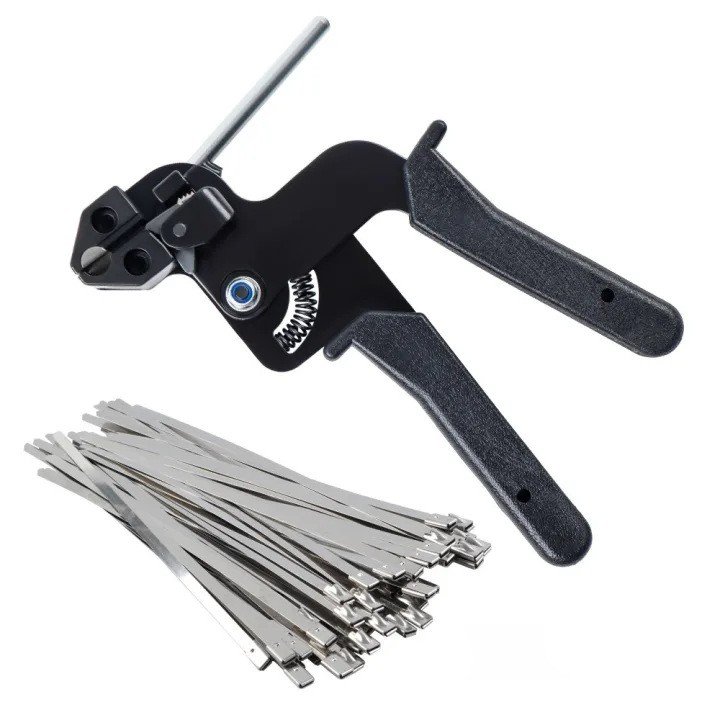
Using Cable Tie Tensioning Tools
Manual tensioning often produces uneven results—either leaving bundles too loose or cranking them down tight enough to pinch the lines.
Consistent tensioning: An industrial cable tie tensioning tool allows installers to preset cutoff tension according to the duct or line bundle diameter.
Flush cutoffs: Hand-cutting nylon tails with wire cutters leaves razor-sharp protruding nubs. Tensioning tools shear the strap perfectly flush against the locking head, eliminating snag points and worker injury risks during service calls.
Speed and repeatability: Calibrated tools accelerate high-volume rough-ins while keeping every strap uniform across the entire facility run.
Stainless Ties on Copper: Preventing Abrasion and Pinhole Leaks
Bare metallic contact between copper tubes and strapping leads to friction wear from compressor vibration, which eventually causes pinhole leaks and refrigerant loss.
Installation Hazard
Risk Level
Correct Strapping Practice
Direct Bare Metal Contact
Critical
Use fully coated stainless steel cable ties with polyester, epoxy, or PVC barriers to prevent metal-on-metal friction.
Galvanic Corrosion
Moderate
Keep dissimilar metals isolated; protective polymer coatings eliminate electrical contact between copper lines and steel supports.
Vibration Abrasion
High
Anchor line runs using cushioned isolators or coated copper pipe straps before securing with heavy-duty ties.
Why HVAC Cable Ties Fail
HVAC installations subject fastening hardware to continuous environmental stress, mechanical motion, and extreme temperature swings. When low-grade straps fail in the field, flexible duct runs sag, insulation tears, and refrigerant line sets lose structural support. Choosing the wrong hvac zip ties leads to expensive service callbacks and system inefficiency.
UV Embrittlement and Surface Cracking
Standard indoor nylon cannot endure direct sunlight. Ultraviolet radiation breaks the polymer chains inside the plastic, leaching out moisture and causing the strap to turn brittle, chalky, and cracked within months. On outdoor condenser units and rooftop mechanical systems, using low-grade straps guarantees premature snapping. To withstand harsh solar exposure, we recommend professional-grade black uv cable ties engineered with carbon black additives to block UV radiation and keep line sets secured year after year.
Creep Under Sustained Tension
Material creep happens when a tie remains under heavy mechanical load for prolonged periods. When an installer suspends heavy insulated ductwork using standard lightweight ties, the nylon molecules slowly stretch and relax. Over time, the duct strap elongates, losing tension and causing flexible ducts to belly, sag, or pull away from sheet metal takeoffs, severely choking airflow.
Insulation Cut-Through and Vapor Barrier Damage
Using thin, narrow ties creates extreme point pressure against soft elastomeric foam and fiberglass vapor barriers. Common installation failures include:
Jacket Piercing: Sharp, narrow strap edges slicing into the outer vapor barrier under tension.
Condensation Pooling: Crushed insulation losing its thermal resistance (R-value), resulting in cold-spot sweating and water damage on ceilings.
Switching to wide strap cable ties distributes holding force evenly, maintaining insulation depth and vapor barrier integrity without biting into the material.
Head Breakage and Vibration Fatigue
Compressors and blowers generate continuous harmonic vibration across refrigerant tubing and air handlers. Inferior ties frequently shear right at the locking head where the strap enters the pawl. Thermal cycling between extreme summer attic heat and sub-zero winter temperatures amplifies this mechanical stress, making brittle locking teeth snap under cyclic shock. Heavy-duty line set straps built with high-tensile locking pawls resist vibration fatigue and keep mechanical lines anchored under demanding operating conditions.
Frequently Asked Questions
What makes HVAC zip ties different from standard cable ties?
Standard nylon ties turn brittle under sunlight, crack in cold winters, and stretch under heat. HVAC zip ties are engineered specifically to survive extreme conditions. We manufacture our HVAC ties using high-grade Polyamide 66 with carbon black additives for outdoor UV protection, or specialized heat-stabilized compounds rated from -20°C to +85°C and beyond. They offer higher loop tensile strength—often 120 lbs to 175 lbs—so flexible air ducts and heavy insulated line sets stay firmly anchored without strap failure.
Can you use standard white nylon ties on outdoor AC condensers?
No. Standard natural nylon ties degrade within months when exposed to ultraviolet radiation, leading to surface micro-cracking and sudden snap breaks. For rooftop units and exterior condenser line runs, we always supply black UV cable ties. The carbon black formulation blocks UV radiation from breaking down the polymer chains, keeping outdoor line set straps flexible and intact through years of sun and weather exposure.
What tensile strength do I need for securing flexible ductwork?
There is no single code number that applies to every job, so size the tie to the collar load rather than to a rule of thumb. On standard residential flexible duct collars, 120 lb heavy-duty ties hold reliably; large-diameter commercial trunks and long vertical drops call for 175 lb or higher. The closure itself must be part of a listed system for the duct being installed—UL 181B covers flexible duct connectors and closure systems—and the duct manufacturer's installation instructions govern which clamp or tape is accepted locally. In practice, the failure mode to guard against is creep: a 50 lb tie on a 16-inch collar will relax under static pressure and open a leak at the collar joint.
When should you switch from nylon to coated stainless steel cable ties?
While heavy-duty nylon handles most residential and commercial split systems, coated stainless steel cable ties are essential for extreme-duty environments. We supply 304 and 316 roller-ball stainless ties for high-temperature exhaust runs, industrial chemical plants, and coastal rooftop condensers facing salt-spray corrosion. The protective epoxy or polyester coating acts as a barrier, preventing galvanic reaction and physical abrasion against bare copper pipes.
How do you prevent zip ties from crushing pipe insulation?
Over-tightening narrow straps pinches closed-cell elastomeric foam, drastically reducing its R-value and causing condensation leaks. To avoid this, we recommend using wide strap cable ties to distribute the load across a broader surface area. Calibrating an ergonomic cable tie tensioning tool ensures consistent cutoffs and holds lines firmly without crushing the insulation or tearing the vapor barrier. You can find more installation insights and mechanical fastening tips across our technical wiring accessories blog.
Are Wandu HVAC cable ties compliant with standard safety codes?
Yes. Wandu manufactures all cable ties and line set fastening hardware under ISO 9001 certified quality controls. Our standard HVAC line set fasteners meet UL 94V-2 flame retardancy requirements, with specialized formulations meeting UL 94V-0 self-extinguishing criteria alongside RoHS and REACH environmental compliance for residential, commercial, and industrial HVAC/R projects worldwide.
About the manufacturer — Zhejiang Wandu Plastic Co., Ltd. is a wiring accessories manufacturer and supplier in Yueqing, Zhejiang, China, founded in 2011 and trading as Wenzhou Wandu Plastic Co., Ltd. until its 2023 renaming. The 6,000 m² factory moulds nylon 66 cable ties on 25 injection moulding machines with 10 test devices; the wider catalogue covers stainless steel cable ties, cable clips, cable glands, tie mounts, cable protection and wiring tools. Certification and test evidence for the cable tie range — ISO 9001:2015, CE (LVD), RoHS, PPWR, food contact, UV ageing and UL 94 — is published on our certificate page. Products ship to buyers in 50+ countries.
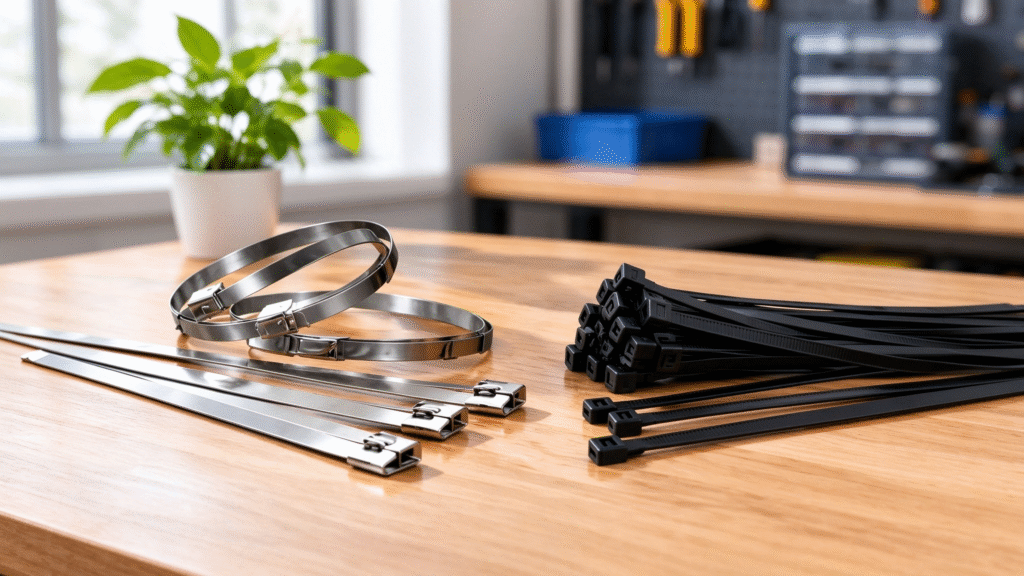
Understanding Metal vs. Plastic Zip Ties Not all zip ties are created equal. Fasteners vary extensively in chemical composition, locking design, structural width, and mechanical load limits. Selecting between polymer and metallic fasteners depends entirely on environmental exposure, mechanical stress, and application demands. What Are Plastic Zip Ties? Plastic cable ties, commonly known as nylon […]
What Are Stainless Steel Zip Ties? Overview and Primary Functions Stainless steel zip ties—also known as metal cable ties—are high-strength, heavy-duty fasteners engineered to secure cables, wires, pipes, and hoses in severe operational environments. When standard plastic ties melt, crack, or degrade, these industrial-grade metal fasteners maintain structural integrity and steady tension. At WANDU, we […]
We use cookies to enhance your browsing experience, serve personalised ads or content, and analyse our traffic. By clicking "Accept All", you consent to our use of cookies.
Looking For High Quality Nylon Cable Ties At A Great Price?
Order now to experience cost-effective cable tie products that provide convenience and protection for your work and life.

 EN
 AR
 ES
 PT
 FR
 RU
 DE
 KO
 JA
 IT
 NL
 TR