What Custom Printed Cable Ties Are and Why Brand Directly on the Tie
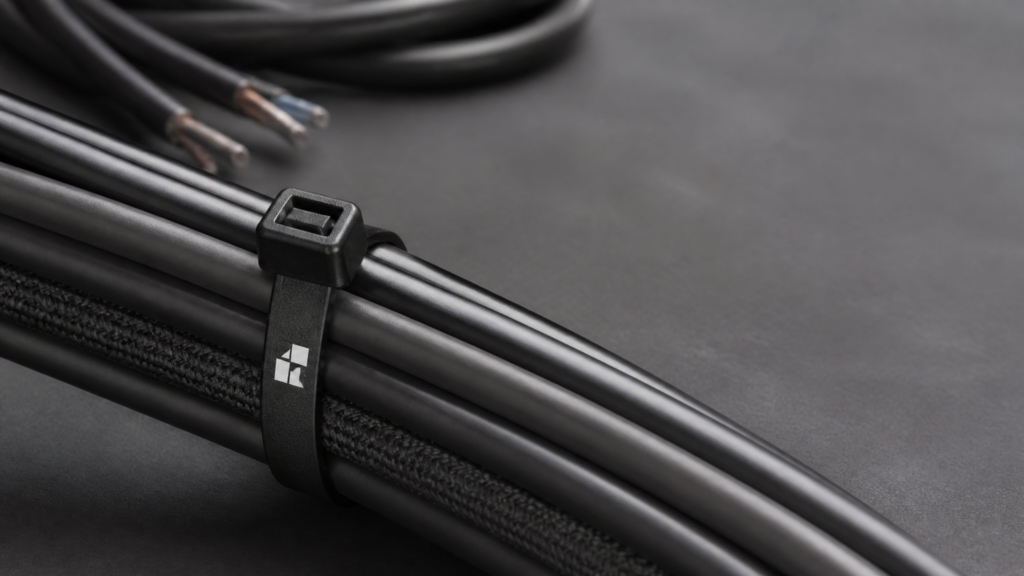
Custom printed cable ties are essential tools for professional identification and corporate branding. By applying logos, serial numbers, or text directly onto the surface of the tie, businesses move beyond simple cable management to integrated asset tracking and brand promotion. Branding directly on the tie ensures that identification remains permanently attached to the bundle, providing a tamper-evident solution that is far more reliable than adhesive labels or tags that may peel or fall off over time.
Key Benefits of Branded Cable Ties for OEMs
For Original Equipment Manufacturers (OEMs), utilizing custom cable ties serves both functional and marketing purposes. These ties streamline assembly processes and improve brand recognition.
Brand Awareness: Transforms standard hardware into a professional marketing touchpoint.
Asset Management: Improves organization through permanent identification and color-coding.
Tamper Evidence: Increases security by providing a branded seal that is difficult to replicate.
Enhanced Traceability: Simplifies inventory management and maintenance through unique numbering.
Core Technical Specifications and Size Selection
Selecting the right dimensions and material properties is critical to ensure durability and performance in specific environments. When choosing cable ties for OEM projects, consider the following technical parameters:
Specification
Typical Range
Importance
Material
Nylon 66 / UV Resistant
Determines structural integrity and lifespan
Width
2.5mm to 12.7mm
Affects tensile strength and holding power
Length
100mm to 1200mm
Dictates the maximum diameter of the bundle
Tensile Strength
18 lbs to 175 lbs
Ensures the tie can support the intended load
Choosing the appropriate size and material grade early in the procurement phase ensures the custom product meets the rigorous demands of industrial and electrical applications.
Materials, Printing Methods, and Customization Options
Material Compatibility and Substrate Selection
Choosing the right material for custom cable ties is essential for performance. We primarily utilize high-grade Nylon 66, which offers a balance of strength and flexibility. Depending on the environment, we can provide variants for extreme conditions, such as UV-stabilized nylon for outdoor exposure or heat-resistant grades. For specialized industrial needs, we ensure the base substrate is compatible with the printing method to guarantee the mark remains legible throughout the product’s lifecycle. The properties of these materials are covered in more detail in our guide to nylon cable tie uses and selection.
Printing Methods: Hot Stamping, Laser Etching, Inkjet, and Silk Screen
To create high-quality custom printed cable ties, we employ various marking technologies tailored to your specific branding needs:
Method
Best For
Durability
Hot Stamping
Crisp, permanent text and logos
High
Laser Etching
Precision detail and serialized numbers
Excellent
Inkjet
High-speed, variable data printing
Moderate
Silk Screen
Large, high-visibility branding
Good
Ink and laser are not interchangeable, and treating one as a free upgrade over the other is the most common way a quotation stalls. When a drawing says ink, the buyer usually has a reason that has nothing to do with durability: a procurement standard, a colour match to a swatch, or a marking already approved by an authority that does not want to re-open the approval. A tie, its dimensions, and its price can all be accepted and the order still pause on the marking method alone.
Where ink is the correct answer: tender documents that name ink, colour matches to a Pantone swatch on a coloured tie, and applications where the mark has to sit on the surface rather than cut into it. Where laser is the better answer: high-contrast white on a dark tie, serialized or variable data, and any environment where abrasion or solvent wiping would destroy a printed layer. One commercial point is worth knowing before you compare prices — laser needs no printing plate, so it carries no per-artwork setup charge. That is why laser often quotes lower on small lots. It is a cost difference, not a quality verdict.
The practical rule: confirm the marking method against the drawing before the price leaves your desk. If the requested method is one you would not recommend, raise it as a question inside the quotation, not as a note after it.
Custom Pantone Colors and Private Label Packaging
We offer full customization for your branded cable ties, including color-matching via Pantone standards. Whether you need specific color-coded ties for wiring organization or a unique brand color for marketing, we ensure consistency across batches. Beyond the tie itself, we provide private label packaging solutions to help your business present a professional, retail-ready product to your end users.
Types of Custom and Branded Cable Ties
Standard, Heavy Duty, UV, and Heat Resistant Nylon Cable Ties
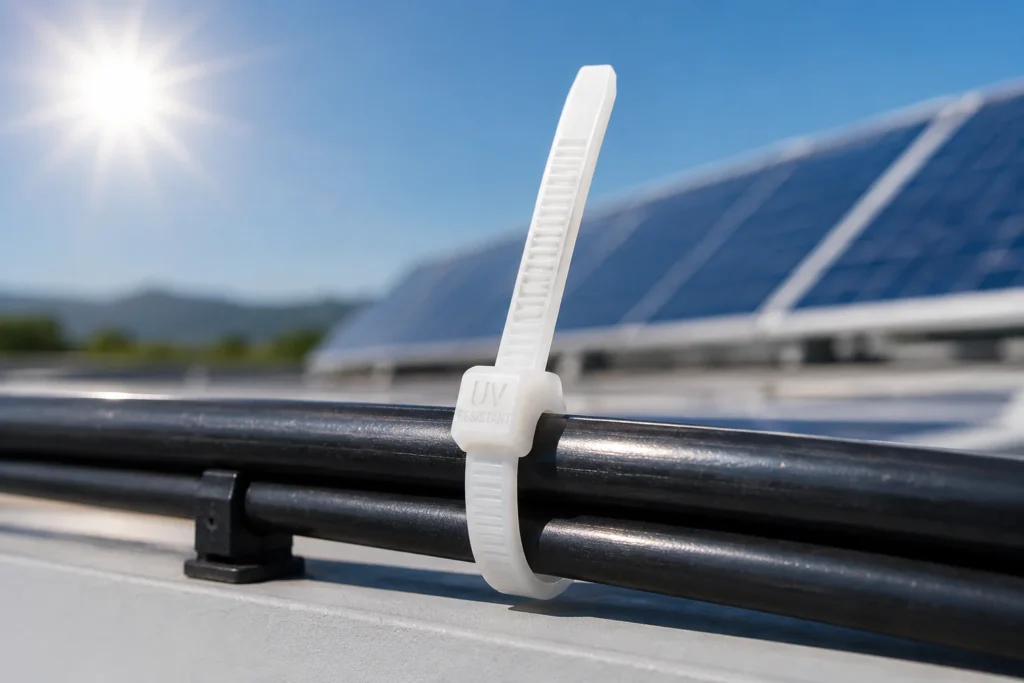
We offer a versatile range of custom cable ties designed to meet diverse operational environments. Our standard nylon ties provide reliable bundling for general indoor use, while our heavy-duty options are engineered for high-tensile strength requirements. For outdoor or industrial settings, we supply UV-stabilized and heat-resistant custom printed cable ties that maintain structural integrity when exposed to harsh sunlight or fluctuating temperatures. Evaluating the durability and cost-effectiveness of nylon cable ties is essential for selecting the right material for your specific application.
Marker and Releasable Cable Ties for Branded Bundling
Our marker cable ties feature a dedicated flag area for clear identification, perfect for labeling complex electrical circuits. We also provide custom zip ties in releasable formats, which allow for quick adjustments or re-routing of cables without the need for cutting. These personalized cable ties ensure that your branding stays visible while offering the flexibility needed during maintenance or installation. When you need to optimize automotive wiring harness and component fixation, these specialized ties provide both security and ease of use.
Hook-and-Loop Cable Ties for Reusable Bundling
For delicate fiber optics or frequently accessed cable bundles, our hook-and-loop custom tie wraps provide a non-abrasive, reusable solution. These branded cable ties can be manufactured to your specific color preferences, offering a professional appearance that aligns with your corporate identity. By combining branding with reusability, these ties serve as an effective tool for event management, office organization, and retail merchandising.
Artwork Preparation and Print File Requirements
Vector Artwork Standards and Design Limitations
For high-quality custom printed cable ties, we require vector files (AI, EPS, or PDF) to ensure clarity during the printing process. Raster images like JPGs often pixelate when scaled to fit smaller tag surfaces. Keep your design simple and high-contrast for the best results on synthetic materials.
Institutional and public-sector buyers usually ask for something more specific than “a vector file”: a high-resolution PDF or image overlaid with die lines showing the finished tie outline with the marking in its exact position. Send that rather than a logo floating on a white background. It lets the buyer check print position against the real strap geometry before a plate is cut, which is the step where position errors are still cheap to fix.
Maximum Print Area, Numbering, and Barcode Verification
The print area is limited by the dimensions of the cable tie flag or strap. We suggest keeping logos and text within these parameters to prevent clipping. When using numbered cable ties or sequential barcodes, ensure the data sequence is provided in a clean spreadsheet format.
Feature
Requirement
File Format
Vector (.AI, .EPS, .PDF), with die lines for OEM work
Color Mode
Pantone Solid Coated
Resolution
300 DPI minimum for any raster element
Font Style
Outlined/Converted to paths
Common Artwork and Specification Mistakes That Cause Reprints
To avoid production delays, please double-check your files for the following common issues:
Tiny Text: Fonts smaller than 6pt often become illegible on custom zip ties.
Complex Gradients: Simple, solid colors print much more reliably than complex shadows or gradients.
Incorrect Scaling: Always verify that the artwork size matches the actual printable surface of the chosen tie length.
Missing Bleeds: Ensure your design does not run too close to the edges of the tag to account for minor print registration shifts.
Method Substitution: Quoting a marking process the drawing does not specify. It is the single most expensive mistake on this page, because it surfaces after the buyer has already approved a specification.
MOQ, Tooling Costs, and Lead Time Planning
Planning procurement for custom cable ties requires balancing batch volumes, initial tooling, and schedule targets. We align our manufacturing setup to keep upfront costs manageable while ensuring your custom printed zip ties meet precise production deadlines.
Minimum Order Quantities (MOQ) and Custom Color or Tooling Rules
Our minimum order quantities depend primarily on whether your order uses standard inventory for post-mold printing or requires dedicated mold fabrication:
Surface-Printed Stock Ties: For custom printed cable ties utilizing standard white or black stock, our MOQs remain low because no custom mold alterations are needed.
Custom Pantone Color Matching: Formulating raw polymer with specific masterbatch color pigments requires batch mixing thresholds to guarantee consistent color saturation across the entire run.
Custom Tooling and Specialized Geometries: Developing custom tie wraps with unique locking mechanisms, custom flags, or proprietary mounting features requires dedicated injection molds. Tooling rules prioritize high-volume production to amortize steel tooling investments.
Large orders change the requirement in the opposite direction. A run of 150,000 pieces is not “150,000 on average” — buyers at this volume routinely demand exact counts per bag and no overage or shortage, because the ties are kitted into fixed sets downstream and a surplus bag is as much of a problem as a short one. That means bag counts, carton counts, and label counts all have to reconcile at packing, and the quotation should state the packing unit explicitly — for example, 150 bags of 1,000 — rather than only a total.
Carton weight is the parameter that most often forces a re-quote after the price has been agreed. A 54 × 38 × 24 cm export carton holding 1,000-count bags of a 4.8 mm × 200 mm tie comes in near 18 kg gross, which is about 39.7 lb. If the buyer’s receiving standard caps cartons at 35 lb (15.9 kg), that packing fails on weight alone — and correcting it changes the bags-per-carton split, the carton count, the total cubic volume, and the pallet count. Ask for the carton weight limit and the required CBM and pallet figures before quoting, not after the order is confirmed.
What Drives Unit Pricing and Setup Fees
Every custom cable tie project involves fixed setup variables and recurring production variables. Knowing what’s the difference between cable ties and zip ties and choosing the right standard profile helps control costs early in the quoting process.
Key pricing drivers include:
Marking Method: Laser etching eliminates recurring stamp plate fees, while hot-foil stamping incurs a one-time die tooling charge per artwork layout.
Print Complexity: Single-location static branding carries lower production fees than serialized, high-precision numbered cable ties or multi-sided custom print layouts.
Material & Profile: Specialty polymers, heat stabilizers, and UV inhibitors adjust the base raw-material cost prior to printing or molding.
Order Volume: Bulk purchasing significantly lowers unit prices by absorbing machine changeover, calibration, and plate setup costs.
A quotation that survives a sourcing review answers more than price. In public-sector tenders and large OEM programs the fields usually required are: unit price per 1,000 in a named currency, total for the stated quantity, validity period, and an FOB named export port. Any minimum that sits above the requested quantity should be flagged rather than applied silently. Deviations from the drawing — a different marking method, a different nylon grade, a substituted colour — belong in the quotation as explicit deviations, never as a footnote added after the order.
Estimated Lead Times for Sampling, Tooling, and Mass Production
Accurate delivery planning prevents production shutdowns and inventory stockouts. Here is our general timeline structure for branded cable ties and OEM manufacturing runs:
Production Phase
Typical Timeline
Scope & Deliverables
Artwork Proofing
1–2 Business Days
Digital rendering, dimensional placement, and print confirmation
Physical Sampling
3–5 Business Days
Pre-production printed samples for aesthetic and dimensional sign-off
Custom Mold Tooling
30–40 Business Days
Precision mold fabrication, mold trial runs, and sample verification (new tooling only)
Mass Production
10–20 Business Days
Batch injection, automated marking, quality control, and bulk packaging
Two things are missing from any production-only timeline, and both of them cause the argument. The first is that the buyer’s deadline is a receiving date, not a ship date. On a North American delivery, ocean freight plus port handling adds roughly four to five weeks after the goods are packed, so a customer who says they need production finished in two weeks is usually working backwards from a fixed delivery window — not asking for a two-week factory lead time. Ask which date is the real one.
The second is that sampling and production are sequential, not parallel. Three to five working days for a physical sample plus ten to twenty working days for mass production gives a thirteen-to-twenty-five working day factory span before freight is even considered. A custom mold adds thirty to forty working days ahead of both. On a stock tie with surface printing, the sample stage is where time can often be compressed. On a custom mold it cannot be compressed at all — the tooling simply takes what it takes.
OEM Ordering Process, Quality Control, and Procurement
Managing an OEM order for custom cable ties requires a predictable system from technical review to container loading. As a wiring accessories manufacturer, Wandu aligns engineering checks, custom tooling, and manufacturing lines to keep custom zip ties consistent across every production run.
Step-by-Step OEM Workflow from RFQ to Delivery
Our custom printed cable ties follow a standard five-phase manufacturing roadmap:
Stage
Action Items
Key Deliverables
1. RFQ & Spec Alignment
Review dimensions, bundle diameter, tensile strength, substrate, and artwork files.
Quotation sheet and technical feasibility confirmation.
2. Pre-Production Proofing
Vector mapping, die-line setup, print-plate creation, or laser indexing.
Digital 2D proof and initial physical sample approval.
3. Tooling & Setup
Custom mold alignment, hot-stamping block engraving, or automated print-head calibration.
First-off production sample sign-off.
4. Mass Production
Injection molding, inline surface treatment, printing, and automated counting.
Barcode labeling, export carton packing, palletization, and dispatch.
Final packing list, commercial invoice, and Bill of Lading.
Quality Control, Certifications, and Sample Approval
Quality management for custom tie wraps covers both mechanical integrity and print durability:
Dimensional & Tensile Verification: Each production lot undergoes mechanical pull-force testing to ensure the locking pawl matches rated tensile loads. For projects requiring specific colors or standardized loads, refer to our blue cable ties sizes and strength guide for baseline structural benchmarks.
Print Legibility and Adhesion: Custom printed zip ties pass rub-resistance, scratch-resistance, and solvent-wipe evaluations so logos, serial numbers, and barcodes stay readable under field handling.
Raw Material Inspection: Virgin polymers undergo moisture and melt-flow index checks to prevent brittleness or premature degradation.
Sample Sign-Off: Before full-scale manufacturing, we issue pre-production golden samples for client sign-off, locking in color matching, imprint placement, and packaging format.
Tensile testing on a printed tie should be run on the finished part, not on the bare strap. Every marking process touches the surface of the nylon — laser vaporises a thin layer, hot foil stamps it under heat and pressure — so a buyer who specifies a minimum breaking strength is entitled to know the number still holds after the mark is applied. State the method next to the result: which standard, what pull rate, and whether the sample was conditioned. “Test data available on request” is a weaker answer than a number with a method attached to it.
B2B Procurement Checklist and Repeat-Order Consistency
Securing consistent output across recurring orders requires systematic master data control:
Engineering Master Sheet: We maintain locked digital drawings with exact print coordinates, font heights, and vector line weights for all branded cable ties.
Master Batch Retention: Physical retains from approved production lots are cataloged to cross-check color uniformity and hot-stamping depth against future batches.
Automated Packaging Controls: Standard bags, custom retail cartons, and export cases utilize verified labeling standards, avoiding mixed counts and mixed lots.
Sequential Number Tracking: For serialized or numbered zip ties, our manufacturing system logs sequence intervals to prevent duplicates between consecutive production cycles.
Industry Applications for Custom Printed Cable Ties
Electrical, Wiring Harness, and Telecommunications
In the electrical and telecommunications sectors, organization is critical for safety and maintenance. Using custom printed cable ties allows technicians to identify specific cable runs instantly, reducing downtime during troubleshooting. Branded zip ties help manage complex wiring harnesses by providing permanent, clear labeling that holds up in dense cable trays and distribution frames. Whether you are using standard cable ties or specialized markers, the ability to print part numbers or circuit IDs directly on the strap streamlines infrastructure management.
Automotive, Renewable Energy, and Industrial Manufacturing
Automotive and renewable energy projects require high-performance fastening solutions that can withstand harsh environments. Custom cable ties are frequently used here to verify quality control, offering tracking through batch numbers or production dates. In large-scale industrial manufacturing, these ties serve as essential markers for equipment assembly, ensuring that every wire is routed correctly according to specific engineering schematics. When durability is the priority, utilizing high-quality materials ensures these markers remain legible under extreme temperature variations and mechanical stress.
Retail Packaging, Merchandising, and Event Branding
Beyond technical utility, custom printed zip ties act as a unique branding tool in retail and event spaces. Companies use personalized cable ties for product security and anti-tamper branding, ensuring that merchandise remains sealed during shipping or display. At large events, they are a practical solution for crowd control, cable management for AV equipment, and even as wearable security credentials. By adding a logo or specific color scheme, businesses transform a standard accessory into a functional marketing asset that reflects professional brand identity.
Frequently Asked Questions
Artwork Submission, Setup Fees, and Print Size Limits
When ordering custom printed cable ties, high-resolution vector files (AI, EPS, or PDF) are preferred to ensure clarity. Setup fees are typically applied to cover the creation of custom printing plates or digital alignment for your specific logo. Keep in mind that the printable area is restricted by the width of the strap; our team will verify your design against the tie dimensions to ensure your branded message remains legible after the tie is cinched.
MOQ, Custom Colors, and Repeat Packaging Control
Minimum Order Quantities (MOQ) for custom cable ties vary based on the level of customization required, such as color matching or specific printing techniques. We can accommodate custom Pantone color requests to ensure brand consistency across your inventory. For repeat orders, we maintain strict records of your specifications and private label packaging requirements to ensure every batch matches your initial order exactly.
Lead Times, Samples, and Specification Checks
Production timelines depend on the complexity of your custom request. Once you confirm the digital proof or physical sample, we move into mass production. Before shipment, all branded zip ties undergo quality checks to verify material integrity and print quality. If you have specific requirements regarding operating temperatures or tensile strength, please outline these during the quotation phase so we can provide the correct material grade for your application.
About the manufacturer — Zhejiang Wandu Plastic Co., Ltd. is a wiring accessories manufacturer and supplier in Yueqing, Zhejiang, China, founded in 2011 and trading as Wenzhou Wandu Plastic Co., Ltd. until its 2023 renaming. The 6,000 m² factory moulds nylon 66 cable ties on 25 injection moulding machines with 10 test devices; the wider catalogue covers stainless steel cable ties, cable clips, cable glands, tie mounts, cable protection and wiring tools. Certification and test evidence for the cable tie range — ISO 9001:2015, CE (LVD), RoHS, PPWR, food contact, UV ageing and UL 94 — is published on our certificate page. Products ship to buyers in 50+ countries.
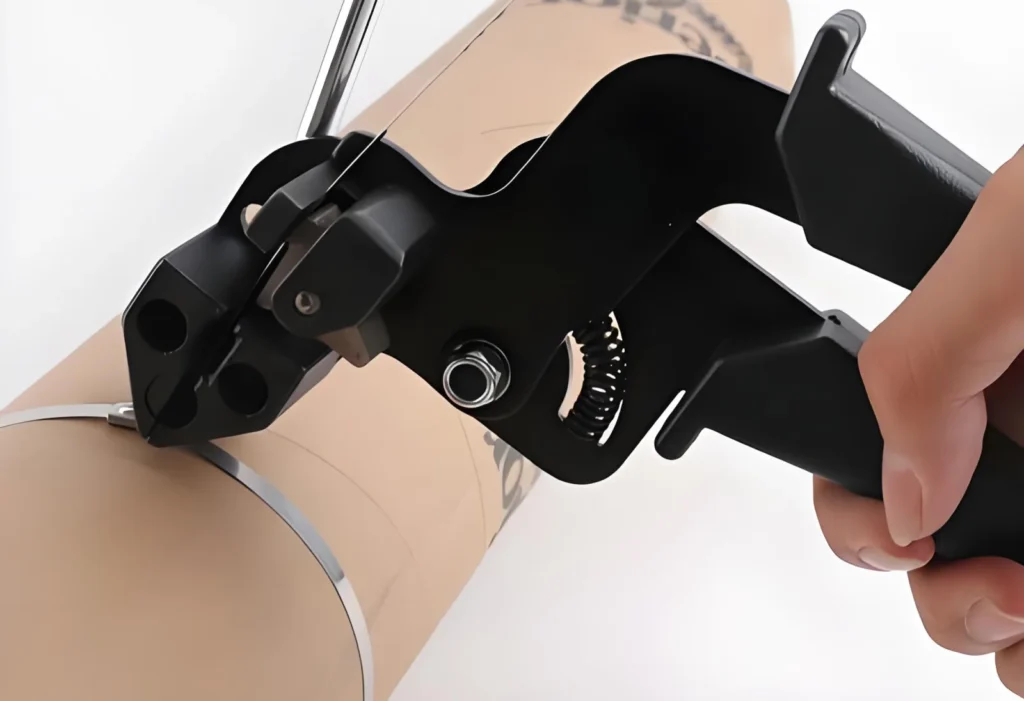
What Are Metal Tie Wraps and How Do They Work? An Overview of Stainless Steel Cable Ties When standard nylon zip ties fall short under extreme conditions, stainless steel cable ties step in as the ultimate heavy-duty bundling solution. Manufactured primarily from high-grade 304 or 316 stainless steel, these metal tie wraps offer unmatched resistance […]
Why Cable Management Matters in Data Center Racks and Cabinets Effective server rack cable management turns a tangled cabinet into a reliable, high-performing network environment. Without structured routing and secure bundling, loose cords create operational bottlenecks that threaten uptime and hardware longevity. Optimizing Airflow and Thermal Efficiency Unorganized wires hanging behind servers block exhaust vents […]
Have you ever used standard white zip ties for an outdoor project, only to watch them snap like twigs a few months later? You’re not alone. It’s a common frustration for contractors and DIYers alike who assume a cable tie is just a cable tie. But when it comes to braving the brutal sun, the […]
We use cookies to enhance your browsing experience, serve personalised ads or content, and analyse our traffic. By clicking "Accept All", you consent to our use of cookies.
Looking For High Quality Nylon Cable Ties At A Great Price?
Order now to experience cost-effective cable tie products that provide convenience and protection for your work and life.


 EN
 AR
 ES
 PT
 FR
 RU
 DE
 KO
 JA
 IT
 NL
 TR