Whether managing cables in your daily life or bundling items in construction or industry, you’ve likely used zip ties. Their simple structure and ease of use make them ubiquitous in nearly every industry, from electronics manufacturing to construction and even aviation.
But have you ever wondered: What are zip ties made of?
Understanding the material of zip ties isn’t just for curiosity; it also depends on their tensile strength, outdoor durability, various special properties, and ultimately, whether they’re suitable for your needs. This article will provide a comprehensive understanding of several commonly used zip tie materials and their characteristics, allowing you to determine which type is best for you
2.What are Zip Ties?
Zip ties, also known as cable ties, are a type of strap used for bundling, organizing, and securing items. They consist of a body and a head. The head has a square locking knob. When the body is threaded through the knob, internal ratchets engage the toothed strips on the strap, securing it securely. Cable ties are categorized as self-locking or reusable, depending on the type of locking knob. Self-locking zip ties feature a one-time tightening feature; reusable zip ties feature a release button on the head, allowing for multiple uses. Zip ties were first designed in the 1950s for cable management in the aviation industry (military aircraft). After numerous design improvements and material upgrades, they are now widely used in gardening, packaging and transportation, electrical wiring, automotive repair, and construction.
3.Main Material Classifications of Zip Ties
3.1 Nylon 6 (PA6)
A commonly used nylon cable tie material with a very low cost.
Advantages: Good toughness and abrasion resistance.
Dynamic Temperature Range: -10°C to +80°C.
Common Application: Indoor Use.
Hygroscopicity: Highly hygroscopic, resulting in reduced tensile strength in humid environments.
The highest quality and most cost-effective zip tie material.
Advantages: Good rigidity and abrasion resistance.
Dynamic Temperature Range: -20°C to +85°C. Common Applications: Suitable for both indoor and outdoor use. UV protection is recommended for outdoor use.
Hygroscopicity: Low hygroscopicity, maintaining stable tensile strength in humid environments.
Advantages: Lightweight (low density), chemical resistance, and floatability in liquids.
Dynamic Temperature Range: 0°C to +80°C.
Common Applications: Nuclear power, chemical industries, and environments with acids, alkalis, oils, and water. Hygroscopicity: Does not absorb water and maintains stable tensile strength underwater.
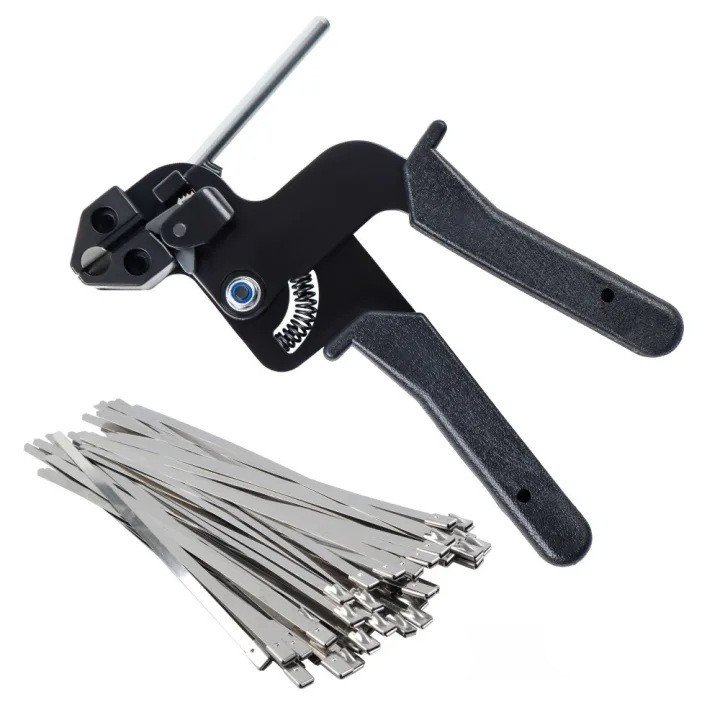
3.4 Stainless Steel
For extreme environments, stainless steel zip ties are the preferred choice.
Advantages: Ultra-high tensile strength, UV resistance, acid and alkali resistance, and low and high temperature resistance. Dynamic Temperature Range: -80°C to +500°C.
Common Applications: Energy, aviation, chemical, fire protection systems, and rail transportation. Hygroscopicity: 0% moisture absorption, suitable for use in both dry and humid environments.
3.5 Special Functional Materials
UV-Resistant Nylon 66: Heat-resistant and UV-resistant nylon 66 material is added to enhance weather and UV resistance, making it suitable for long-term outdoor use (UV-resistant zip ties).
Metal Detectable Nylon 66: Metal particles are added to nylon 66 (at a 10%-20% concentration), enabling detection by metal detectors or X-rays. These zip ties are commonly used in the food processing and pharmaceutical industries (metal detectable zip ties).
V0 Flame Retardant Nylon 66: Flame-retardant nylon 66 material is added to meet the UL94V-0 flame retardant standard, making it suitable for applications requiring extremely high fire protection levels.
4.Performance comparison table of different materials
Material
Dynamic Temperature Resistance
Tensile Strength
Corrosion resistance
Advantages
Application Scenarios
Nylon 6
-10°C ~ +80°C
Medium
Medium
Low cost
Indoor
Nylon 6.6
-20°C ~ +85°C
High
Medium
Good quality
Outdoor
Polypropylene (pp)
0°C ~ +80°C
Low
High
Corrosion resistant
Chemical Industry
Stainless Steel
-80°C ~ +500°C
Extremely high
Extremely high
Adapt to extreme environments
Shi、Aviation
UV resistant Nylon 66
-20°C ~ +100°C
High
Medium
UV resistant
Photovoltaics、Architecture
Metal detectable nylon 66
0°C ~ +80°C
High
Medium
Metal detectable
Food Industry
V0 flame-retardant nylon 66
-20°C ~ +85°C
High
Medium
V0 flame-retardant
Fire Protection System
5.How to Choose the Right Zip Tie Material
When choosing, consider the following factors:
Use Environment: Will they be exposed to sunlight, moisture, or chemicals for extended periods?
Usage Requirements: Are they disposable, long-term use, or reusable for short periods?
Industry Standards: Are they flame-retardant, UV-resistant, or metal-detectable?
Cost: Cable ties made of different materials or using different processes have different prices.
6.Environmental Protection and Sustainable Development Trends
With growing environmental awareness, water-soluble or biodegradable zip ties have emerged on the market. These new materials can dissolve in water or be degraded by microorganisms in soil, significantly reducing plastic pollution in the natural environment. However, cable ties made from these new materials are expensive.
7.Conclusion
There’s no single answer to the question of “what zip ties are made of.” Common materials include nylon, polypropylene, stainless steel, and a variety of specialized functional materials. Each material offers unique advantages, and careful selection maximizes the potential of cable ties in terms of strength, durability, and safety. Whether facing indoor, outdoor, high temperature, low temperature or chemical corrosion and other diverse environments, there is always a material of cable tie that can meet your application needs.
Are your cable ties up to the challenge of withstanding harsh weather conditions?While standard nylon cable ties are suitable for indoor use, they may not be the best choice for outdoor applications. Weatherproof cable ties are specifically designed to endure exposure to sunlight, moisture, and extreme temperatures. This blog post will explore the world of […]
Nylon tie wire breakage is a frequent problem in industries ranging from automotive to electronics. Although nylon ties are small, their failure can cause equipment malfunctions and safety risks. Understanding the causes of nylon tie breakage—from materials and manufacturing to storage and application—is key to preventing costly issues. Influence of the material itself Raw material […]
1. Introduction: Background and Importance With the continuous development of industrial production, electrical wiring, automotive manufacturing, and home DIY, the demand for cable fixing and management is growing. Traditional cable tie self locking, although low-cost, cannot be reused, and are discarded after use, leading to resource waste. In contrast, Releasable Zip Ties can be reused […]
We use cookies to enhance your browsing experience, serve personalised ads or content, and analyse our traffic. By clicking "Accept All", you consent to our use of cookies.
Looking For High Quality Nylon Cable Ties At A Great Price?
Order now to experience cost-effective cable tie products that provide convenience and protection for your work and life.


 EN
EN  AR
AR  ES
ES  PT
PT  FR
FR  RU
RU  DE
DE  KO
KO  JA
JA  IT
IT  NL
NL