In modern industrial production, electronic equipment assembly, home organization, and even aerospace fields, plastic self locking zip ties, as an efficient and convenient fastening tool, have long become indispensable basic consumables. With extremely simple operation, reliable fixing performance, and wide environmental adaptability, they have completely changed the complexity and inefficiency of traditional bundling methods. This article will provide an in-depth introduction to the development history and core structural principles of self locking cable tie, analyze in detail the characteristics and application scenarios of different product types, and answer common questions in procurement and use.
The birth of Self locking nylon cable zip ties originated from the urgent need to solve efficient cable fastening. In the mid-20th century, with the rapid development of the aviation industry, complex internal cable bundling in aircraft became a key factor restricting production efficiency. At that time, workers at Boeing aircraft manufacturing plants had to use waxed nylon ropes to manually tie cables stretching thousands of feet, which was not only time-consuming and labor-intensive, but also frequently caused finger injuries during operation.
This pain point prompted engineer Maurus C. Logan of Thomas & Betts, a subsidiary of the ABB Group, to devote himself to research and development. In 1958, the world’s first cable tie standard Ty-Rap invented by him was granted a patent, marking the official birth of self locking cable tie. Prior to this, in 1955, Kurt Robel had submitted a similar nylon wire ties patent in France, laying the foundation for subsequent technological development.
Over more than sixty years since its introduction, cable tie self locking has achieved leapfrog development. From a single product initially used only for aircraft cable fastening, it has gradually evolved into a series of products suitable for extreme temperatures, UV resistance, flame retardancy, and chemical corrosion resistance. In 2018 alone, the output of Ty-Rap cable ties produced by Thomas & Betts exceeded 28 billion pieces. If connected end to end, their total length would be sufficient to circle the sun seven times.
2. Core Structure and Working Principle
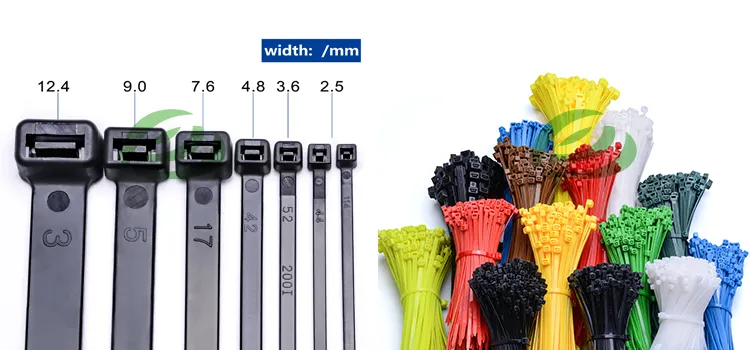
The outstanding performance of Self locking zip ties originates from their extremely simple yet ingenious structural design, which consists of two core parts: the ratchet head and the tie body.
1. Core Structural Components
Ratchet head: Usually square or rectangular in structure, with an internally embedded inclined ratchet pawl (a tooth-like component), which is the key core for achieving the self-locking function. A channel is reserved in the head for the tie body to pass through. The channel size matches the tie body, ensuring smooth insertion while maintaining locking accuracy.
Tie body: Made of a long strip of plastic material, with regularly arranged serrated teeth on one side. The tail end of the tie body gradually narrows, making it easy to pass through the locking channel of the head and improving operational convenience.
The entire locking process requires no auxiliary tools and is simple and efficient. When the tail of the tie body passes through the channel of the ratchet head, the serrations on the tie body come into contact with the inclined ratchet pawl inside the head. Due to the inclined design of the pawl, it only allows the tie body to move in the tightening direction. When the user pulls the tie body to secure cables or bundled items at an appropriate tightness, the pawl firmly engages in the gaps between the serrations, creating reverse resistance and completely preventing the tie body from slipping back. This “pull-and-lock” design ensures fast fastening while guaranteeing fixing reliability. Unless the tie body is manually cut, it cannot be easily loosened.
3. Main Categories and Application Scenarios
According to material characteristics and functional requirements, plastic self locking zip ties have developed into multiple subcategories suitable for different usage environments. The following is a detailed introduction to specialty zip ties.
1. Standard Nylon Cable Ties
Core material: Mainly made of Nylon 6 (PA6) or Nylon 66 (PA66). Nylon 66 offers superior tensile strength, temperature resistance, and aging resistance, making it suitable for a wider range of applications. Nylon 6 has relatively lower cost and can meet basic needs in conventional scenarios.
Application scenarios: Widely used in industrial, household, and office environments. Industrial applications include internal cable organization of electronic equipment (such as computers, servers, routers), bundling of hydraulic pipes and sensor lines in machinery. Household applications include organizing power cords and network cables behind TV cabinets and computer desks, sealing food packaging bags in kitchens, and fixing garden plants. Office applications include document archiving and cable management for projectors and printers. It is also widely used for fixing electrical and network conduits during renovation and reinforcement of goods packaging in logistics transportation.
Core material: Made of Nylon 66 with UV inhibitors added (Nylon 66UV), enhancing resistance to ultraviolet radiation through special formulations and delaying material aging.
Application scenarios: Designed for long-term outdoor exposure. Typical applications include cable fixing for photovoltaic panels in solar power stations, tested to withstand weathering equivalent to 24 years while maintaining stable performance under strong UV radiation. Other uses include cable bundling at outdoor communication base stations (5G base stations), exterior wall wiring fixation of buildings, fixing covering materials in agricultural greenhouses, outdoor gardening plant supports, and cable management in high-UV environments such as ship decks and offshore platforms.
Core material: Made of heat-stabilized Nylon 66, with special heat-resistant additives to improve heat deformation temperature and thermal stability.
Application scenarios: Suitable for high-temperature working environments, such as cable and pipe fixation inside automotive engine compartments, wiring fixation in charging piles and energy storage stations in the new energy sector, cable bundling in high-temperature workshops (such as metallurgy and glass manufacturing), and cable organization around electronic equipment heat dissipation modules. The normal temperature resistance range can reach -40°C to 120°C, with some special models capable of withstanding 150°C for short periods.
Core material: Made of toughened Nylon 66, enhancing material toughness in low-temperature environments through molecular structure modification to prevent brittleness.
Application scenarios: Suitable for cold regions or low-temperature working environments, including cable fixation for outdoor communication facilities and power transmission lines in northern areas, bundling goods and organizing cables in refrigerated trucks during cold chain logistics, temporary fixation of polar expedition equipment, and pipeline fixation in low-temperature laboratories and cold storage facilities. Stable performance can be maintained within a temperature range of -40°C to 85°C.
Core material: Made of flame-retardant Nylon 66 with high-efficiency flame retardants added. It has passed UL94 V-0 flame retardant certification and can self-extinguish within 30 seconds under contact with an 850°C flame without molten dripping.
Application scenarios: Suitable for environments with extremely high fire safety requirements, such as cable fixation inside data center server cabinets and precision electronic equipment, wiring harness bundling inside new energy vehicle battery packs to reduce fire risks, pipeline fixation in chemical workshops and gas stations, and electrical wiring and fire protection pipeline fixation in high-rise buildings, significantly improving overall fire safety levels.
Core material: Made of Nylon 66 with metal particles added, allowing the ties (including small fragments after cutting) to be detected by standard metal detectors.
Application scenarios: Mainly used in the food, beverage, and pharmaceutical industries. Applications include wiring fixation on food processing production lines and pipeline bundling in beverage filling equipment. If fragments fall off accidentally, they can be detected in time by metal detection equipment to prevent product contamination. It is also used in pharmaceutical packaging production lines and cleanroom pipeline fixation to help companies meet safety standards such as HACCP, and in cosmetic manufacturing industries with high purity requirements.
Core material: Made of polypropylene (PP), featuring light weight, chemical corrosion resistance, and controllable cost.
Application scenarios: Used in various industrial and daily scenarios. Industrial applications include cable fixation in electroplating workshops and chemical pipelines under highly corrosive environments, passing 72-hour salt spray tests without embrittlement. Electronic manufacturing applications include fixation of small precision cables (such as internal mobile phone wiring). Agricultural applications include crop stem bundling and greenhouse support fixation. Daily applications include light goods packaging, household item organization, and temporary wiring fixation. Its environmental characteristics also make it suitable for export products requiring compliance with RoHS and REACH regulations.
4. Differences Between Different Types of Self Locking Cable Ties
Zip tie type
Material
Dynamic temperature range
Tensile strength (standard models)
Cost
Outdoor service life
standard zip ties
Nylon 6 (PA6) / Nylon 66 (PA66)
PA6: -10℃ to 75℃; PA66: -20℃ to 85℃
PA6: Low; PA66: High
PA6: Medium-low; PA66: Medium
PA6: 6 months; PA66: 1 year
uv resistant tie wraps
Nylon 66 UV-stabilized material
-20℃ to 85℃
High
Medium-high
1–2 years
high temperature wire ties
Heat-stabilized Nylon 66
-20℃ to 150℃
High
High
1–2 years
cold weather cable ties
Toughened Nylon 66
-40℃ to 85℃
Low
High
1 year
V0 flame retardant cable ties
Flame-retardant Nylon 66
-20℃ to 85℃
High
High
1 year
metal detectable wire ties
Nylon 66 + metal powder
0℃ to 85℃
High
Very high
1 year
pp cable ties
Polypropylene (PP)
0℃ to 60℃
Low
Very high
6 months
5. Frequently Asked Questions (FAQ)
1. How should standard cable ties made of Nylon 6 and Nylon 66 be selected?
For light-duty bundling in normal environments (household cable management and document fixing), Nylon 6 is recommended due to lower cost. For industrial fastening, long-term use, or applications requiring higher tensile strength (Nylon 66 is over 30% stronger than Nylon 6), Nylon 66 is recommended for better aging and temperature resistance.
2. Can Self locking nylon cable ties be reused?
Standard cable tie is designed for single use, and forced removal may cause damage. For repeated adjustment or temporary fixation, releasable cable ties with release buttons are recommended, suitable for temporary wiring and gardening adjustments.
3. How can I determine whether a zip tie is suitable for long-term outdoor use?
For long-term outdoor use, UV resistance is critical. Choose products labeled as UV-resistant or weather-resistant and that have passed UV aging tests. Nylon 66 is preferred, as its aging resistance is superior to Nylon 6 and standard PP.
4. How should tensile strength be matched to usage requirements?
Select based on bundling weight: 8kg standard models for household cable management and light packaging; 22kg or higher heavy-duty models for industrial cables and heavy goods; and 45kg or higher high-tensile models for wind power equipment and similar applications. A safety margin is recommended.
6. Summary
Although self locking zip ties are basic consumables, continuous material innovation and structural optimization have enabled them to meet diversified demands ranging from daily household use to advanced industrial applications. Selection should be based on environmental temperature, corrosion resistance, fire protection requirements, and the weight and precision requirements of bundled items, ensuring accurate matching with appropriate specialty cable ties. Whether for efficient home organization or fastening solutions that meet strict industrial standards, choosing the right self-locking cable tie can significantly improve work efficiency and safety.
How to use nylon cable ties? When selecting a high-quality nylon cable tie manufacturer, it is important to first understand the intended use of the cable ties.Nylon cable ties are a versatile and widely used binding tool, mainly used to bundle and secure wires, cables and other items. Its use is simple and effective, and […]
What is PVC Tape? PVC tape is a high-performance adhesive solution manufactured from Polyvinyl Chloride, specifically designed for insulation, protection, and bundling in electrical and industrial environments. In the field of wiring accessories, it serves as a critical component for maintaining the safety and integrity of cable systems. Whether used as pvc electrical insulation tape […]
This guide provides an in-depth analysis of heat resistant cable ties: revealing the material properties, temperature limits, and core applications in industries like automotive, aerospace, and high-temperature environments. It will help you efficiently and safely manage cables in high-heat scenarios. Introduction Among various cable ties, heat resistant cable ties are highly regarded for their excellent […]
We use cookies to enhance your browsing experience, serve personalised ads or content, and analyse our traffic. By clicking "Accept All", you consent to our use of cookies.
Looking For High Quality Nylon Cable Ties At A Great Price?
Order now to experience cost-effective cable tie products that provide convenience and protection for your work and life.





 English
  Arabic
  Spanish