Branchenanwendungen
Wie man Kabelclips entfernt, ohne Wände zu beschädigen
Wie man Kabelclips entfernt, ohne Wände zu beschädigen
Mehr lesen
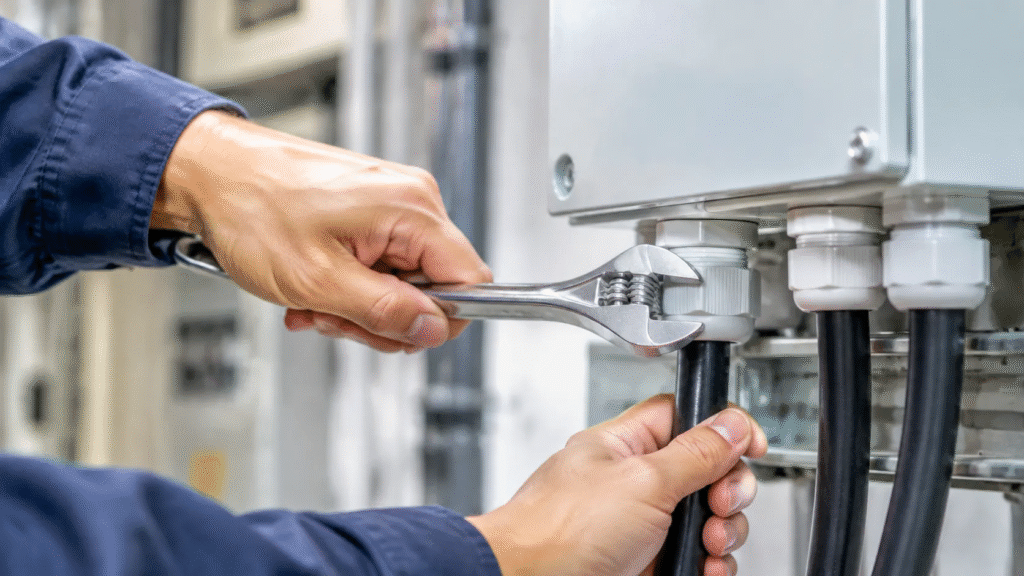
Getting the correct clamping force on an electrical entry point directly determines operational safety. Knowing how tight a cable gland should be prevents environmental ingress and avoids mechanical damage to the cable structure. Cable gland torque controls the transition between loose clearance and an engineered pressure boundary.
Tightening torque represents the rotational force applied to transform mechanical movement into radial and axial compression. On a modern cable gland, applying precise torque achieves two critical functions:
Applying the correct cable gland tightening torque ensures an installation maintains its specified ingress protection rating, such as an IP68 cable gland rating, without causing conductor creep or outer sheath rupture.
A secure termination relies on balancing forces across three distinct mechanical contact points:
There is no single universal torque chart for every installation. Required tightening torque varies based on key physical variables:
cURL Too many subrequests by single Worker invocation. To configure this limit, refer to https://developers.cloudflare.com/workers/wrangler/configuration/#limits
cURL Too many subrequests by single Worker invocation. To configure this limit, refer to https://developers.cloudflare.com/workers/wrangler/configuration/#limits
cURL Too many subrequests by single Worker invocation. To configure this limit, refer to https://developers.cloudflare.com/workers/wrangler/configuration/#limits cURL Too many subrequests by single Worker invocation. To configure this limit, refer to https://developers.cloudflare.com/workers/wrangler/configuration/#limits cURL Too many subrequests by single Worker invocation. To configure this limit, refer to https://developers.cloudflare.com/workers/wrangler/configuration/#limits
cURL Too many subrequests by single Worker invocation. To configure this limit, refer to https://developers.cloudflare.com/workers/wrangler/configuration/#limits
cURL Too many subrequests by single Worker invocation. To configure this limit, refer to https://developers.cloudflare.com/workers/wrangler/configuration/#limits
cURL Too many subrequests by single Worker invocation. To configure this limit, refer to https://developers.cloudflare.com/workers/wrangler/configuration/#limits
cURL Too many subrequests by single Worker invocation. To configure this limit, refer to https://developers.cloudflare.com/workers/wrangler/configuration/#limits
cURL Too many subrequests by single Worker invocation. To configure this limit, refer to https://developers.cloudflare.com/workers/wrangler/configuration/#limits
When you are out in the field without a calibrated torque wrench, determining how tight a cable gland should be comes down to mechanical feel and material behavior. You do not always have manufacturer tables on hand, but you still need an airtight, watertight seal that will not strip threads or crush inner conductors. Tightening a gland is about controlled elastomeric deformation, not brute force.
The classic rule of thumb in electrical assembly is “hand-tight plus a quarter to a half turn,” but field technicians often misunderstand what “hand-tight” actually implies:
You can verify your seal compression using three quick physical checks:
To avoid field guesswork entirely, collect the essential engineering data from your supplier before ordering in bulk:
When you check a technical data sheet for a cable gland, the numbers tell a specific story about mechanical limits. Understanding spanner size, thread engagement, and material dynamics prevents field damage and ensures your assembly delivers its full sealing potential.
Most specification tables list two distinct spanner dimensions because a proper installation requires counter-holding. You cannot secure a gland correctly with a single tool.
cURL Too many subrequests by single Worker invocation. To configure this limit, refer to https://developers.cloudflare.com/workers/wrangler/configuration/#limits cURL Too many subrequests by single Worker invocation. To configure this limit, refer to https://developers.cloudflare.com/workers/wrangler/configuration/#limits cURL Too many subrequests by single Worker invocation. To configure this limit, refer to https://developers.cloudflare.com/workers/wrangler/configuration/#limits
| cURL Too many subrequests by single Worker invocation. To configure this limit, refer to https://developers.cloudflare.com/workers/wrangler/configuration/#limits | Artikel-Nr. | Kabelbereich (mm) | cURL Too many subrequests by single Worker invocation. To configure this limit, refer to https://developers.cloudflare.com/workers/wrangler/configuration/#limits |
|---|---|---|---|
| cURL Too many subrequests by single Worker invocation. To configure this limit, refer to https://developers.cloudflare.com/workers/wrangler/configuration/#limits | cURL Too many subrequests by single Worker invocation. To configure this limit, refer to https://developers.cloudflare.com/workers/wrangler/configuration/#limits | 2-4 | 11/11 |
| cURL Too many subrequests by single Worker invocation. To configure this limit, refer to https://developers.cloudflare.com/workers/wrangler/configuration/#limits | cURL Too many subrequests by single Worker invocation. To configure this limit, refer to https://developers.cloudflare.com/workers/wrangler/configuration/#limits | 4-8 | 18/18 |
| cURL Too many subrequests by single Worker invocation. To configure this limit, refer to https://developers.cloudflare.com/workers/wrangler/configuration/#limits | cURL Too many subrequests by single Worker invocation. To configure this limit, refer to https://developers.cloudflare.com/workers/wrangler/configuration/#limits | 6-12 | 22/22 |
| cURL Too many subrequests by single Worker invocation. To configure this limit, refer to https://developers.cloudflare.com/workers/wrangler/configuration/#limits | cURL Too many subrequests by single Worker invocation. To configure this limit, refer to https://developers.cloudflare.com/workers/wrangler/configuration/#limits | 12-16 | 27/27 |
| cURL Too many subrequests by single Worker invocation. To configure this limit, refer to https://developers.cloudflare.com/workers/wrangler/configuration/#limits | cURL Too many subrequests by single Worker invocation. To configure this limit, refer to https://developers.cloudflare.com/workers/wrangler/configuration/#limits | 15-22 | 35/35 |
| cURL Too many subrequests by single Worker invocation. To configure this limit, refer to https://developers.cloudflare.com/workers/wrangler/configuration/#limits | cURL Too many subrequests by single Worker invocation. To configure this limit, refer to https://developers.cloudflare.com/workers/wrangler/configuration/#limits | 22-30 | 45/45 |
| cURL Too many subrequests by single Worker invocation. To configure this limit, refer to https://developers.cloudflare.com/workers/wrangler/configuration/#limits | cURL Too many subrequests by single Worker invocation. To configure this limit, refer to https://developers.cloudflare.com/workers/wrangler/configuration/#limits | 32-38 | 57/55 |
| cURL Too many subrequests by single Worker invocation. To configure this limit, refer to https://developers.cloudflare.com/workers/wrangler/configuration/#limits | cURL Too many subrequests by single Worker invocation. To configure this limit, refer to https://developers.cloudflare.com/workers/wrangler/configuration/#limits | 37-44 | 64/68 |
| cURL Too many subrequests by single Worker invocation. To configure this limit, refer to https://developers.cloudflare.com/workers/wrangler/configuration/#limits | cURL Too many subrequests by single Worker invocation. To configure this limit, refer to https://developers.cloudflare.com/workers/wrangler/configuration/#limits | 42-52 | 78/80 |
| cURL Too many subrequests by single Worker invocation. To configure this limit, refer to https://developers.cloudflare.com/workers/wrangler/configuration/#limits | cURL Too many subrequests by single Worker invocation. To configure this limit, refer to https://developers.cloudflare.com/workers/wrangler/configuration/#limits | 78-84 | 110/110 |
cURL Too many subrequests by single Worker invocation. To configure this limit, refer to https://developers.cloudflare.com/workers/wrangler/configuration/#limits
cURL Too many subrequests by single Worker invocation. To configure this limit, refer to https://developers.cloudflare.com/workers/wrangler/configuration/#limits
cURL Too many subrequests by single Worker invocation. To configure this limit, refer to https://developers.cloudflare.com/workers/wrangler/configuration/#limits
cURL Too many subrequests by single Worker invocation. To configure this limit, refer to https://developers.cloudflare.com/workers/wrangler/configuration/#limits
cURL Too many subrequests by single Worker invocation. To configure this limit, refer to https://developers.cloudflare.com/workers/wrangler/configuration/#limits
| cURL Too many subrequests by single Worker invocation. To configure this limit, refer to https://developers.cloudflare.com/workers/wrangler/configuration/#limits | cURL Too many subrequests by single Worker invocation. To configure this limit, refer to https://developers.cloudflare.com/workers/wrangler/configuration/#limits | Gewindelänge (mm) | cURL Too many subrequests by single Worker invocation. To configure this limit, refer to https://developers.cloudflare.com/workers/wrangler/configuration/#limits |
|---|---|---|---|
| cURL Too many subrequests by single Worker invocation. To configure this limit, refer to https://developers.cloudflare.com/workers/wrangler/configuration/#limits | 1.25 | 5 | 4.0 |
| cURL Too many subrequests by single Worker invocation. To configure this limit, refer to https://developers.cloudflare.com/workers/wrangler/configuration/#limits | 1.5 | 6.5 | 4.3 |
| cURL Too many subrequests by single Worker invocation. To configure this limit, refer to https://developers.cloudflare.com/workers/wrangler/configuration/#limits | 1.5 | 8 | 5.3 |
| cURL Too many subrequests by single Worker invocation. To configure this limit, refer to https://developers.cloudflare.com/workers/wrangler/configuration/#limits | 1.5 | 8 | 5.3 |
| cURL Too many subrequests by single Worker invocation. To configure this limit, refer to https://developers.cloudflare.com/workers/wrangler/configuration/#limits | 1.5 | 9 | 6.0 |
| cURL Too many subrequests by single Worker invocation. To configure this limit, refer to https://developers.cloudflare.com/workers/wrangler/configuration/#limits | 1.5 | 10 | 6.7 |
| cURL Too many subrequests by single Worker invocation. To configure this limit, refer to https://developers.cloudflare.com/workers/wrangler/configuration/#limits | 1.5 | 11 | 7.3 |
| cURL Too many subrequests by single Worker invocation. To configure this limit, refer to https://developers.cloudflare.com/workers/wrangler/configuration/#limits | 1.5 | 12 | 8.0 |
| cURL Too many subrequests by single Worker invocation. To configure this limit, refer to https://developers.cloudflare.com/workers/wrangler/configuration/#limits | 1.5 | 13 | 8.7 |
| cURL Too many subrequests by single Worker invocation. To configure this limit, refer to https://developers.cloudflare.com/workers/wrangler/configuration/#limits | 2 | 15 | 7.5 |
| cURL Too many subrequests by single Worker invocation. To configure this limit, refer to https://developers.cloudflare.com/workers/wrangler/configuration/#limits | 2 | 15 | 7.5 |
cURL Too many subrequests by single Worker invocation. To configure this limit, refer to https://developers.cloudflare.com/workers/wrangler/configuration/#limits
cURL Too many subrequests by single Worker invocation. To configure this limit, refer to https://developers.cloudflare.com/workers/wrangler/configuration/#limits Schraubverschraubungsgrößenguide cURL Too many subrequests by single Worker invocation. To configure this limit, refer to https://developers.cloudflare.com/workers/wrangler/configuration/#limits
cURL Too many subrequests by single Worker invocation. To configure this limit, refer to https://developers.cloudflare.com/workers/wrangler/configuration/#limits
In the MBCG series the clamp ring sits behind the PA66 claw, so radial force builds progressively over each turn rather than landing on the seal at a single point. That sequencing is what keeps the elastomer inside its elastic band while the claw is still travelling.
Cable glands are never a fit-and-forget component. Even when you establish how tight a cable gland should be during initial commissioning, real-world factors like mechanical vibration, thermal shifts, and material creep constantly work against that joint. Routine inspection ensures the gland maintains its mechanical grip and ingress barrier throughout its operating life.
Mark the cap flat and the body flat with a paint line before the enclosure is closed, so any relative movement becomes visible at a glance. We recommend an initial check within 24 to 48 hours after installation to catch early relaxation, followed by scheduled audits every 6 to 12 months:
Re-tightening is only a solution when hardware has backed off mechanically while the elastomer inside is still pliable. If a dome nut has loosened due to light vibration, using a cable gland torque wrench to bring it back to the original cable gland tightening torque restores the seal compression safely.
However, re-tightening will make leaks worse if the cable gland seal has already experienced severe compression set. When an aged, heat-hardened elastomer loses its elasticity, over tightening the cap nut simply crushes the cable jacket and shears the brittle rubber. This creates micro-channels for moisture rather than sealing them. If you notice persistent leakage or jacket necking, follow our step-by-step cable gland installation guide to dismantle, inspect, and reset the assembly rather than continuously forcing more torque onto damaged components.
When any component passes its service threshold, full replacement is the only way to preserve the IP68 rating. Replace the assembly immediately if you encounter any of these triggers:
Run the dome nut down by hand until the internal seal makes firm, even contact with the jacket, then add a quarter to a half turn with a spanner on the flats. Treat this as a field fallback rather than a specification: it assumes a sound thread and a pliable insert, and it gives no protection against an enclosure wall that flexes under load.
In most cases the gland itself has not failed. The breach comes from one of four places: an insert compressed past its elastic limit so it cannot recover, insufficient engagement leaving a capillary path along the jacket, differential expansion between brass, PA66 and NBR over thermal cycles, or a sealing washer crushed against a knockout that was punched oversize.
The elastomer reaches compression set first and stops pushing back against the jacket, which removes the radial pressure that was holding the seal closed. The PA66 claw then buckles past its design angle and may bite through the sheath. The brass body usually survives, but the seating shoulder can warp enough to stop the claw contracting concentrically, and the gland is scrap from that point on.
No. Spanner size is a length in millimetres, not a rotation force. A larger flat allows a longer wrench and therefore a longer lever arm, so the same hand force produces more torque — which is precisely why field feel becomes less reliable as gland size increases. The actual torque figure has to come from the supplier, and it cannot be transferred between manufacturers.
Über Wandu — Zhejiang Wandu Plastic Co., Ltd. has produced nylon cable ties in Yueqing, Zhejiang, China since 2011. Our ISO 9001 certified factory runs 10 high-speed injection moulding machines and 8 professional cable tie test benches, covering nylon cable ties, stainless steel cable ties, cable clips, cable glands and spiral wrap. Products are CE and RoHS compliant and ship to buyers in 50+ countries. Every technical question below is answered by our own engineering team.
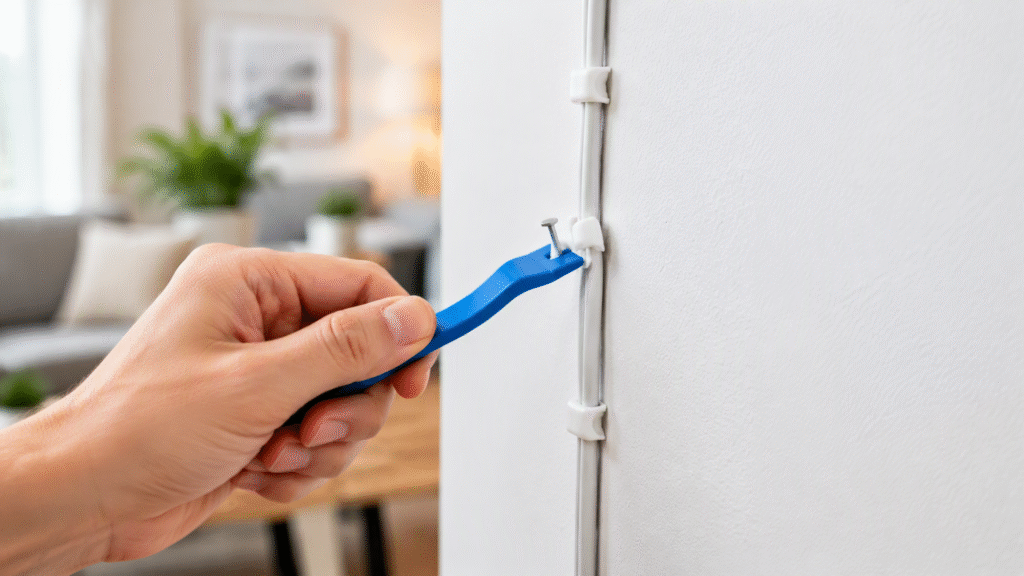
Wie man Kabelclips entfernt, ohne Wände zu beschädigen
Mehr lesen
Feuchtigkeit beeinflusst Nylon-Kabelbinder erheblich. Dieser Artikel untersucht die Natur von Nylon 6.6, seine hygroskopischen Eigenschaften und wie Feuchtigkeit die Leistung von Nylon-Kabelbindern beeinflusst. Die Natur von Nylon 6.6 Nylon 6.6 ist ein Hochleistungs-Synthetikpolymer, das aus der Polymerisation von Hexamethylendiamin und Adipinsäure hergestellt wird. Es besitzt ausgezeichnete mechanische Festigkeit, Hitzebeständigkeit und Dimensionsstabilität […]
Mehr lesen
Warum Sie eine Alternative zum Heißluftgebläse benötigen könnten Während ein elektrisches Heißluftgebläse branchenüblich ist, um Schrumpfschläuche zu aktivieren, ist es nicht immer das praktischste oder zugänglichste Werkzeug für jede Situation. Einfallsreichtum ist in der elektrischen Wartung entscheidend, und das Verständnis, wie man mit alternativen Wärmequellen eine professionelle Abdichtung erreicht […]
Mehr lesen
 DE
 EN
 AR
 ES
 PT
 FR
 RU
 KO
 JA
 IT
 NL
 TR