What Cable Gland Tightening Torque Really Controls
Getting the correct clamping force on an electrical entry point directly determines operational safety. Knowing how tight a cable gland should be prevents environmental ingress and avoids mechanical damage to the cable structure. Cable gland torque controls the transition between loose clearance and an engineered pressure boundary.
What Tightening Torque Means on a Cable Gland
Tightening torque represents the rotational force applied to transform mechanical movement into radial and axial compression. On a modern cable gland, applying precise torque achieves two critical functions:
Radial Seal Compression: Driving the elastomeric insert inward to close all air pathways around the cable jacket.
تخفيف الإجهاد الميكانيكي: Engaging internal claws or grip rings to secure the cable against pull-out forces without crushing internal conductors.
Applying the correct cable gland tightening torque ensures an installation maintains its specified ingress protection rating, such as an IP68 cable gland rating, without causing conductor creep or outer sheath rupture.
The Three Interfaces: Cap, Body and Locknut
A secure termination relies on balancing forces across three distinct mechanical contact points:
The Dome Nut (Cap): Compresses the internal cable gland seal onto the cable sheath. Applying torque here controls radial sealing and mechanical retention.
The Gland Body: Seats the entire assembly against the enclosure wall or threaded hub, transferring external mechanical stresses safely away from the conductors.
The Cable Gland Locknut: Clamps the gland body securely across the enclosure wall, compressing the cable gland sealing washer to block moisture from bypassing the chassis hole.
Why No Universal Torque Table Exists for Cable Glands
There is no single universal torque chart for every installation. Required tightening torque varies based on key physical variables:
Gland Construction: A جلاند كابل نحاسي withstands significantly higher torque loads than polyamide or standard plastic variants before thread distortion occurs.
cURL Too many subrequests by single Worker invocation. To configure this limit, refer to https://developers.cloudflare.com/workers/wrangler/configuration/#limits cURL Too many subrequests by single Worker invocation. To configure this limit, refer to https://developers.cloudflare.com/workers/wrangler/configuration/#limits
cURL Too many subrequests by single Worker invocation. To configure this limit, refer to https://developers.cloudflare.com/workers/wrangler/configuration/#limits cURL Too many subrequests by single Worker invocation. To configure this limit, refer to https://developers.cloudflare.com/workers/wrangler/configuration/#limits
cURL Too many subrequests by single Worker invocation. To configure this limit, refer to https://developers.cloudflare.com/workers/wrangler/configuration/#limits cURL Too many subrequests by single Worker invocation. To configure this limit, refer to https://developers.cloudflare.com/workers/wrangler/configuration/#limits
cURL Too many subrequests by single Worker invocation. To configure this limit, refer to https://developers.cloudflare.com/workers/wrangler/configuration/#limits
cURL Too many subrequests by single Worker invocation. To configure this limit, refer to https://developers.cloudflare.com/workers/wrangler/configuration/#limits
cURL Too many subrequests by single Worker invocation. To configure this limit, refer to https://developers.cloudflare.com/workers/wrangler/configuration/#limits
cURL Too many subrequests by single Worker invocation. To configure this limit, refer to https://developers.cloudflare.com/workers/wrangler/configuration/#limits
cURL Too many subrequests by single Worker invocation. To configure this limit, refer to https://developers.cloudflare.com/workers/wrangler/configuration/#limits
cURL Too many subrequests by single Worker invocation. To configure this limit, refer to https://developers.cloudflare.com/workers/wrangler/configuration/#limits cURL Too many subrequests by single Worker invocation. To configure this limit, refer to https://developers.cloudflare.com/workers/wrangler/configuration/#limits
cURL Too many subrequests by single Worker invocation. To configure this limit, refer to https://developers.cloudflare.com/workers/wrangler/configuration/#limits cURL Too many subrequests by single Worker invocation. To configure this limit, refer to https://developers.cloudflare.com/workers/wrangler/configuration/#limits
cURL Too many subrequests by single Worker invocation. To configure this limit, refer to https://developers.cloudflare.com/workers/wrangler/configuration/#limits cURL Too many subrequests by single Worker invocation. To configure this limit, refer to https://developers.cloudflare.com/workers/wrangler/configuration/#limits
cURL Too many subrequests by single Worker invocation. To configure this limit, refer to https://developers.cloudflare.com/workers/wrangler/configuration/#limits
cURL Too many subrequests by single Worker invocation. To configure this limit, refer to https://developers.cloudflare.com/workers/wrangler/configuration/#limits
cURL Too many subrequests by single Worker invocation. To configure this limit, refer to https://developers.cloudflare.com/workers/wrangler/configuration/#limits
cURL Too many subrequests by single Worker invocation. To configure this limit, refer to https://developers.cloudflare.com/workers/wrangler/configuration/#limits cURL Too many subrequests by single Worker invocation. To configure this limit, refer to https://developers.cloudflare.com/workers/wrangler/configuration/#limits
cURL Too many subrequests by single Worker invocation. To configure this limit, refer to https://developers.cloudflare.com/workers/wrangler/configuration/#limits cURL Too many subrequests by single Worker invocation. To configure this limit, refer to https://developers.cloudflare.com/workers/wrangler/configuration/#limits
cURL Too many subrequests by single Worker invocation. To configure this limit, refer to https://developers.cloudflare.com/workers/wrangler/configuration/#limits cURL Too many subrequests by single Worker invocation. To configure this limit, refer to https://developers.cloudflare.com/workers/wrangler/configuration/#limits
cURL Too many subrequests by single Worker invocation. To configure this limit, refer to https://developers.cloudflare.com/workers/wrangler/configuration/#limits
cURL Too many subrequests by single Worker invocation. To configure this limit, refer to https://developers.cloudflare.com/workers/wrangler/configuration/#limits
cURL Too many subrequests by single Worker invocation. To configure this limit, refer to https://developers.cloudflare.com/workers/wrangler/configuration/#limits cURL Too many subrequests by single Worker invocation. To configure this limit, refer to https://developers.cloudflare.com/workers/wrangler/configuration/#limits
cURL Too many subrequests by single Worker invocation. To configure this limit, refer to https://developers.cloudflare.com/workers/wrangler/configuration/#limits cURL Too many subrequests by single Worker invocation. To configure this limit, refer to https://developers.cloudflare.com/workers/wrangler/configuration/#limits
cURL Too many subrequests by single Worker invocation. To configure this limit, refer to https://developers.cloudflare.com/workers/wrangler/configuration/#limits cURL Too many subrequests by single Worker invocation. To configure this limit, refer to https://developers.cloudflare.com/workers/wrangler/configuration/#limits
cURL Too many subrequests by single Worker invocation. To configure this limit, refer to https://developers.cloudflare.com/workers/wrangler/configuration/#limits
cURL Too many subrequests by single Worker invocation. To configure this limit, refer to https://developers.cloudflare.com/workers/wrangler/configuration/#limits
cURL Too many subrequests by single Worker invocation. To configure this limit, refer to https://developers.cloudflare.com/workers/wrangler/configuration/#limits cURL Too many subrequests by single Worker invocation. To configure this limit, refer to https://developers.cloudflare.com/workers/wrangler/configuration/#limits
cURL Too many subrequests by single Worker invocation. To configure this limit, refer to https://developers.cloudflare.com/workers/wrangler/configuration/#limits cURL Too many subrequests by single Worker invocation. To configure this limit, refer to https://developers.cloudflare.com/workers/wrangler/configuration/#limits
cURL Too many subrequests by single Worker invocation. To configure this limit, refer to https://developers.cloudflare.com/workers/wrangler/configuration/#limits cURL Too many subrequests by single Worker invocation. To configure this limit, refer to https://developers.cloudflare.com/workers/wrangler/configuration/#limits
How to Judge a Seal Without a Torque Value
When you are out in the field without a calibrated torque wrench, determining how tight a cable gland should be comes down to mechanical feel and material behavior. You do not always have manufacturer tables on hand, but you still need an airtight, watertight seal that will not strip threads or crush inner conductors. Tightening a gland is about controlled elastomeric deformation, not brute force.
Hand-Tight Plus a Quarter Turn: What That Actually Means
The classic rule of thumb in electrical assembly is “hand-tight plus a quarter to a half turn,” but field technicians often misunderstand what “hand-tight” actually implies:
Finding Zero Point: Thread the dome nut by hand until you feel the internal rubber seal make firm, uniform contact with the outer cable sheath. This is your true zero point, not when the threads simply begin to drag.
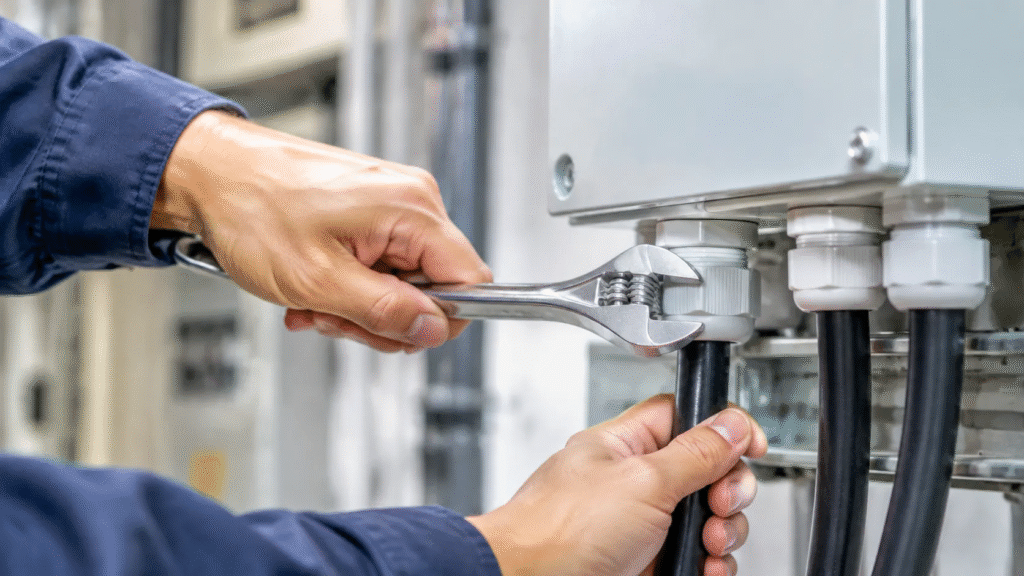
The Mechanical Turn: Engage a proper spanner or cable gland tightening tool on the flats. Rotate the dome nut an additional 90 to 180 degrees (a quarter to half turn).
Claw Engagement: On quality polyamide and brass fittings, this final turn forces the internal clamping fingers inward, generating the radial pressure required for an IP68 cable gland rating without over-stressing the entry threads.
Visual, Tactile and Pull-Test Criteria
You can verify your seal compression using three quick physical checks:
The Visual Check: Inspect the rubber seal where it meets the cable sheath. The elastomer should bulge slightly inward and form an even, smooth ring around the cable jacket. If the seal mushrooms outward irregularly or if the cable jacket wrinkles, you are dealing with severe over-tightening.
The Tactile Check: Run your thumb along the joint where the cable exits the cap nut. The jacket should remain round and firm. If you feel a distinct hourglass waist or a deep necked groove in the jacket, back the nut off immediately.
The Pull Test: Grip the cable firmly about 300 mm (12 inches) away from the enclosure and apply a firm axial pull along with a gentle twist. The cable must not slip, rotate, or pull through the gland body even slightly under routine hand force.
What to Ask a Supplier Before You Order
To avoid field guesswork entirely, collect the essential engineering data from your supplier before ordering in bulk:
Clamping Outer Diameter (OD) Range: Confirm the exact minimum and maximum cable OD tolerance for the specific insert, ensuring your cable does not sit at the absolute extreme edge of the range.
Target Tightening Torque: Request the exact torque specification (in Nm) for both the dome nut and the gland body into the enclosure wall.
Seal Material Compatibility: Ask whether the internal insert is NBR, silicone, or EPDM to ensure it can withstand the chemicals, sunlight, and working temperatures of your operating environment.
Reading the Spec Table: Spanner Size, Thread Engagement and Material
When you check a technical data sheet for a cable gland, the numbers tell a specific story about mechanical limits. Understanding spanner size, thread engagement, and material dynamics prevents field damage and ensures your assembly delivers its full sealing potential.
Two Wrenches, Two Flats: Why Spanner Size Comes in Pairs
Most specification tables list two distinct spanner dimensions because a proper installation requires counter-holding. You cannot secure a gland correctly with a single tool.
Body Spanner Flat: Holds the gland body rigid against the enclosure wall or secures it while torquing the cable gland locknut.
Dome Nut Flat: cURL Too many subrequests by single Worker invocation. To configure this limit, refer to https://developers.cloudflare.com/workers/wrangler/configuration/#limits
cURL Too many subrequests by single Worker invocation. To configure this limit, refer to https://developers.cloudflare.com/workers/wrangler/configuration/#limits
رقم العنصر
نطاق الكابل (مم)
cURL Too many subrequests by single Worker invocation. To configure this limit, refer to https://developers.cloudflare.com/workers/wrangler/configuration/#limits
cURL Too many subrequests by single Worker invocation. To configure this limit, refer to https://developers.cloudflare.com/workers/wrangler/configuration/#limits
cURL Too many subrequests by single Worker invocation. To configure this limit, refer to https://developers.cloudflare.com/workers/wrangler/configuration/#limits
2-4
11/11
cURL Too many subrequests by single Worker invocation. To configure this limit, refer to https://developers.cloudflare.com/workers/wrangler/configuration/#limits
cURL Too many subrequests by single Worker invocation. To configure this limit, refer to https://developers.cloudflare.com/workers/wrangler/configuration/#limits
4-8
18/18
cURL Too many subrequests by single Worker invocation. To configure this limit, refer to https://developers.cloudflare.com/workers/wrangler/configuration/#limits
cURL Too many subrequests by single Worker invocation. To configure this limit, refer to https://developers.cloudflare.com/workers/wrangler/configuration/#limits
6-12
22/22
cURL Too many subrequests by single Worker invocation. To configure this limit, refer to https://developers.cloudflare.com/workers/wrangler/configuration/#limits
cURL Too many subrequests by single Worker invocation. To configure this limit, refer to https://developers.cloudflare.com/workers/wrangler/configuration/#limits
12-16
27/27
cURL Too many subrequests by single Worker invocation. To configure this limit, refer to https://developers.cloudflare.com/workers/wrangler/configuration/#limits
cURL Too many subrequests by single Worker invocation. To configure this limit, refer to https://developers.cloudflare.com/workers/wrangler/configuration/#limits
15-22
35/35
cURL Too many subrequests by single Worker invocation. To configure this limit, refer to https://developers.cloudflare.com/workers/wrangler/configuration/#limits
cURL Too many subrequests by single Worker invocation. To configure this limit, refer to https://developers.cloudflare.com/workers/wrangler/configuration/#limits
22-30
45/45
cURL Too many subrequests by single Worker invocation. To configure this limit, refer to https://developers.cloudflare.com/workers/wrangler/configuration/#limits
cURL Too many subrequests by single Worker invocation. To configure this limit, refer to https://developers.cloudflare.com/workers/wrangler/configuration/#limits
32-38
57/55
cURL Too many subrequests by single Worker invocation. To configure this limit, refer to https://developers.cloudflare.com/workers/wrangler/configuration/#limits
cURL Too many subrequests by single Worker invocation. To configure this limit, refer to https://developers.cloudflare.com/workers/wrangler/configuration/#limits
37-44
64/68
cURL Too many subrequests by single Worker invocation. To configure this limit, refer to https://developers.cloudflare.com/workers/wrangler/configuration/#limits
cURL Too many subrequests by single Worker invocation. To configure this limit, refer to https://developers.cloudflare.com/workers/wrangler/configuration/#limits
42-52
78/80
cURL Too many subrequests by single Worker invocation. To configure this limit, refer to https://developers.cloudflare.com/workers/wrangler/configuration/#limits
cURL Too many subrequests by single Worker invocation. To configure this limit, refer to https://developers.cloudflare.com/workers/wrangler/configuration/#limits
78-84
110/110
cURL Too many subrequests by single Worker invocation. To configure this limit, refer to https://developers.cloudflare.com/workers/wrangler/configuration/#limits
cURL Too many subrequests by single Worker invocation. To configure this limit, refer to https://developers.cloudflare.com/workers/wrangler/configuration/#limits
cURL Too many subrequests by single Worker invocation. To configure this limit, refer to https://developers.cloudflare.com/workers/wrangler/configuration/#limits
cURL Too many subrequests by single Worker invocation. To configure this limit, refer to https://developers.cloudflare.com/workers/wrangler/configuration/#limits
cURL Too many subrequests by single Worker invocation. To configure this limit, refer to https://developers.cloudflare.com/workers/wrangler/configuration/#limits
cURL Too many subrequests by single Worker invocation. To configure this limit, refer to https://developers.cloudflare.com/workers/wrangler/configuration/#limits
cURL Too many subrequests by single Worker invocation. To configure this limit, refer to https://developers.cloudflare.com/workers/wrangler/configuration/#limits
cURL Too many subrequests by single Worker invocation. To configure this limit, refer to https://developers.cloudflare.com/workers/wrangler/configuration/#limits
طول الخيط (مم)
cURL Too many subrequests by single Worker invocation. To configure this limit, refer to https://developers.cloudflare.com/workers/wrangler/configuration/#limits
cURL Too many subrequests by single Worker invocation. To configure this limit, refer to https://developers.cloudflare.com/workers/wrangler/configuration/#limits
1.25
5
4.0
cURL Too many subrequests by single Worker invocation. To configure this limit, refer to https://developers.cloudflare.com/workers/wrangler/configuration/#limits
1.5
6.5
4.3
cURL Too many subrequests by single Worker invocation. To configure this limit, refer to https://developers.cloudflare.com/workers/wrangler/configuration/#limits
1.5
8
5.3
cURL Too many subrequests by single Worker invocation. To configure this limit, refer to https://developers.cloudflare.com/workers/wrangler/configuration/#limits
1.5
8
5.3
cURL Too many subrequests by single Worker invocation. To configure this limit, refer to https://developers.cloudflare.com/workers/wrangler/configuration/#limits
1.5
9
6.0
cURL Too many subrequests by single Worker invocation. To configure this limit, refer to https://developers.cloudflare.com/workers/wrangler/configuration/#limits
1.5
10
6.7
cURL Too many subrequests by single Worker invocation. To configure this limit, refer to https://developers.cloudflare.com/workers/wrangler/configuration/#limits
1.5
11
7.3
cURL Too many subrequests by single Worker invocation. To configure this limit, refer to https://developers.cloudflare.com/workers/wrangler/configuration/#limits
1.5
12
8.0
cURL Too many subrequests by single Worker invocation. To configure this limit, refer to https://developers.cloudflare.com/workers/wrangler/configuration/#limits
1.5
13
8.7
cURL Too many subrequests by single Worker invocation. To configure this limit, refer to https://developers.cloudflare.com/workers/wrangler/configuration/#limits
2
15
7.5
cURL Too many subrequests by single Worker invocation. To configure this limit, refer to https://developers.cloudflare.com/workers/wrangler/configuration/#limits
2
15
7.5
cURL Too many subrequests by single Worker invocation. To configure this limit, refer to https://developers.cloudflare.com/workers/wrangler/configuration/#limits
cURL Too many subrequests by single Worker invocation. To configure this limit, refer to https://developers.cloudflare.com/workers/wrangler/configuration/#limits دليل حجم غدة الكابل cURL Too many subrequests by single Worker invocation. To configure this limit, refer to https://developers.cloudflare.com/workers/wrangler/configuration/#limits
cURL Too many subrequests by single Worker invocation. To configure this limit, refer to https://developers.cloudflare.com/workers/wrangler/configuration/#limits
cURL Too many subrequests by single Worker invocation. To configure this limit, refer to https://developers.cloudflare.com/workers/wrangler/configuration/#limits
cURL Too many subrequests by single Worker invocation. To configure this limit, refer to https://developers.cloudflare.com/workers/wrangler/configuration/#limits cURL Too many subrequests by single Worker invocation. To configure this limit, refer to https://developers.cloudflare.com/workers/wrangler/configuration/#limits
cURL Too many subrequests by single Worker invocation. To configure this limit, refer to https://developers.cloudflare.com/workers/wrangler/configuration/#limits cURL Too many subrequests by single Worker invocation. To configure this limit, refer to https://developers.cloudflare.com/workers/wrangler/configuration/#limits
cURL Too many subrequests by single Worker invocation. To configure this limit, refer to https://developers.cloudflare.com/workers/wrangler/configuration/#limits cURL Too many subrequests by single Worker invocation. To configure this limit, refer to https://developers.cloudflare.com/workers/wrangler/configuration/#limits
In the MBCG series the clamp ring sits behind the PA66 claw, so radial force builds progressively over each turn rather than landing on the seal at a single point. That sequencing is what keeps the elastomer inside its elastic band while the claw is still travelling.
Inspection and Re-Tightening Over Service Life
Cable glands are never a fit-and-forget component. Even when you establish how tight a cable gland should be during initial commissioning, real-world factors like mechanical vibration, thermal shifts, and material creep constantly work against that joint. Routine inspection ensures the gland maintains its mechanical grip and ingress barrier throughout its operating life.
What to Check and How Often
Mark the cap flat and the body flat with a paint line before the enclosure is closed, so any relative movement becomes visible at a glance. We recommend an initial check within 24 to 48 hours after installation to catch early relaxation, followed by scheduled audits every 6 to 12 months:
Cap Nut Position: Verify that the cable gland dome nut has not backed off due to equipment vibration. Check the alignment of the cable gland spanner flat against your initial torque marks.
Cable Grip: Perform a gentle manual push-pull check to ensure the cable jacket has not slipped or loosened inside the gland body.
Panel Interface: Inspect the cable gland sealing washer and cable gland locknut at the enclosure wall to confirm the gland body remains firmly seated with zero wobble.
Material Condition: Look for surface cracks on rubber components, UV degradation, oil softening, or corrosion on a brass cable gland installation.
When Re-Tightening Helps and When It Makes Leaks Worse
Re-tightening is only a solution when hardware has backed off mechanically while the elastomer inside is still pliable. If a dome nut has loosened due to light vibration, using a cable gland torque wrench to bring it back to the original cable gland tightening torque restores the seal compression safely.
However, re-tightening will make leaks worse if the cable gland seal has already experienced severe compression set. When an aged, heat-hardened elastomer loses its elasticity, over tightening the cap nut simply crushes the cable jacket and shears the brittle rubber. This creates micro-channels for moisture rather than sealing them. If you notice persistent leakage or jacket necking, follow our step-by-step cable gland installation guide to dismantle, inspect, and reset the assembly rather than continuously forcing more torque onto damaged components.
Replacement Triggers: Seal, Washer and Shroud
When any component passes its service threshold, full replacement is the only way to preserve the IP68 rating. Replace the assembly immediately if you encounter any of these triggers:
The Cable Gland Seal: Shows permanent indentation, splits, tearing along the clamping claws, or extrusion out of the gland neck.
The Sealing Washer: Exhibits permanent thinning, extrusion past the entry thread shoulder, or cracking around the knockout hole.
The Protective Shroud: Becomes brittle, discolored from sunlight exposure, torn, or begins trapping moisture against the entry threads.
The Thread Interface: Displays galling, stripped entry threads, or warped claws that fail to contract evenly around the cable.
الأسئلة الشائعة
How tight should a cable gland be without a torque wrench?
Run the dome nut down by hand until the internal seal makes firm, even contact with the jacket, then add a quarter to a half turn with a spanner on the flats. Treat this as a field fallback rather than a specification: it assumes a sound thread and a pliable insert, and it gives no protection against an enclosure wall that flexes under load.
Why do IP68 cable glands leak after installation?
In most cases the gland itself has not failed. The breach comes from one of four places: an insert compressed past its elastic limit so it cannot recover, insufficient engagement leaving a capillary path along the jacket, differential expansion between brass, PA66 and NBR over thermal cycles, or a sealing washer crushed against a knockout that was punched oversize.
What happens if you over-tighten a cable gland?
The elastomer reaches compression set first and stops pushing back against the jacket, which removes the radial pressure that was holding the seal closed. The PA66 claw then buckles past its design angle and may bite through the sheath. The brass body usually survives, but the seating shoulder can warp enough to stop the claw contracting concentrically, and the gland is scrap from that point on.
Does a bigger spanner size mean a higher torque?
No. Spanner size is a length in millimetres, not a rotation force. A larger flat allows a longer wrench and therefore a longer lever arm, so the same hand force produces more torque — which is precisely why field feel becomes less reliable as gland size increases. The actual torque figure has to come from the supplier, and it cannot be transferred between manufacturers.
عن واندو — Zhejiang Wandu Plastic Co., Ltd. has produced nylon cable ties in Yueqing, Zhejiang, China since 2011. Our ISO 9001 certified factory runs 10 high-speed injection moulding machines and 8 professional cable tie test benches, covering nylon cable ties, stainless steel cable ties, cable clips, cable glands and spiral wrap. Products are CE and RoHS compliant and ship to buyers in 50+ countries. Every technical question below is answered by our own engineering team.
ما هو رابط الكابل؟ فهم التشريح سواء أطلقتم عليه روابط الربط، روابط الأسلاك، أو مثبتات الأنابيب، فإن روابط الكابل هي الأبطال المجهولون في التنظيم الحديث. تُستخدم عالميًا عبر القطاعات الصناعية والسكنية، توفر هذه المثبتات البسيطة تثبيتًا آمنًا بشكل لا يصدق مع جهد قليل. كشركة رائدة في تصنيع وتوريد ملحقات الأسلاك، واندو […]
هل تساءلت يومًا إذا كان هذا المشبك البلاستيكي تحت غطاء سيارتك أو داخل لوحة كهربائية على وشك أن يذوب؟ إذا كنت تسأل، "هل يمكن للأربطة البلاستيكية أن تتحمل الحرارة؟" — الجواب المختصر هو نعم، لكن استخدام النوع الخطأ يمكن أن يؤدي بسرعة إلى تكسر هش، أو ذوبان البلاستيك، أو فشل معدات مكلف. الحقيقة هي، بينما الأربطة النايلون القياسية […]
هل الشريط الكهربائي مقاوم للماء أو مقاوم للماء بشكل كامل؟ يُعد الشريط الكهربائي الفينيل القياسي أحد أكثر الأدوات استخدامًا في التركيبات الكهربائية والصيانة والإصلاحات. ومع ذلك، فإن الخلط بين خصائصه الوقائية يمكن أن يؤدي إلى تلف الأسلاك أو مخاطر كهربائية خطيرة. الجواب المباشر: مقاوم للماء مقابل مقاوم للماء بشكل كامل. الشريط الكهربائي الكهربائي القياسي مقاوم للماء، وليس مقاومًا للماء بشكل كامل. بينما البولي فينيل كلوريد […]
نستخدم الكوكيز لتحسين تجربتك في التصفح، وتقديم إعلانات أو محتوى مخصص، وتحليل حركة المرور لدينا. بالنقر على "قبول الكل"، فإنك توافق على استخدامنا للكوكيز.
هل تبحث عن روابط توصيل نايلون عالية الجودة وبسعر ممتاز؟
اطلب الآن لتجربة منتجات روابط الكابلات ذات التكلفة الفعالة التي توفر الراحة والحماية لعملك وحياتك.



 AR
 EN
 ES
 PT
 FR
 RU
 DE
 KO
 JA
 IT
 NL
 TR