1. Introduction
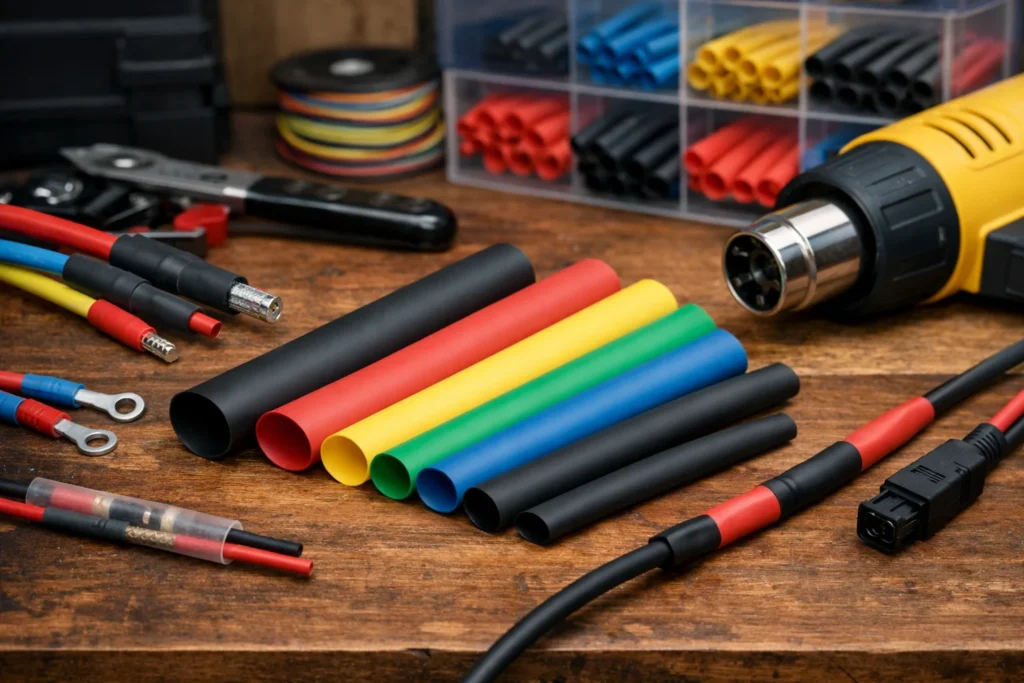
Shrink heat tube (commonly known as heat shrink tubing) is a polymer tubular material made using radiation crosslinking and other techniques. Its key feature is that it can shrink radially when heated, tightly fitting the target object to achieve insulation, protection, and sealing functions. This material is widely used in industries such as electronics, automotive manufacturing, communication equipment, aerospace, and healthcare. It is primarily used for wire insulation, joint waterproofing, solder point protection, and component identification. It has become an important miniaturized functional component in modern industry. This article will explain the working principle, material types, shrink specifications, technical parameters, application scenarios, and usage tips of tube heat shrink, helping readers systematically master relevant knowledge.
2. Core Principle of Shrink Heat Tube
Core Technology Foundation: Crosslinking Reaction — By applying radiation treatments such as electron beams, covalent bonds are formed between polymer molecules, breaking the original linear molecular structure and imparting a “plastic memory” characteristic to the material.
Shrink Mechanism Process: During the manufacturing stage, the material is “heated to soften, stretched, and cooled to set” to form an expanded tube; in use, it is heated to the initial shrink temperature (typically 70°C to 100°C), at which point the molecular chains return to their original crosslinked arrangement, achieving shrinkage. Heating to the full shrink temperature (typically 100°C to 130°C) results in the best fit.
Principle and Parameter Correlation: The degree of crosslinking in different materials determines the shrink temperature threshold, shrink ratio limits, and dimensional stability of tube heat shrink. This is the core technical basis for selecting materials and matching specifications.
3. Material Composition
(1) Polyolefin: Including polyethylene (PE), this is the most widely used base material with excellent insulation, wear resistance, and cost-effectiveness. It can be modified to create double-wall adhesive types, suitable for general electronic and electrical applications.
(2) Polyvinyl Chloride (PVC): An economical material with thin walls and a low-temperature resistance range (85°C to 105°C). It is suitable for battery wrapping and low-demand packaging but is less commonly used abroad due to environmental concerns.
(3) Fluoroplastics: Includes PTFE (Polytetrafluoroethylene, temperature resistance up to 260°C), PVDF (Polyvinylidene fluoride, temperature resistance 150°C–175°C), and FEP (Fluorinated ethylene propylene, temperature resistance 200°C). These materials have excellent high-temperature and chemical resistance, suitable for special applications in military, chemical, and high-temperature equipment.
(4) Rubber Types: Including fluoroelastomers (resistant to -65°C and high temperatures, oil and chemical-resistant), EPDM (Ethylene Propylene Diene Monomer, temperature resistance up to 150°C, good weather resistance), and silicone rubber (temperature resistance up to 200°C, excellent flexibility), suitable for automotive, aerospace, and medical applications requiring flexibility or extreme temperature resistance.
Auxiliary Components: Some shrink heat tubes include functional additives such as the hot melt adhesive layer in double-wall tubes (waterproof sealing), flame retardant additives, and halogen-free components, further expanding the material’s application range.
4. Classification (by Shrink Ratio)
Shrink Ratio Definition: The shrink ratio refers to the ratio of the inner diameter of the heat shrinking tube before shrinkage to the inner diameter after full shrinkage (expressed as X:1). It is a key indicator of the tube heat shrink capacity, directly determining the diameter range of the object being covered.
Main Classifications and Applications:
- 2:1 Shrink Ratio: The most common basic type. For example, a Φ6mm tube shrinks to Φ3mm. Suitable for regular applications with small diameter variations (electronic component pins, regular cable joints), covering most civilian and general industrial needs.
- 3:1 Shrink Ratio: Medium to high shrink capability. For example, a Φ12mm tube shrinks to Φ4mm. Suitable for applications where the diameter of the covered object varies significantly or requires cross-size adaptation (complex cable branches, medium and small connector sealing), balancing versatility and flexibility.
- 4:1 and Higher Shrink Ratios: High shrink capability types. For example, a Φ20mm tube shrinks to Φ5mm. Suitable for large connectors, irregular parts, or scenarios where repairs can be made without disassembling the original components (e.g., cable repair). Mainly used in military, communication equipment maintenance, and other special needs.
Note: The higher the shrink ratio for the same material, the higher the production process requirements (crosslinking degree, stretching control), leading to higher costs. Rational selection should be based on actual needs.
5. Application Scenarios
1. Electronics: Shrink heat tubes are used for insulating circuit board pins, protecting solder points, reinforcing cable ends, and organizing internal wiring in equipment, meeting the precision protection requirements of miniaturized electronic products.
2. Electrical Industry: Heat shrink wrap tubes are used for sealing cable joints, insulating busbars, and waterproofing in substations, effectively preventing leakage and moisture intrusion, ensuring the safe operation of electrical systems.
3. Automotive Industry: With high-temperature resistance, oil resistance, and vibration resistance, they are used for engine wire harnesses, internal wiring for lights, and sealing automotive electronic joints.
4. Communication Industry: Heat shrink tubes provide waterproof and moisture protection for base station feeder joints, fiber optic connectors, etc., ensuring stable signals and resisting outdoor weather and UV exposure.
5. Special Applications: Covering aerospace (extreme temperature and radiation resistance), medical (biocompatible materials), and chemical vessels (chemical corrosion resistance) for professional protection.
6. Civilian and Other Applications: Heating shrink tubes are widely used for rust protection on metal joints, tool coating, DIY electronics, and internal wiring in home appliances.
6. Usage Methods and Precautions
- Selection Match: Choose a heat shrinking tube with an inner diameter slightly larger than the maximum diameter of the object to be covered and ensure the shrink ratio fits the final tight fit requirement.
- Measuring and Cutting: Cut the required length of the heat shrink wrap tube, leaving about 5%-10% extra length to compensate for longitudinal shrinkage during heating.
- Positioning: Place the cut heat shrink tube over the target position, ensuring it fully covers the joint, solder point, or exposed part.
- Even Heating: Use a shrink tube heat gun, moving steadily from the center to the ends, or use an oven for batch processing, until the heat shrink plastic tube fully shrinks and fits smoothly.
- Cooling and Shaping: Allow the tube to cool naturally. If using a double-wall tube with adhesive, wait for several minutes to let the inner hot melt adhesive fully cure for the best sealing effect.
2. Key Precautions
- Heating Control: Avoid overheating or using open flames, which may damage, age, or cause uneven shrinkage. Keep away from flammable materials when heating.
- Operating Restrictions: Do not forcibly stretch the heat tube during fitting, as it may damage the shrinkage performance. Avoid working directly over sharp edges to prevent punctures.
- Environmental Adaptation: Preheat the object to be covered in low-temperature environments. In humid environments, check the sealing integrity after installation to prevent water vapor residue.
- Safety Protection: It is recommended to wear heat-resistant gloves and operate in a well-ventilated environment, especially when handling materials like PVC.
- Special Material Handling: For high-temperature materials like PTFE and FEP, use specialized heat guns for shrink tubes and control the heating temperature to ensure complete shrinkage without deformation.
7. FAQ
A1: Choose based on the size and shape of the object to be covered. For regular cables, the 2:1 general type is suitable. For objects with large size variations or irregular shapes, consider 3:1. For large or repairable components, 4:1 or higher ratios are recommended.
Q2: Why do bubbles or wrinkles appear after shrinking?
A2: Common reasons include uneven heating, dirty surfaces, or improper size matching. It is recommended to heat evenly, clean surfaces, and select the right product size.
Q3: What are common sizes for heat shrink tubes?
A3: Small sizes include heat shrink tube 3mm, heat shrink tube 6mm, and heat shrink tube 12mm. Larger heat shrink tube sizes include heat shrink tube 25mm, and heat shrink tube 50mm.
Q4: What is the difference between working temperature and shrink temperature?
A4: Working temperature refers to the range of temperatures the tube can endure during use, while shrink temperature refers to the temperature required for installation. They serve different functions.
Q5: How to choose between single-wall and double-wall adhesive heat shrink cable tubes?
A5: Choose single-wall for basic insulation. Double-wall adhesive types should be used for outdoor, humid, or sealing and waterproofing applications.
Q6: Where can I buy heat shrink tubes?
A6: Zhejiang Wandu Plastic Co., Ltd. is a professional heat shrink tube manufacturer, providing various colors, sizes, and specifications. Click the button on the right of the website to get a free heat shrink tube size chart and price list.




 English
  Arabic
  Spanish