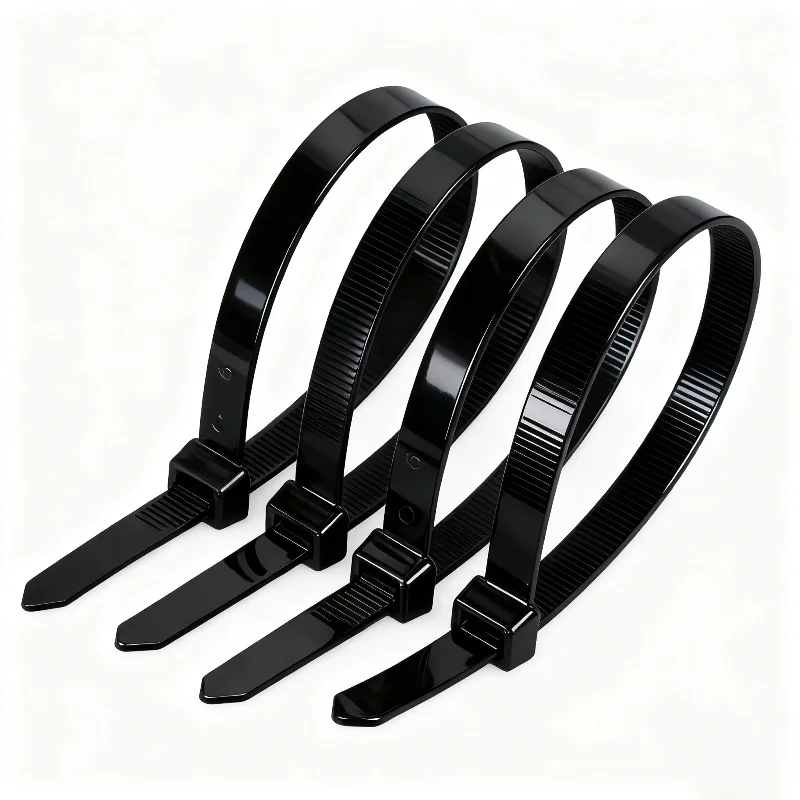
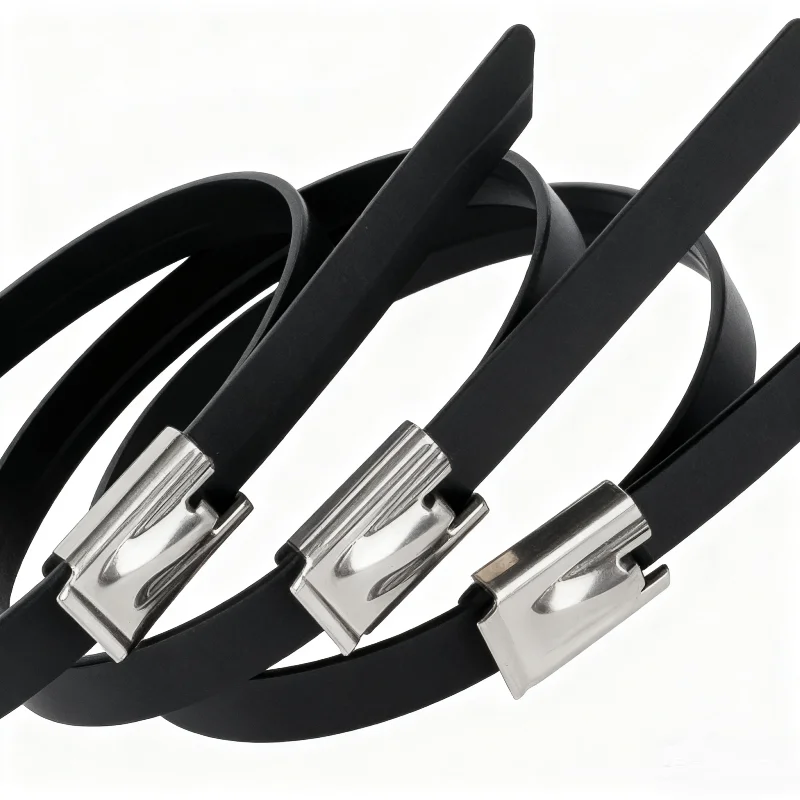
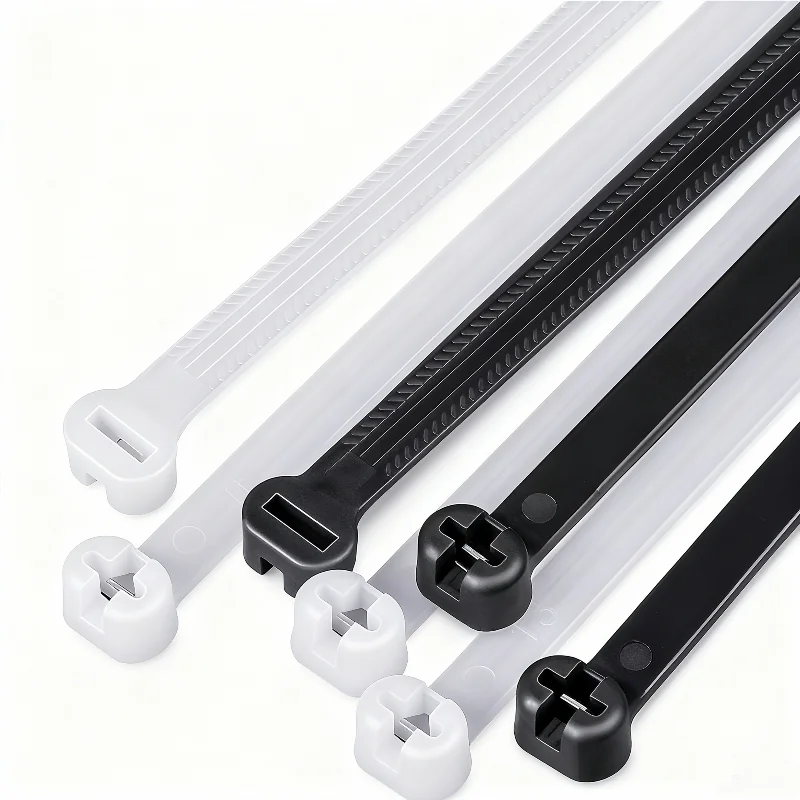
1. What Are Nylon Cable Ties
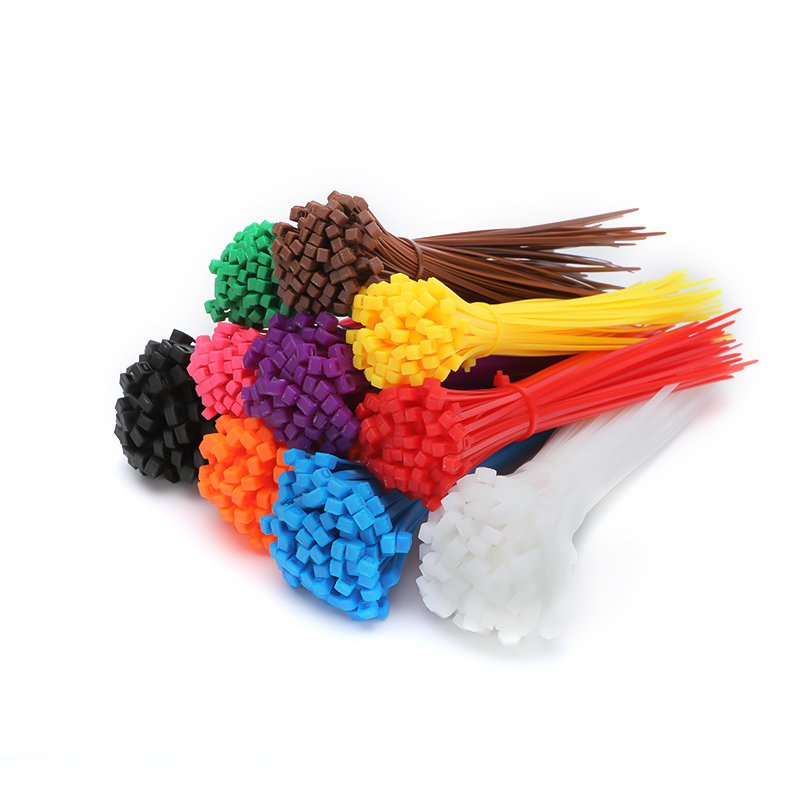
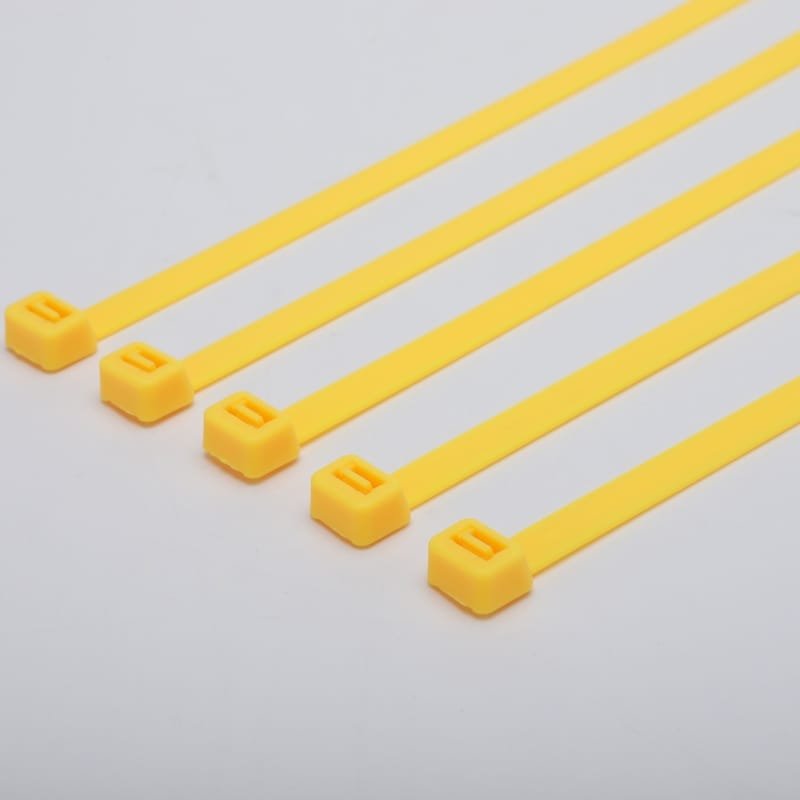
Nylon cable ties , also known as wire ties, are bundling and fastening accessories made primarily from polyamide (PA). With characteristics such as insulation, wear resistance, lightweight structure, and ease of operation.they are widely used in electronics, automotive, power, household, and industrial fields, mainly for cable organization, item bundling, and equipment fixation.
Many people are concerned about what material are zip ties made of. Nylon 6 (PA6) and Nylon 66 (PA66) are the two most commonly used types of nylon cable ties. They are also the most mainstream choices among zip tie material, cable tie material, and tie wrap material. Their cable tie material specification differs significantly due to differences in molecular structure. The two materials have clear distinctions in performance and application scenarios and are easily confused. Today we will explain in detail the characteristics and specific differentiation methods of these two materials.
2. What Are Nylon 6 and Nylon 66 Materials
Nylon 6 (PA6) and Nylon 66 (PA66) both belong to the polyamide family for producing nylon cable ties. Their molecular structures differ, resulting in significant differences in physical properties. This causes the two types of cable ties material to exhibit completely different characteristics:
Nylon 6 (PA6): Polymerized from caprolactam, it is a cost-effective general-purpose polyamide material. Its molding process is mature, production efficiency is high, and the material has good toughness with a relatively soft feel. The cost is comparatively lower, but high-temperature resistance, tensile strength.Weather resistance performance are average, making it suitable for conventional environments.
Nylon 66 (PA66): Polymerized from adipic acid and hexamethylenediamine, it is a high-performance industrial-grade polyamide material. Its molecular structure is more compact, and its mechanical strength, high-temperature resistance.Also aging resistance are all superior to Nylon 6. It has higher rigidity and is less prone to deformation or breakage under long-term stress. However, raw material cost is higher, making it suitable for scenarios requiring high stability and durability. This is also the core material advantage of pa66 cable tie.
3. Three Methods to Distinguish Nylon 6 and Nylon 66 Cable Ties
Whether for procurement inspection, on-site selection, or daily use, mastering the following three simple and practical differentiation methods. With this, you can quickly distinguish between the two materials without complex professional knowledge. These methods are also practical techniques for identifying different zip tie material.
Zip tie tensile strength is one of the most intuitive performance differences,which is also a preliminary judgment method that does not require professional instruments. The tensile strength of zip ties is also an important indicator for distinguishing nylon zip tie material. Under the same thickness and width specifications, the cable tie tensile strength of pa66 cable tie is approximately 20% higher than that of Nylon 6 cable ties. Under the same temperature and humidity conditions, using a tensile testing machine to test the pulling force of the two ties will clearly show that Nylon 6 cable ties are more likely to stretch and even break after force is applied, and their zip tie strength performance is relatively weaker. In contrast, pa66 cable tie has stronger tensile force, higher hardness, and is less prone to stretching and breaking, with more outstanding cable tie breaking strength performance.
(2) Melting Point Differentiation
Melting point is the most precise method for distinguishing the two materials. The difference in zip tie melting point between them is obvious and can be quickly identified using professional instruments. The cable tie melting point of pa66 cable tie is approximately 260°C, while the plastic zip tie melting point of Nylon 6 cable ties is approximately 220°C. If you have a melting point tester, simply take a small sample of the cable tie and conduct testing to accurately determine the material by comparing melting points. If you do not have such professional instruments, there is no need to worry — you can mail the sample to us, and we will provide free melting point testing services to ensure accurate material identification and avoid incorrect purchases.
(3) Color Differentiation
Color differentiation is the most convenient auxiliary method and only applies to white nylon cable ties. There is no obvious difference in black cable ties. Under the same production process, white pa66 cable tie tends to appear slightly yellowish with a warmer tone, while white Nylon 6 cable ties are closer to pure white with relatively brighter color. It should be noted that color differentiation can only be used as an auxiliary method and cannot serve as the sole basis for judgment. It must be combined with tensile strength or melting point testing for further confirmation.
4. Application Scenario Differentiation
Among nylon cable ties, the application scenarios of Nylon 6 and pa66 cable tie are clearly defined. The core determining factors are usage temperature, load requirements, and whether the ties are exposed outdoors. The two materials have almost no overlapping scenarios. Accurately matching the scenario allows quick selection and ensures the performance of the corresponding cable tie material is fully utilized.
Nylon 6 (PA6) Cable Ties: Mainly used in ordinary civilian and light-load indoor scenarios. These scenarios involve no high temperature, no outdoor exposure, and no heavy loads, with cost-effectiveness being more important. Common applications include household cable organization (such as network cables and electrical wire bundling), office equipment wiring, indoor low-voltage engineering, internal component fixation of small appliances, and gift packaging.
Nylon 66 (PA66) Cable Ties: Mainly used in industrial-grade, heavy-load, and outdoor scenarios. These environments have extremely high requirements for high-temperature resistance, tensile strength, and weather resistance, where stability takes priority over cost. Common applications include automotive engine compartment or chassis wiring (high temperature and vibration environments), industrial workshop pipeline fixation (heavy load and high temperature), outdoor power and communication engineering (exposure to sunlight and rain), chemical storage scenarios (mild corrosive environments), and heavy machinery cable bundling.
5. Detailed Explanation of Outdoor Applications
In outdoor applications, the advantages of pa66 cable tie far exceed those of Nylon 6 nylon cable ties. The core difference lies in aging resistance and ultraviolet resistance performance. This directly determines outdoor service life and represents the core performance gap between the two cable ties material in outdoor environments.
Reasons for stronger aging and UV resistance of Nylon 66 cable ties: Its molecular structure is more compact and chemically stable, effectively resisting ultraviolet radiation from sunlight and preventing molecular chain breakage. At the same time, industrial-grade pa66 cable tie usually adds anti-UV modifiers to further enhance weather resistance, making it less susceptible to brittleness caused by wind and prolonged sun exposure.
Outdoor service life differentiation: Due to average UV and aging resistance performance, Nylon 6 cable ties will gradually become brittle, discolor, and break after approximately six months of sun exposure and weathering outdoors, rendering them unusable. In contrast, pa66 zip tie can achieve a service life of more than one year in outdoor environments, maintaining good mechanical performance and structural stability for a long time. Even with prolonged exposure to sunlight and rain, it is less likely to become brittle or break, making it suitable for long-term outdoor usage scenarios.
6. FAQ (Frequently Asked Questions)
Q1: Without professional instruments, how can pa6 and pa66 cable tie material of nylon cable ties be quickly and preliminarily distinguished?
A1: You can combine “tensile strength + color” for comprehensive judgment. Under the same specifications, the tie with stronger tensile force and less likelihood of breaking is pa66 cable tie. White ties that appear slightly beige are more likely to be pa66 cable tie, while pure white ties are more likely to be Nylon 6 cable ties. For black ties, focus on tensile testing — the one with stronger zip tie strength is nylon66 cable tie.
Q2: Can Nylon 6 and Nylon 66 zip tie nylon zip ties be used interchangeably?
A2: Interchangeable use is not recommended. Nylon 6 cable ties are suitable for civilian indoor light-load scenarios and offer better cost performance. However, in industrial outdoor, high-temperature, and heavy-load scenarios, replacing Nylon 66 zip tie with Nylon 6 cable ties may result in softening, breakage, or loosening, affecting safety and stability.
Q3: Do you provide free cable tie material specification testing services? Is the testing process complicated?
A3: Yes, we provide free material testing services (including melting point testing and cable tie tensile strength testing). The testing process is simple: you only need to mail the cable tie sample to us. After receiving the sample, we will complete testing within 24–48 hours and issue a detailed cable tie material specification test report, providing timely feedback to you.
7. Summary
In summary, the core differences between Nylon 6 and Nylon 66 cable ties lie in mechanical strength, high-temperature resistance, and weather resistance. Their application scenarios are clearly defined: Nylon 6 cable ties focus on “high cost performance and civilian indoor light load,” while pa66 cable tie focuses on “high performance and industrial outdoor heavy load.” By using the three methods of tensile strength, melting point, and color differentiation, the zip tie material can be accurately distinguished, avoiding misuse during procurement and application.
As a professional nylon cable ties manufacturer, we have cultivated the industry for many years and focus on providing high-quality and highly adaptable products to global customers. If you are unable to determine the cable tie material of the ties in your possession or require precise selection advice, feel free to contact us — we provide free sample testing services and reasonable product quotations, fully assisting you in reducing procurement costs, accurately matching usage scenarios, and solving your selection and identification challenges.